
AI Video Production

AI video ads and 3D product animation for beverage, beauty, supplement and food brands in the US, UK and Europe.
We plan every shot in 3D before anything is generated, keep your real product and label exact in every frame, and finish the footage by hand: compositing, grade, upscaling and sound. Then we deliver it in every format your channels need.
Updated November 2026 · By Mehmet Turan, founder of 35milimetre · Start a video project
What you get
- 3D product animation: CGI packshots in motion, product films and social loops
- AI video ads: campaign spots and UGC-style ads, built around your real product
- 3D previz: a grey-box version of every shot, so camera, layout and timing are approved before anything is generated
- Finishing: compositing, label lock-in, colour grade, upscaling to 4K, sound design, music and voice-over
- Enhancement of footage you already have: upscaling, cleanup, local grading, and changing part of a shot without a reshoot
- Every format you need: 9:16, 1:1, 4:5 and 16:9 cuts, with and without captions, plus a high-quality master
Who it's for
- Beverage, supplement, beauty and food brands that need more video than a shoot budget allows
- Performance teams testing hooks and variations for paid social
- Brands launching a product that has no footage yet
- Agencies that need a production and finishing partner for AI-assisted work
Probably not a fit: projects that need a film crew on location. We work from 3D, AI generation and footage you already have.
How it works
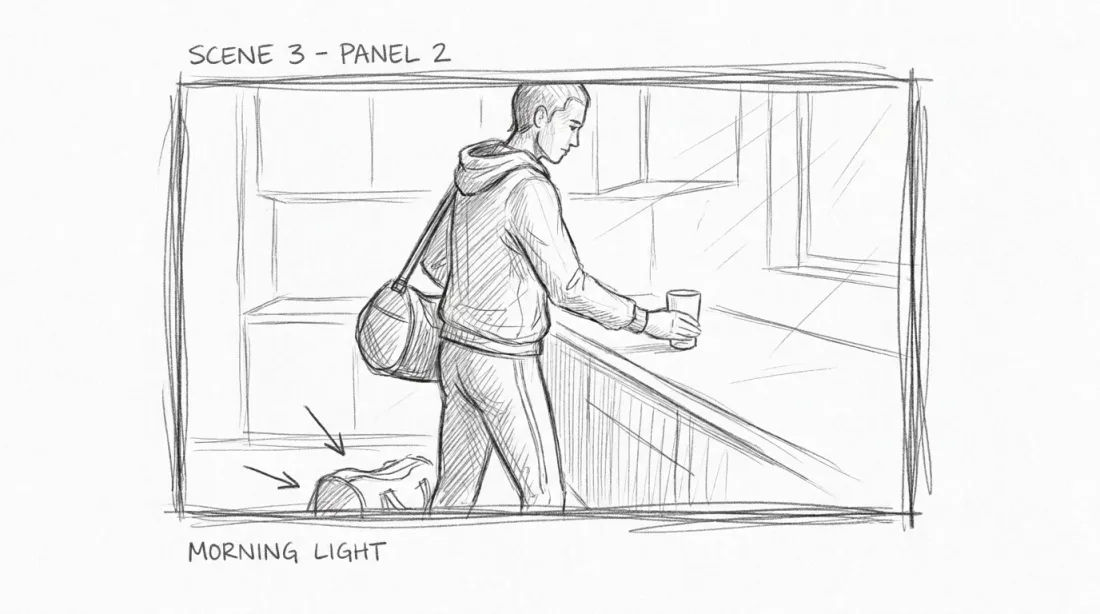
- Brief and storyboard. Every shot starts as a drawing: camera, action, timing. For ads we also agree the hooks, fixed lines, allowed claims and disclosure before anything is generated.
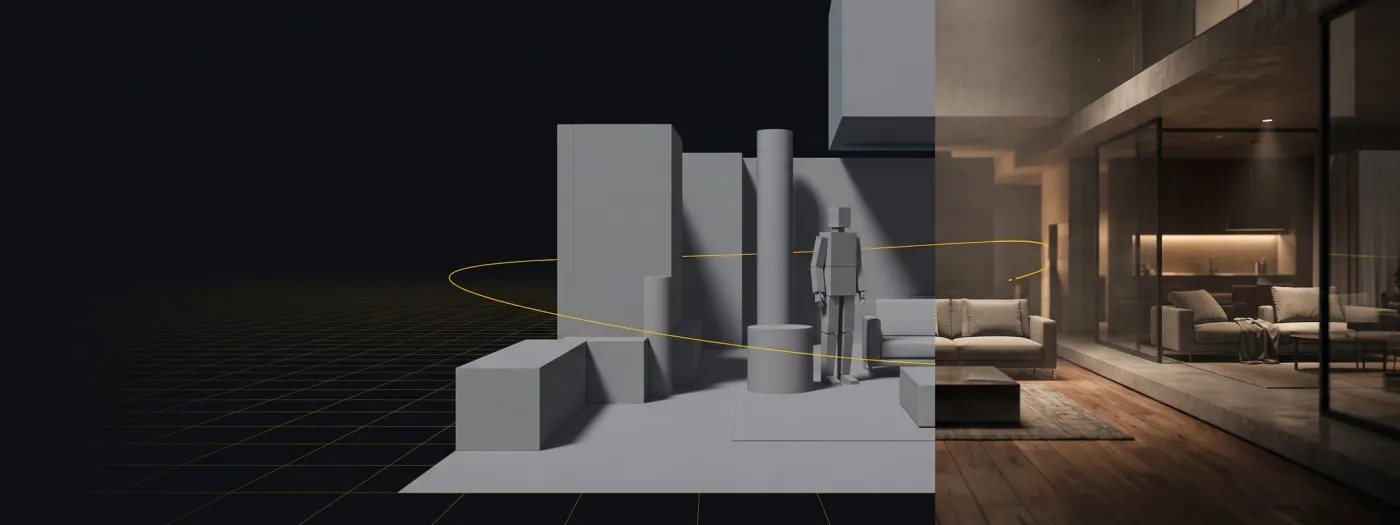
- 3D block-out. A rough grey-box scene with correct proportions, a locked camera and the light direction. You approve camera and layout here, where changes cost almost nothing.
- Generation in passes. The 3D frames, storyboard panels and your product references go into the video model together, so every retry stays on the same shot.
- Lock the product. Labels are where generation fails first. We keep a clean product reference in every pass and composite the real label back in when it drifts.
- Finish. Upscale, grade, sound, music and voice-over, cut to one beat map.
- Check and deliver. Every clip is reviewed at half speed, full size and with sound, then exported for each placement.
Typical timing: for a two-spot campaign, a day or two on storyboards and direction, a day on the 3D block-out, a few days of generation passes, then compositing, upscaling and sound. Why we block out in 3D first
For 3D animation and motion design, approvals run style frames, storyboard, animatic, then animation. The animatic is the last point where story, order and length change cheaply. What to approve at each step
How pricing works
Every project gets a flat fee, agreed after a short call about your product, channels and formats. No hourly billing.
What shapes the quote: the number of spots and their length, how many hooks or versions you need, whether a 3D model of your product already exists, the aspect ratios, and voice-over and music.
For ad batches we suggest starting small: three to five clips that test different hooks, then scaling only what works.
We invoice in USD, EUR or GBP. New clients pay 70% upfront and returning clients 50%, with the balance due on delivery of the final files.
Selected video work
From pencil to pixel: a two-spot spec campaign. For an all-in-one supplement drink concept, we took two spots from pencil storyboards through a 3ds Max block-out, Seedance 2.0 generation, Magnific upscaling and ElevenLabs sound to a finished 40-second film. This is our own spec work, not a client job. See the breakdown
Unplugs × Live Nation: a late change, turned around fast. Just before final approval of the campaign film, the client asked for one more line of on-screen text using the animation already in the edit. With Claude connected to Premiere Pro, the change took a short check instead of a working session, and we still reviewed every frame before sending it. Read more

Fuzion Gamz: grading footage that a global grade could not fix. Kids lit from behind sat in front of very bright screens. We treated the screens and the kids as separate tracked regions and balanced them against each other. The third test round was approved and became the reference for the full section. Read more
Studio clients also include Unilever (US and UK), Sony Europe, L'Oréal and Pepsi.
“Mehmet and his team did a wonderful job of bringing our product to life. The animation is compelling and has been well received by all those that have watched!”
Stewart A., Founder, Unplugs
Keeping the product right
Video models are good at casual settings, natural camera movement and light. They are still weak at labels and small text, the exact shape of a pack, hands holding objects, and keeping the same presenter across clips. Your product is the one thing that must be right, so that is where most of our work goes.
- Labels: we mask the problem area and add the real label back as a tracked overlay, matched to movement, light and perspective
- Unstable edges: we cut the product from one good frame and track it back over the frames that wobble
- Flicker: light temporal denoising, applied through a mask so the product itself stays sharp
- On-screen text: added in the edit, never generated
Our rule: if a mask, a patch or a grade can fix it, we fix it. If the subject has to do something different, we go back to the generator. How we fix AI video artifacts
Disclosure, claims and likeness
Disclosure. The EU AI Act's transparency obligations under Article 50 apply from 2 August 2026, and TikTok requires labels on realistic AI-generated content. We decide how an ad will be labelled before production, not after.
Claims. A generated person saying a product changed their life is a testimonial from someone who does not exist. The FTC's 2024 rule on reviews and testimonials names AI-generated fake reviews, so we never present a generated presenter as a real customer.
Likeness. A generated performer in a scene is still a performer. Real people's likenesses need written consent for the specific use.
We flag where these rules may apply. We are not lawyers, so the final call sits with your legal team.
Formats and delivery
- Social: MP4 (H.264) in 9:16, 1:1 and 4:5, with and without captions
- Paid ads: each platform's current specs per placement, plus a ProRes master
- Graphics for editors: ProRes 4444 with alpha, or PNG sequences, for logo stings and overlays
- Website: a light MP4 with a still for loading, or Lottie for UI animation when it is planned from the start
One approved clip can usually be reframed into the other formats without regenerating it. How we reframe AI video · Which files to ask for
Compared with the alternatives
Traditional shoot. Real footage and real performances. Crew, location and reshoot costs make variations expensive.
Prompt-only AI tool. Fast and cheap for mood films. Products drift between cuts, labels break, and nobody checks the frames.
Freelance video editor. Good for cutting existing footage. Rarely builds 3D previz or locks a product label frame by frame.
35milimetre. A post-production studio with 26 years of retouching and compositing behind it, plus 3D and AI generation in one team, so the product looks the same in your ads, on your shelf and in your stills.
Can AI video show our real product with the correct label?
Yes, because we don't leave the label to the model. A clean product reference goes into every generation pass, and when the label drifts we composite the real one back in as a tracked overlay.
Do you make 3D product animation as well as AI video?
Yes. Product films, CGI packshots in motion and social loops are built in 3D, and the same 3D scene can guide the AI shots, so the product and the camera match across both.
How long does an AI video ad take?
For a two-spot campaign: a day or two on storyboards and direction, a day on the 3D block-out, a few days of generation passes, then compositing, upscaling and sound. That is still faster than a shoot-and-post schedule for the same films.
How many ad versions should we order?
Start with three to five clips that test different hooks with the same body and presenter. Run them as a small paid test, then build the batch from the hooks that worked. What to brief before a batch
Can you improve footage we already have?
Yes. We upscale (for example 1080p to 4K), clean up noise, grade parts of a shot separately, and can change one element of a shot without a reshoot. Product close-ups and faces go through the most conservative route.
Do we need to label the ads as AI-generated?
It depends on the market and the platform. EU AI Act transparency duties apply from 2 August 2026, and TikTok requires labels on realistic AI content. We plan labelling before production; the final call sits with your legal team.
What files will we receive?
MP4 files in each aspect ratio you need, with and without captions, a ProRes master, and ProRes 4444 with alpha or PNG sequences for graphics. Lottie files for websites when they are planned from the start.
How is AI video priced?
We quote a flat fee after a short call, based on the number and length of spots, how many versions you need, the formats, and whether a 3D model of your product is needed. We invoice in USD, EUR or GBP.