


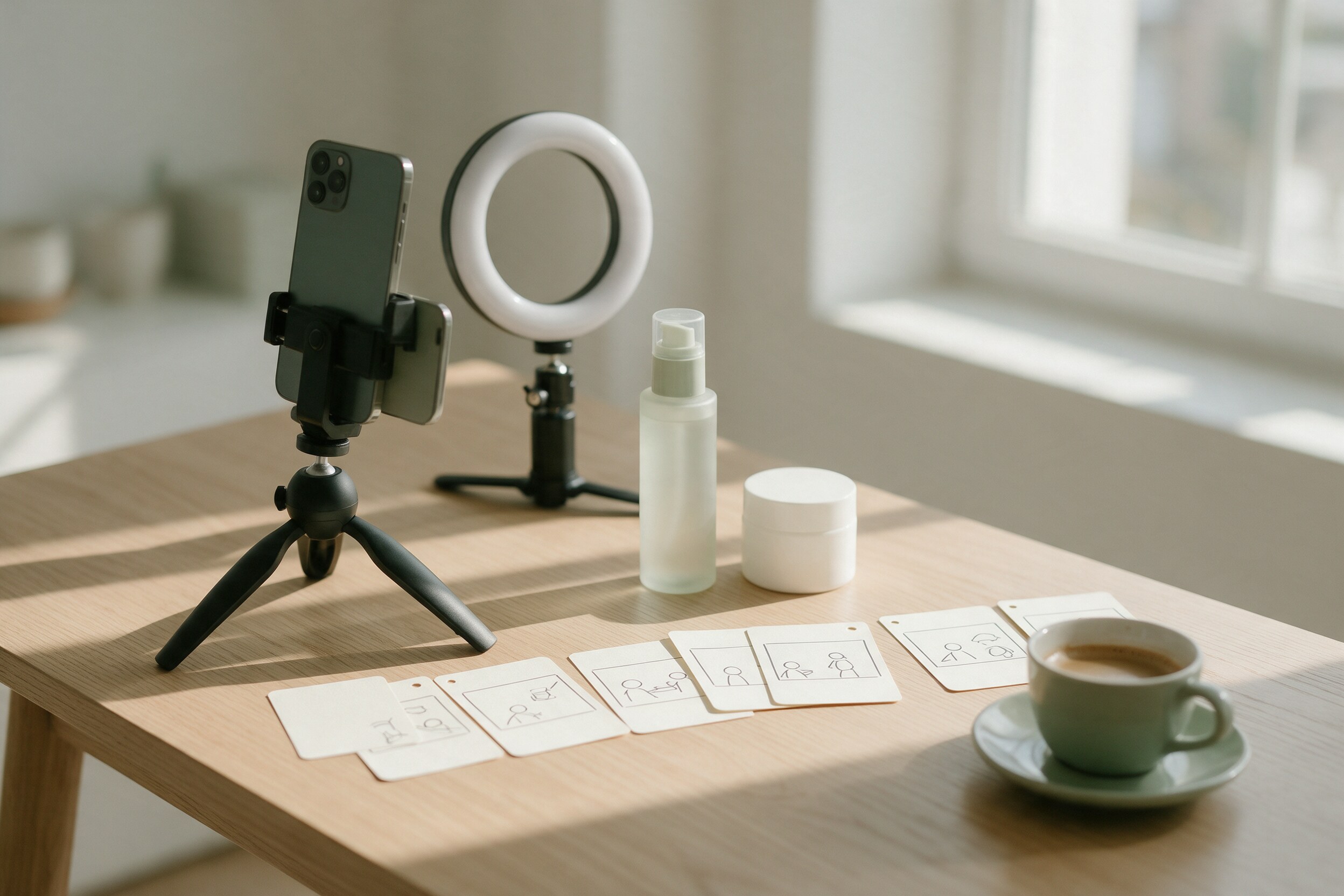
UGC-style ads are the short, phone-shot videos where a person talks about a product as if they found it themselves. They work because they feel casual. Now AI can make them: a generated presenter, a generated voice, your product in their hands.
The appeal is obvious. Instead of booking creators one by one, you ask for twenty versions and see which one sells. In practice, a batch of twenty only makes sense if the brief is tight. Otherwise you get twenty clips with the same problems. Here is what we think a buyer should decide before asking for a batch.
What the tools can and cannot do now
Video models have moved quickly. Google says its Veo model can generate sound effects, ambient noise and dialogue natively with the video, while also noting that spoken audio, especially short speech segments, is still being developed (Google DeepMind). That matches what we see: talking clips are possible, but lip sync, pacing and voice tone still need checking line by line.
What AI does well: casual settings, natural camera wobble, light that feels like a phone, and fast variations of the same idea. What it still does badly: product labels and small text, the exact shape of a pack, hands holding objects, and keeping the same presenter across many clips. Your product is the one thing that must be right, and it is the thing models handle worst.
That is why we see these ads as post-production projects, not one-click jobs. The generation is the start; checking and fixing is most of the work. We wrote about one way to keep products steady in 3D-Referenced AI Video.
What to put in the brief
A good brief answers these questions in writing.
- Who is the viewer? One audience per batch. A clip for new parents and a clip for gym regulars should not share a script.
- What are the hooks? The first two seconds decide everything. Write five to ten different opening lines or opening actions. Hooks are where variation pays off.
- What is the script? Keep it short, in plain spoken language. Mark which lines are fixed (claims, product name, price) and which can be rephrased.
- What must the product look like? Send clean photos from every side, the exact colours, and the label artwork. Say which details must be readable on screen.
- What claims are allowed? Only claims you can support. A generated person saying "this cleared my skin in a week" is a testimonial from someone who does not exist.
- Formats and length. Usually vertical 9:16, plus lengths such as 15 and 30 seconds. Say where captions sit so they avoid platform buttons.
- Disclosure. Decide how the ad will be labelled as AI-generated before production, not after.
That last point matters. TikTok says it requires people to label realistic AI-generated content on the platform (TikTok). In the US, the FTC's rule on reviews and testimonials, announced in August 2024, bans testimonials that misrepresent that they are by someone who does not exist, and names AI-generated fake reviews as an example (FTC). Rules differ by platform and country, so check them with your legal team. The safe approach is simple: do not present a generated person as a real customer.
Start with a small paid test
We would not start with twenty. Start with three to five clips that test different hooks with the same body and the same presenter. Run them as a small paid test. Then make the batch from the hooks that worked.
This does two things. It stops you paying for twenty clips built on a weak idea. And it gives the production team a locked look (presenter, setting, product shots) that the batch can follow, which makes consistency much easier.
It also helps to plan the batch as parts, not as twenty separate films: a set of hooks, a shared middle, and two or three endings. Mixing these parts is faster and keeps the product shots the same across every version.
What to check in every clip
Before any clip goes out, someone should watch it with sound, at full size, and check:
- The product label, logo and colours match the real product in every frame.
- The pack shape does not bend or change between shots.
- Hands hold the product believably, with the right number of fingers.
- Lip sync matches the words, and the voice sounds the same across clips.
- On-screen text is spelled correctly. AI-made text is often wrong, so add captions in editing, not in generation.
- No claim appears that is not in the approved script.
- The disclosure label is applied.
If a clip fails on the product, fix it or drop it. A good hook with a wrong label is still a wrong ad.
A practical takeaway
Brief the hooks, the fixed lines, the product references, the allowed claims and the disclosure before anyone generates anything. Order a small test first, scale only what works, and check every clip against one written list. AI makes the volume cheap; the brief and the checks are what make it usable.
AI UGC ads can be a fast way to learn what your audience responds to, as long as the product stays true and the viewer is not misled. If you would like to see how we approach AI video and finishing, our work is at 35milimetre.com.