
Content trends ad agencies must act on in 2026

Ad spending worldwide grew 8.6% year over year in 2025, yet holding company revenues fell 1.2% over the same period. That gap is not a blip; it is a signal that money is moving through channels and capabilities that traditional agency models were not built to capture. If you are a creative director or marketing strategist trying to make sense of where to steer your agency in 2026, this guide breaks down the evidence-based themes, AI-enhanced production shifts, and operational plays that will define whether agencies grow with the market or quietly lose ground to it.
Table of Contents
- Why 2026 is a turning point for ad agencies
- Emerging creative themes: From AI to authentic connections
- AI-enhanced imagery: Opportunities and creative guardrails
- Winning with social-first content and specialization
- What most “trends” miss: Creative direction is king in an AI world
- Next steps: Elevate your visuals with expert support
- Frequently asked questions
Key Takeaways
| Point | Details |
|---|---|
| AI is a tool, not a strategy | Agencies must blend AI-assisted production with human creativity for best results. |
| Emotional connection is vital | Trends show content that feels genuine and culturally grounded outperforms generic creative. |
| Social-first and specialized win | Focusing on social-first content and niche expertise captures larger budgets and new business. |
| Streamlined workflows matter | Operational efficiency must support, not inhibit, content innovation as agency models evolve. |
Why 2026 is a turning point for ad agencies
The tension between rising ad spend and shrinking agency revenue tells you something important: growth is happening, just not at agencies by default. Brands are pulling more work in-house, AI tools are handling tasks that once required full production teams, and economic uncertainty is pressuring procurement teams to scrutinize retainer agreements. Agencies that position themselves primarily as execution vendors are the most exposed to this squeeze.
The strategic response is not to panic. It is to pivot. As AI transforms advertising workflows, the agencies winning new business are the ones repositioning around strategy, data-driven services, and scalable creative production rather than billable hours alone. The legitimacy and relevance squeeze from automation and AI-driven work is real, and the agencies that acknowledge it early have the clearest path forward.
Consider this: a brand that once needed an agency for six weeks of production might now achieve a comparable output in ten days using AI tools internally. That does not mean the agency is irrelevant. It means the agency needs to offer something those internal teams cannot replicate: creative vision, cultural intelligence, and the kind of nuanced storytelling that moves people.
| Agency Strength Before 2025 | Required Pivot for 2026 |
|---|---|
| Execution-focused production | Strategy-led creative consulting |
| Broad generalist offerings | Niche specialization by sector or format |
| Manual production at scale | AI-assisted workflows with human curation |
| Traditional media buying | Data-informed, cross-channel optimization |
“The agencies that will define 2026 are not the ones that adopted the most AI tools. They are the ones that redefined what only a great agency can do.”
The pivot is not only about adding new services. It is about clarifying the irreplaceable value your team brings to every project, then building production capacity around that value.
Emerging creative themes: From AI to authentic connections
Knowing that a shift is needed is one thing. Knowing what to create is another. Adobe’s 2026 creative research identifies four themes that are shaping the highest-performing campaigns, all of which share one common thread: human emotional truth. 70 percent of consumer decisions are driven by emotion, which means content that feels manufactured or impersonal is fighting against the way audiences actually make choices.
The four themes Adobe identifies are “All the Feels,” “Connectioneering,” “Surreal Silliness,” and “Local Flavor.” Each one pushes back against the sterile, generically polished look that AI-generated imagery defaults to. Exploring broader visual content trends reinforces why these directions are gaining traction: audiences have developed a sophisticated ability to detect when something feels fake, and they disengage quickly.
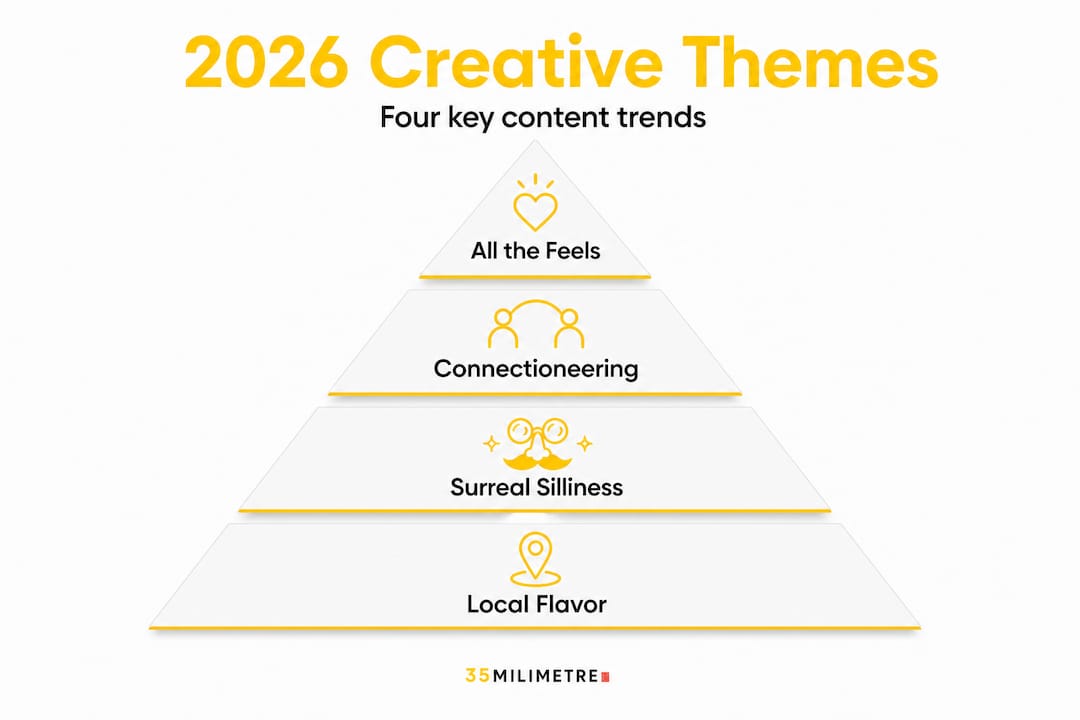
| Creative Theme | Core Idea | Campaign Implication |
|---|---|---|
| All the Feels | Sensory and emotional immersion | Prioritize texture, sound design, and visceral imagery |
| Connectioneering | Engineering relatable touchpoints | Create characters and scenarios that mirror real audience lives |
| Surreal Silliness | Playful absurdist humor | Use unexpected visuals to generate memorability and shareability |
| Local Flavor | Hyper-regional cultural authenticity | Ground global campaigns in local landmarks, dialects, and customs |
“Connectioneering” deserves particular attention. The term means deliberately designing emotional and relatable moments into every frame, every line of copy, every transition. It is not enough to show a diverse cast or a warm color palette. The story structure itself has to make the viewer feel seen. Campaigns built around connectioneering tend to generate longer view times on social platforms and stronger brand recall scores in post-campaign research.
For agencies incorporating sensory engagement into their content strategy, several practical approaches are worth considering. Investing in high-quality compositing that layers environmental textures into product imagery creates tactile appeal even in a static frame. Collaborating with local photographers and culture consultants ensures that “Local Flavor” does not become superficial set dressing. Pairing surprising visual juxtapositions with straightforward copy lets humor land without diluting the brand message. Content formats that cross into audio, like podcast content trends, extend sensory engagement beyond the screen and give audiences another touchpoint in the brand relationship.
The critical warning here is that none of these themes can be outsourced entirely to an AI image generator. The emotional intelligence required to execute them well still lives in human creative directors who understand cultural context, client brand history, and the subtle difference between an image that resonates and one that falls flat.
AI-enhanced imagery: Opportunities and creative guardrails
After understanding the new creative themes, agencies should see how AI is and is not a silver bullet. The honest picture is that AI-enhanced workflows deliver real productivity gains, but they introduce risks that experienced creative directors need to manage actively.
On the opportunity side, assistive production at scale is where AI genuinely earns its place. Automated resizing for different formats, generating controlled variations of a hero image for A/B testing, applying motion effects to static product photography for social video, these tasks used to consume significant post-production hours. AI handles them faster, freeing your team to focus on the conceptual and directorial decisions that actually differentiate campaigns.
However, the risks are just as real. Over-reliance on image-generation models leads to repetitive visual outputs, gradual skill atrophy in core post-production disciplines, and what some industry observers are calling an “ouroboros” effect: human creatives unconsciously mimicking AI aesthetics because generative tools have become their default reference. The result is campaigns that look AI-produced even when they are not, which undercuts the authenticity that every major 2026 creative theme is demanding.
Building efficient visual workflows means treating AI as a production layer within a human-led process, not as a substitute for creative judgment. The following steps offer a practical framework:
- Define the creative concept and emotional target before opening any AI tool, so the technology serves the vision rather than generating the vision.
- Use AI for format adaptation and variation generation, keeping a senior post-production artist responsible for approving every output.
- Schedule regular creative reviews where the team evaluates work against the original emotional brief, specifically checking for the telltale flatness of uncurated AI outputs.
- Maintain hands-on practice in traditional post-production for visual storytelling, including compositing, retouching, and color grading, to prevent skill atrophy across the team.
- Document your creative guardrails as a standing brief so that every AI-assisted project defaults to the same standards around tone, color palette, and cultural sensitivity.
Pro Tip: Write a one-page “AI creative brief” for each campaign that specifies what AI can generate, what it must not touch, and who has final approval authority. This single document dramatically reduces the risk of generic outputs slipping through to client delivery.
“The question is not whether to use AI. The question is where human curation adds the most value and whether you have protected that space in your workflow.”
Agencies that answer that question clearly will deliver imagery that is both efficient to produce and genuinely distinctive. Agencies that do not will find themselves in an uncomfortable race to the bottom on production costs.
Winning with social-first content and specialization
Once you have balanced AI capability with authentic creative direction, the final strategic piece is operational. How your agency is structured and how it positions itself in competitive reviews matters just as much as the quality of the work you produce.
Social-first creative commands larger budgets in 2026, and agency specialization is consistently cited as a success factor in new business. These two data points together suggest a clear direction: agencies that build recognized expertise in a specific channel, sector, or visual format win more pitches than those offering generic full-service capabilities. A creative director who can walk into a pitch and say “we built our entire workflow around social-first video for technology brands” is speaking directly to the brief rather than hoping a broad portfolio speaks for itself.
AI anxiety and operational dysfunction are among the top internal challenges agencies report, sitting alongside concerns about process silos and tool fragmentation. This tells us that the content trend conversation cannot stop at “what to make.” It has to include “how teams are organized to make it well.” An agency producing brilliant concepts but struggling with internal handoffs between strategy, design, and production will lose efficiency and morale simultaneously.
The following action steps support both new business positioning and operational health heading into 2026. Build a specialty practice around your strongest vertical, whether that is AI-enhanced automotive imagery, social video for consumer tech, or culturally specific campaigns for a regional market. Develop a visible point of view on that specialty through published work, case studies, and thought leadership that makes your expertise legible to prospective clients. Audit your key visual strategies to identify where production bottlenecks slow creative delivery, then introduce AI tools specifically into those friction points. Run quarterly tool reviews with your team so adoption feels collaborative rather than imposed, which directly addresses AI anxiety before it becomes resistance.
Pro Tip: Audit your current process for AI friction points and introduce regular team training on emerging tools, with sessions focused on specific campaign types rather than general AI literacy. Concrete practice on real briefs reduces anxiety faster than any workshop presentation.
Social-first content also changes the compositional and technical standards your visual team needs to meet. Vertical formats, rapid scene transitions, text overlays integrated into the image rather than added afterward, these are production considerations that require skilled post-production work, not just a resize algorithm. The agencies investing in both the creative strategy and the production craft for social-first formats are the ones justifying larger budget conversations.
What most “trends” miss: Creative direction is king in an AI world
Here is the uncomfortable observation that most trend reports skip past: technology adoption and trend identification are not a strategy. They are a starting point. We have seen agencies spend significant energy integrating new AI tools and building elaborate processes around them, only to produce work that is technically sophisticated and creatively forgettable. The tool is not the problem. The absence of strong creative leadership is.
At 35milimetre, we work with agencies that are navigating exactly this tension. The ones producing the most distinctive campaigns in 2026 share one characteristic: a creative director with a clear, specific aesthetic point of view who treats AI and production tools as instruments, not authorities. The tools serve the vision. The vision does not emerge from the tools.
What makes agency output stand out in an AI-saturated field is the same thing that made it stand out before generative AI existed: a human being with taste, judgment, and accountability for the final image. That person needs to know compositing well enough to give informed direction. They need to understand color grading intuitively. They need to recognize when an AI-generated variation is technically correct but emotionally inert. The craft knowledge is what makes creative direction credible.
This connects directly to team culture. Agencies where creative directors are deeply involved in production decisions, where designers and post-production artists are encouraged to push back on AI outputs that feel generic, tend to create work that retains a distinctive voice. The guardrails we discussed in the AI section matter most when the creative culture enforces them, not when they are simply written in a brief that nobody reads. Elevating creative storytelling leadership within your agency structure is the most future-proof investment you can make, more so than any specific tool subscription.
Ask yourself honestly: if your agency’s AI workflow disappeared tomorrow, would your team still know how to produce exceptional imagery from scratch? If the answer is uncertain, the real priority for 2026 is not trend adoption. It is craft preservation.
Next steps: Elevate your visuals with expert support
The strategies in this guide are only as strong as the visual execution behind them. For agencies ready to blend the efficiency of AI-assisted production with the craft precision that 2026’s creative themes demand, expert post-production support can be the deciding factor between good and genuinely memorable campaign imagery.

At 35milimetre, we specialize in exactly that intersection: professional visual post production that brings together compositing, retouching, color grading, and AI-enhanced imagery under experienced human direction. Whether you need a production partner for a technology campaign, a social-first visual series, or high-end automotive imagery, our team is structured to integrate with your agency workflow and deliver at the standard your clients expect. If the guide has clarified where your agency needs to grow visually, we are ready to help you get there.
Frequently asked questions
How can agencies keep their creative work from looking generic as AI usage rises?
Human curation is required at every stage of AI-assisted production, combined with clear creative direction that sets emotional and cultural targets before any tool is opened. Agencies that skip this step risk the “ouroboros” effect, where human-made work ends up looking AI-produced because generative aesthetics have become the unconscious default.
What is “connectioneering” and why does it matter for campaigns in 2026?
“Connectioneering” means deliberately engineering emotionally relatable touchpoints into campaign content so audiences feel seen rather than marketed to. It is one of the four core creative themes Adobe identifies for 2026 and is particularly effective at driving brand recall and extended engagement on social platforms.
Why is social-first content prioritized for agency budgets in 2026?
Social-first creative commands larger budgets because it consistently demonstrates higher engagement and is increasingly the primary channel where consumer decisions are influenced. Agencies that build specialized social-first production capabilities are winning more competitive reviews as a direct result.
How should agencies address internal “AI anxiety” while updating workflows?
Combine transparent team communication about the role of AI with hands-on, campaign-specific training sessions rather than abstract tool orientations. AI anxiety and process silos are documented as top operational challenges, and the most effective response is making adoption feel like a collaborative craft evolution rather than a top-down mandate.
