
What Are Commercial Renderings: a Business Guide
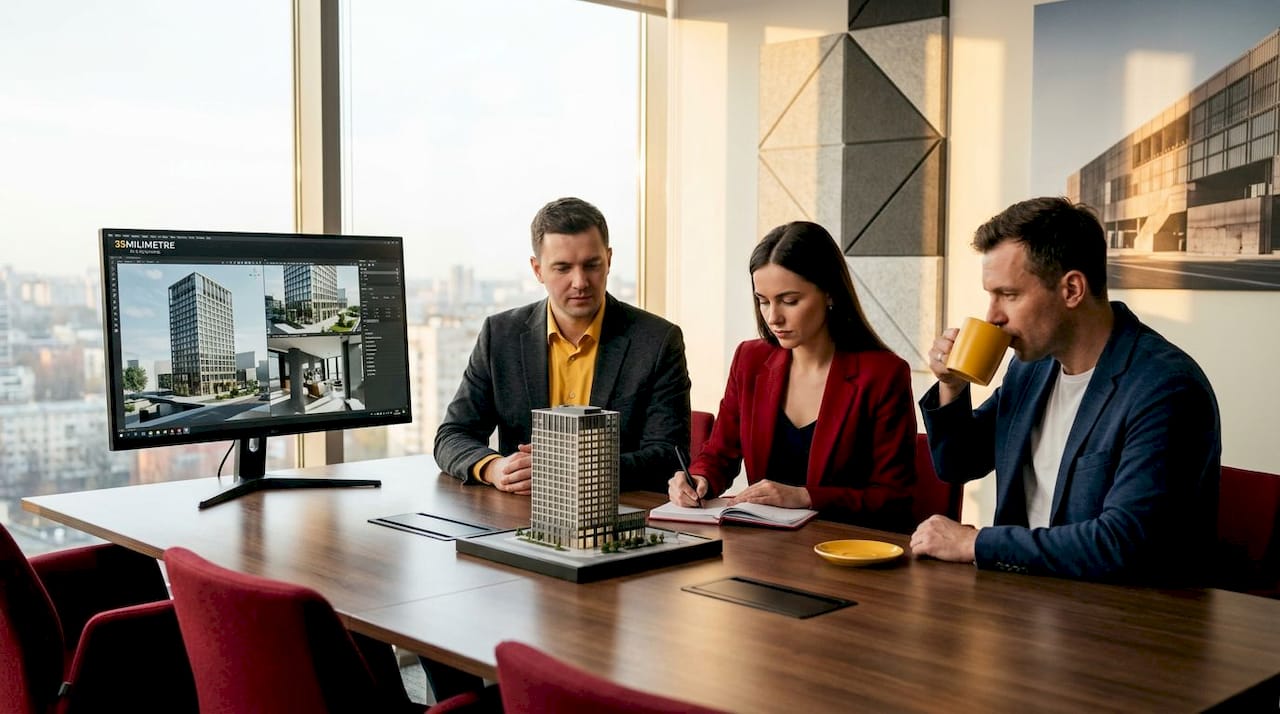
If you’ve ever presented a product concept, pitched a property development, or launched a marketing campaign before the physical thing existed, you’ve already felt the gap that commercial renderings fill. Put simply, what are commercial renderings? They are photorealistic, computer-generated images or animations that represent commercial spaces, products, or architectural projects with enough visual precision to replace the need for physical samples or completed construction. Far from being just polished eye candy, these visuals drive real decisions: pre-sales, investor commitments, planning approvals, and campaign performance.
Table of Contents
- Key takeaways
- What commercial renderings are and how they work
- The measurable business impact of commercial renderings
- How to create commercial renderings that meet deadlines
- Commercial rendering examples across industries and channels
- My perspective on where commercial renderings really create value
- Ready to build visuals that perform
- FAQ
Key takeaways
| Point | Details |
|---|---|
| Commercial renderings drive pre-sales | Projects using 3D visualization achieve 40–50% pre-sales before groundbreaking, far ahead of minimal-visualization approaches. |
| Engagement metrics improve significantly | Properties with professional 3D tours earn 87% more views and substantially higher click-through rates than static photos. |
| Plan timelines carefully | A single rendering takes 4–6 days; full packages require 3–5 weeks, so briefing early prevents costly delays. |
| Package commissioning beats ad hoc ordering | Unified visualization packages from a single 3D model deliver better brand consistency and lower overall cost. |
| Business outcomes matter more than technical specs | The most effective commercial rendering partners focus on sales results, not just pixel quality. |
What commercial renderings are and how they work
Commercial renderings are computer-generated visuals built from 3D models, CGI technology, and photorealistic rendering engines. The workflow starts with a digital model of the space or product. Artists then apply materials, lighting, camera angles, and environmental context to produce an image that is often indistinguishable from professional photography. Cloud rendering technology has accelerated this dramatically, distributing frame calculations across hundreds of machines simultaneously so that what once took weeks can now be completed in hours.
The types of commercial renderings you will encounter in practice fall into several clear categories:
- Exterior renderings show a building’s facade, streetscape, and surrounding context from eye level or an elevated perspective.
- Interior renderings depict designed spaces such as lobbies, offices, retail floors, hotel rooms, and restaurant environments with styled furnishings and accurate lighting.
- Aerial or bird’s-eye renderings place a project within its broader urban context, which is especially useful for large-scale commercial or mixed-use developments.
- Flythrough animations move the camera through a space or around a building in a continuous sequence, creating a cinematic experience.
- Product renderings focus on individual items rather than architecture, producing marketplace-ready imagery for packaging, e-commerce listings, and advertising.
What separates commercial renderings from residential or generic visualizations is the intended audience and the stakes involved. A residential rendering might help a homeowner picture their kitchen remodel. A commercial rendering is deployed to secure eight-figure financing, win a planning committee vote, or launch a digital ad campaign targeting a specific buyer demographic. Investors and corporate real estate teams now treat high-quality visualization as a required standard rather than an optional presentation enhancement. The strategic function is fundamentally different.
The measurable business impact of commercial renderings
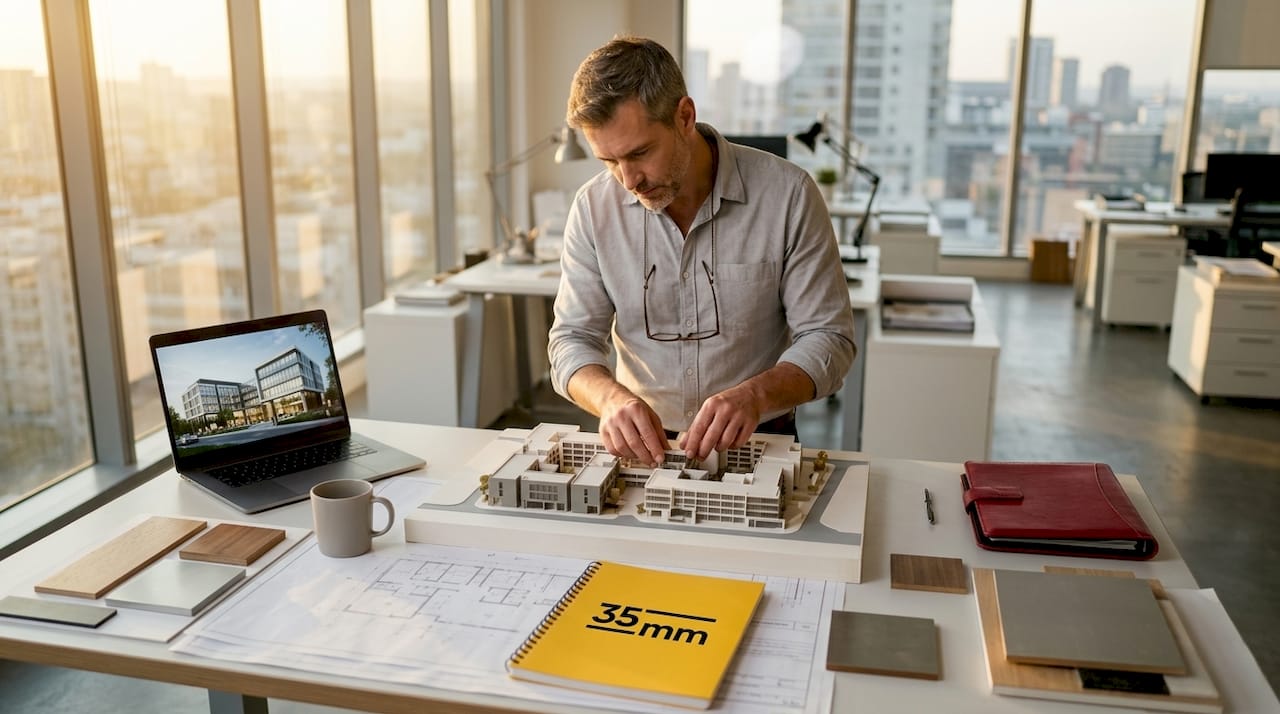
The benefits of commercial renderings are not abstract. They show up in conversion rates, pre-sales figures, and the average transaction value your marketing generates. Commercial projects using comprehensive 3D visualization consistently achieve 40–50% pre-sales before groundbreaking, compared to just 15–20% for projects that rely on minimal visualization. That gap represents millions of dollars in secured revenue before a single foundation is poured.
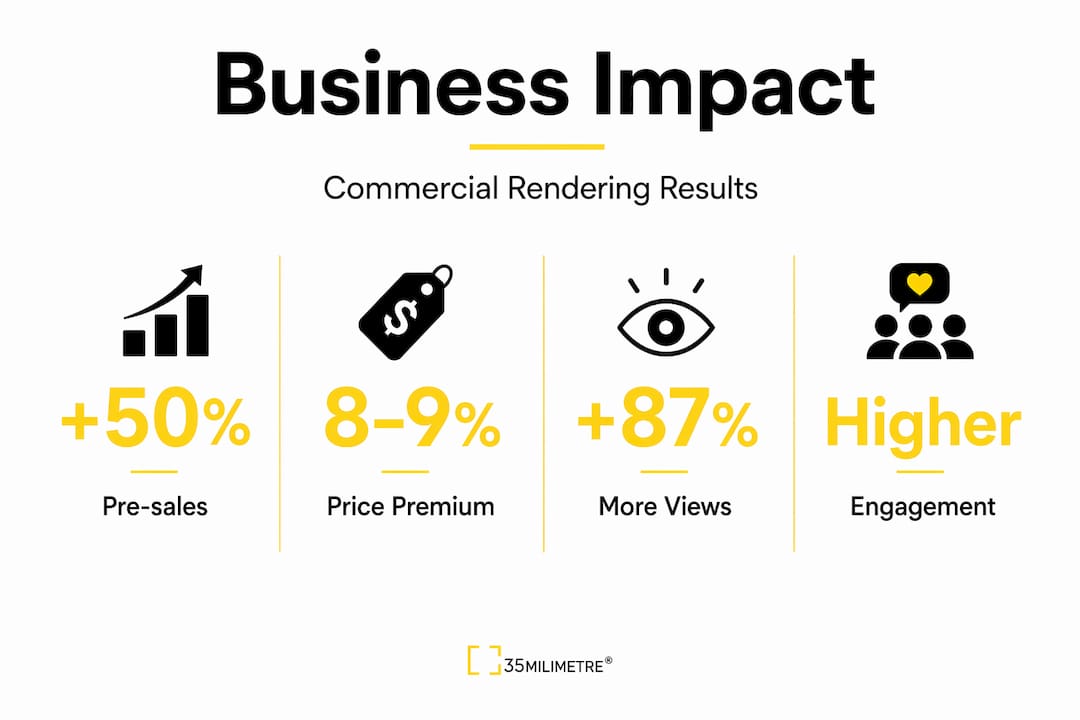
Price premiums are another concrete outcome. Properties supported by high-quality 3D visualization sell at 8–9% price premiums on average compared to those presented with traditional 2D plans. The visual certainty that a great rendering creates reduces buyer hesitation and justifies a higher asking price. When your audience can see exactly what they are buying, they are more willing to commit and less likely to negotiate aggressively.
Engagement metrics reinforce the case. Properties with professional 3D tours receive 87% more views and significantly more clicks than static image listings. Interactive virtual tours keep visitors four to six times longer on a page than static images alone, which translates directly into more qualified leads entering your sales funnel.
| Marketing approach | Pre-sales rate | Avg. engagement time | Price premium |
|---|---|---|---|
| Traditional 2D plans only | 15–20% | Baseline | None |
| Professional 3D renderings | 40–50% | 4–6x longer | 8–9% higher |
| Interactive virtual tours added | Maximum impact | Highest dwell time | Best conversion |
Pro Tip: If you are preparing for a capital raise or a pre-launch campaign, prioritize a hero dusk exterior rendering first. Cinematic dusk renderings have been shown to generate fundamentally higher click-through rates in digital ads than flat daytime versions, so your media spend works harder from day one.
The strategic role of visuals in marketing has evolved considerably, and commercial renderings sit at the center of that shift. They are no longer a finishing touch applied after the hard marketing work is done. They are the foundation of the entire pre-launch sales strategy.
How to create commercial renderings that meet deadlines
Understanding how to create commercial renderings effectively is as much about project management as it is about artistic skill. Most businesses lose time and money not because they hired the wrong studio, but because they underestimated what the production process requires from their side. Here is a realistic view of what the timeline looks like.
- Brief preparation. Before any 3D work begins, the studio needs architectural drawings, product specs, brand guidelines, material references, and mood board imagery. Incomplete briefs are the single biggest source of delays. Complete project briefs are the most influential factor for meeting both deadlines and quality expectations.
- Modeling and asset creation. The 3D artist builds the digital model from your supplied documentation. For complex commercial spaces, this phase alone can take a week or more.
- Lighting, materials, and styling. This is where the image acquires its photorealistic quality. Artists calibrate light sources, apply textures, add furnishings, and set camera angles to match your brief.
- Initial renders and review. The studio delivers first-round images for your feedback. A single exterior or interior rendering typically takes 4–6 days to complete, with full packages requiring 3–5 weeks.
- Revision rounds. Each revision round adds 2–5 business days to the schedule. Underestimating the number of revision rounds is one of the most common causes of missed launch deadlines.
- Final delivery and post-production. Finished images go through compositing, color grading, and any platform-specific optimization before delivery.
The practical implication here is clear: brief your studio at least 5–6 weeks before your launch date, especially if you need a full marketing package. Building a high-efficiency workflow for your visual production process pays dividends across every campaign you run.
Pro Tip: Consolidate all stakeholder feedback into a single, organized document before sending each revision request. Fragmented feedback arriving in multiple emails or messages forces the studio to interpret conflicting instructions, which costs time and often produces a result no one is fully happy with.
One decision that consistently separates successful projects from costly ones is whether you commission a unified pre-sales visualization package rather than ordering renderings one at a time. A single 3D model can yield hero exteriors, interior unit shots styled by buyer demographic, amenity views, aerial context renderings, and animation sequences. Ordering these assets from one model ensures consistent lighting, scale, and brand identity across every channel.
Commercial rendering examples across industries and channels
The range of commercial rendering examples in active use today is broader than most marketers realize. Understanding where and how other businesses deploy these visuals gives you a clearer picture of what is possible for your own campaigns.
In the commercial architecture visualization space, you will find renderings powering sales galleries for office towers, hospitality groups launching new hotel concepts, and retail developers presenting anchor tenant spaces to prospective leaseholders. Mixed-use projects routinely use aerial renderings to show how retail, residential, and amenity floors relate to each other and to the surrounding city block. These visuals appear in planning submissions, investor decks, and construction hoardings simultaneously, all derived from the same source model.
For product-focused businesses, commercial renderings replace expensive physical prototypes and photography sessions. A packaging concept can be visualized in photorealistic detail before a single unit is manufactured. The image can then be used across e-commerce listings, digital ads, and printed catalogs without any reshooting.
Digital marketing has become one of the highest-leverage applications. Cinematic dusk exterior renderings generate fundamentally higher click-through rates in paid social and display campaigns than standard daytime images. When you crop and optimize a single high-resolution rendering for multiple ad formats, Instagram stories, banner ads, and LinkedIn posts, all pulling from the same visual asset, your production cost per impression drops sharply.
“Rendering has become a required standard, not a luxury presentation tool. The businesses that treat it as infrastructure rather than an optional upgrade are consistently the ones closing deals faster.” Visual Certainty in Commercial Development
Looking at visual content trends for 2026, interactive elements like virtual tours and animated flythroughs are becoming expectations rather than differentiators. Buyers, tenants, and investors increasingly want to explore a space before they commit, and static images alone no longer deliver that level of confidence.
My perspective on where commercial renderings really create value
I’ve worked with a lot of clients who come in thinking about rendering quality in terms of pixel count and photorealism. That conversation matters, but I’ve learned that it’s actually the wrong starting point. The real question is whether the visual moves your audience toward a decision. Everything else is secondary.
What I’ve found over years of working on post-production and visualization projects is that the businesses getting the most out of commercial renderings are treating them as business infrastructure rather than a one-time visual expense. They build a library of assets from a single production investment and deploy those assets across every touchpoint: website, paid media, printed collateral, sales presentations, and planning documents.
The mistake I see repeatedly is focusing on technical rendering specs rather than on what the image needs to accomplish commercially. A rendering that is technically flawless but styled for the wrong audience, or delivered too late to support the campaign launch, creates zero business value. Timing and audience alignment matter as much as quality.
My honest advice: find a studio that asks you about your sales timeline, your buyer demographics, and your marketing channels before they ask about your floor plans. That is the conversation that produces visuals worth investing in.
— 35mm
Ready to build visuals that perform
At 35milimetre, we work with brands, developers, and agencies that need post-production and visualization work to carry real marketing weight. Whether you need product compositing, CGI integration, or a complete pre-launch visual package, we approach every project from the perspective of what the image needs to do commercially, not just how it looks technically.
Our team of post-production artists, designers, and 3D specialists has spent over two decades producing high-end commercial visuals for major brands across technology, automotive, and commercial development sectors. We know how to turn a brief into a visual asset that performs across every platform you need it on. If you’re preparing a product launch, a pre-sales campaign, or a brand refresh, we’re ready to talk about what your visuals need to accomplish.
FAQ
What are commercial renderings used for?
Commercial renderings are used to market and sell properties, products, and architectural projects before they are built or manufactured. They appear in investor presentations, sales galleries, digital ad campaigns, brochures, and planning submissions.
How long does it take to produce a commercial rendering?
A single exterior or interior rendering typically takes 4–6 business days to complete, while a full pre-sales visualization package requires 3–5 weeks. Briefing your studio at least five to six weeks before your campaign launch date is strongly recommended.
What are the measurable benefits of commercial renderings?
Projects using professional 3D visualization achieve 40–50% pre-sales before groundbreaking, compared to 15–20% with minimal visuals. Properties also command an average 8–9% price premium and generate 87% more views than those relying on traditional 2D plans.
What should a commercial rendering package include?
A well-structured package typically includes hero exterior renderings, interior shots styled by buyer demographic, amenity views, aerial context images, and optimized assets for digital advertising. Producing all assets from a single 3D model keeps branding consistent and reduces overall cost.
How do commercial renderings differ from residential ones?
Commercial renderings serve higher-stakes business purposes: securing financing, winning planning approvals, and driving pre-sales campaigns. The intended audience is investors, corporate buyers, and marketing teams rather than individual homeowners, which changes the required visual strategy entirely.
