
The Role of AI in Creative Studios in 2026
The role of AI in creative studios is widely misunderstood. Most conversations either overstate AI as a threat to human creativity or understate it as a simple productivity hack. The reality sits somewhere more interesting: AI is reshaping how studios operate at every stage, from initial concepting through final post-production delivery. For creative professionals and studio owners, understanding where AI genuinely adds value and where human judgment remains non-negotiable is the difference between staying competitive and falling behind.
Table of Contents
- Key takeaways
- The role of AI in creative studios and how it reshapes workflows
- How creative roles are evolving in AI-augmented studios
- AI as infrastructure in modern creative studios
- Challenges studios face when adopting AI
- My perspective on AI and creative leadership
- How 35milimetre uses AI to deliver stronger visual work
- FAQ
Key takeaways
| Point | Details |
|---|---|
| AI accelerates production timelines | AI-assisted pipelines can reduce post-production timelines by months while cutting VFX budgets significantly. |
| Workflows need redesign, not just new tools | Studios that restructure their entire workflow around AI see nearly three times more measurable business impact than those that simply add AI tools. |
| Creative roles are shifting, not disappearing | Creative directors are evolving into orchestrators who define briefs, evaluate AI outputs, and enforce brand consistency. |
| Transparency builds audience trust | Openly disclosing AI use repositions it as a value multiplier rather than a cost-cutting shortcut. |
| Infrastructure beats isolated features | Treating AI as end-to-end infrastructure, not a standalone plugin, is what separates high-performing studios from the rest. |
The role of AI in creative studios and how it reshapes workflows
The most immediate and measurable impact of AI in creative studios is on production speed. Tasks that once consumed entire days of a post-production artist’s time, such as rotoscoping, background masking, and noise reduction, are now handled in a fraction of the time. AI-assisted pipelines reduce film post-production timelines from 18 to 24 months down to 6 to 8 months, while cutting VFX budgets by 30 to 40 percent. Automated segmentation now handles roughly 70 percent of rotoscoping work, and AI denoising cuts rendering times by 50 to 80 percent.
Beyond speed, AI changes the nature of creative iteration. When generating concept variations takes minutes instead of hours, studios can explore more directions before committing to a final approach. Faster exploration leads to better-informed decisions and fewer costly late-stage revisions. That shift alone changes how studios price projects and how they communicate value to clients.
The structural change is equally significant. Unified AI-assisted pipelines now merge editing, VFX, and continuity fixes into a single workflow, reducing the handoff delays that historically slowed down production. Transcript-based editing accelerates revision cycles, and continuity issues get flagged early rather than discovered in the final review. For studios working with ad agencies on tight delivery windows, this kind of integrated workflow is no longer a luxury. It is a baseline expectation.
Pro Tip: Before adopting any AI tool, map your current production pipeline stage by stage. The goal is to identify where time is genuinely lost, not just where AI happens to be available. That specificity is what makes the difference between a useful integration and an expensive distraction.
Here is a practical sequence for integrating AI across a studio production pipeline:
- Concept and ideation: Use AI image generation to produce rapid visual references and mood board variations before any manual work begins.
- Asset preparation: Apply AI-powered masking and segmentation to isolate subjects, reducing manual selection time in compositing.
- Color and retouching: Use AI-assisted color grading and skin retouching tools to establish a baseline, then refine with human judgment.
- VFX and compositing: Leverage AI denoising and upscaling to accelerate rendering and improve output quality without proportional increases in compute time.
- Review and delivery: Use AI-driven quality checks to flag inconsistencies in color, sharpness, or brand elements before final export.
How creative roles are evolving in AI-augmented studios
The most significant shift happening inside studios right now is not technical. It is organizational. AI creative directors are shifting focus from manual execution to defining briefs, evaluating AI outputs, and enforcing brand and style consistency. AI functions as a junior creative that executes quickly but requires human taste, ethical oversight, and strategic review to produce work that actually serves the client.
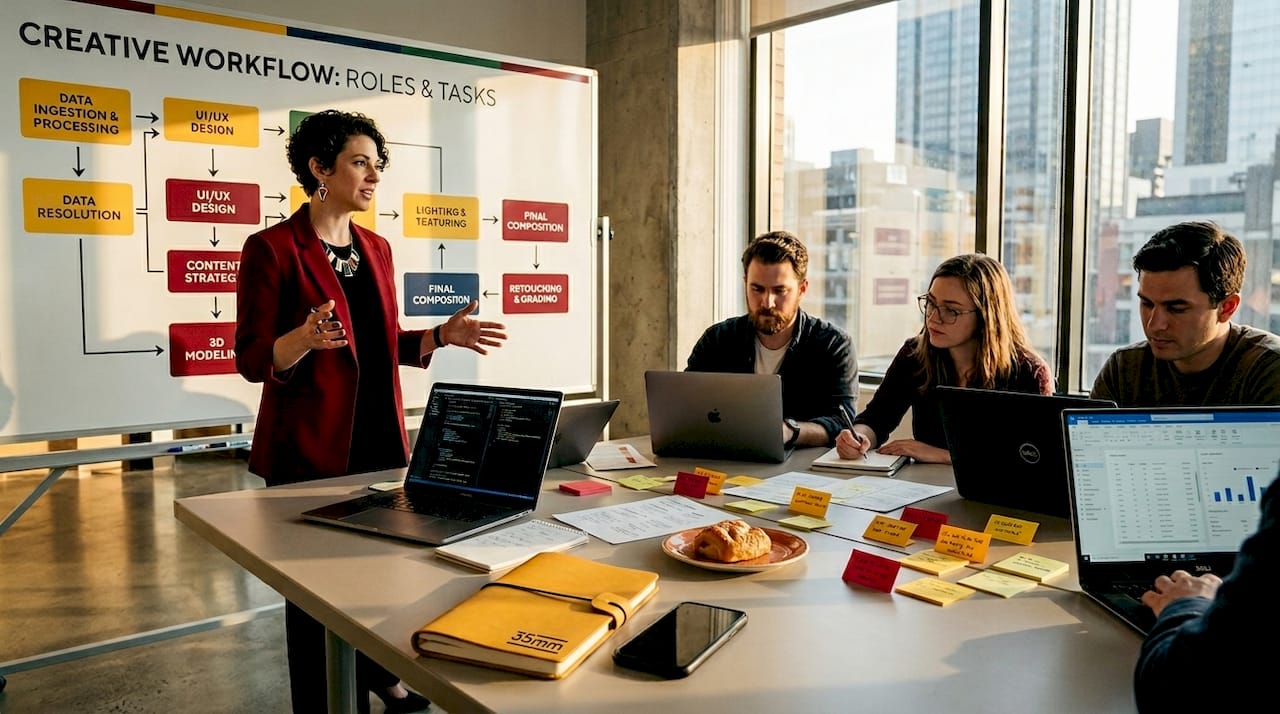
This evolution is producing new roles that did not exist five years ago. Prompt strategists specialize in translating creative briefs into precise AI instructions that yield usable outputs. Workflow architects design the systems that connect AI tools into coherent production pipelines. These roles require a combination of creative literacy and technical fluency that traditional job descriptions never anticipated.
What does not change is the value of human judgment. AI can generate hundreds of image variations, but it cannot tell you which one aligns with a brand’s long-term positioning or which one will resonate with a specific audience segment. That call still belongs to the creative director. The creative direction role is becoming less about making things and more about deciding which things are worth making.
For studio owners, this has real implications for hiring and training. The skills that matter most now include critical evaluation of AI outputs, prompt engineering, and an understanding of where AI introduces risk. Studios that invest in developing these capabilities internally are building a durable advantage. Those that treat AI as a self-managing tool will find the outputs gradually drifting from their creative standards.
Pro Tip: When reviewing AI-generated work, build a structured evaluation checklist tied to your brand guidelines. Consistency in how you evaluate outputs is what keeps your studio’s creative quality stable as production volume scales up.
AI as infrastructure in modern creative studios
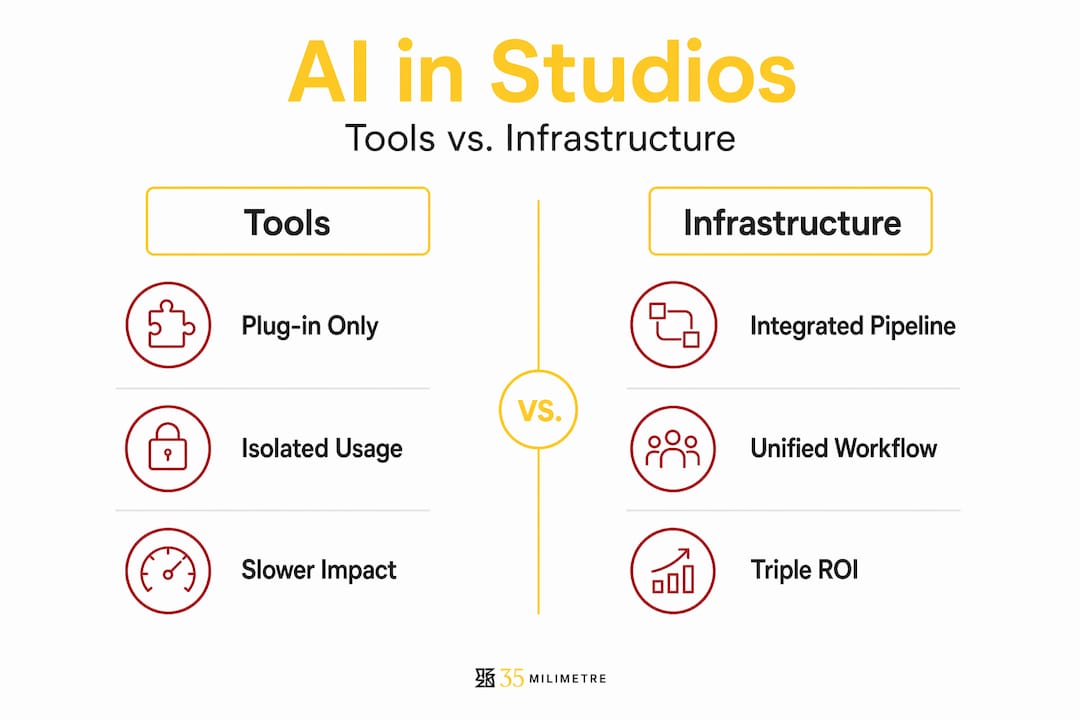
The studios seeing the strongest results from AI are not the ones with the most tools. They are the ones that have rebuilt their workflows around AI as a foundational layer rather than a collection of add-ons. Successful AI adoption treats AI as infrastructure supporting every stage of the creative pipeline, and top agencies are building unified platforms that increase output per creative head without sacrificing quality.
The contrast between these two approaches is significant.
| Approach | AI as isolated tools | AI as infrastructure |
|---|---|---|
| Integration depth | Plugged into specific tasks | Embedded across the full pipeline |
| Workflow structure | Linear and siloed | Parallel and interconnected |
| Brand consistency | Manually enforced | Systematically governed |
| Scalability | Limited by individual tool capacity | Scales with pipeline architecture |
| Creative control | Fragmented across tools | Centralized and auditable |
Studios that redesign workflows for AI see nearly three times more measurable business impact compared to those that simply layer AI tools onto existing processes. The difference comes down to how deeply AI is woven into decision-making, not just task execution.
Localization is one area where this infrastructure advantage becomes concrete. A studio producing campaign imagery for a global brand needs to adapt visuals across markets, languages, and cultural contexts at speed. AI-powered localization tools embedded in the production pipeline can handle background swaps, text adaptation, and regional color adjustments automatically, freeing the creative team to focus on the work that actually requires cultural sensitivity and storytelling judgment.
The role of AI in post-production specifically has matured to the point where it touches nearly every technical discipline. Color science, compositing, rendering, and quality control all have AI-native tools available. The studios winning on efficiency are the ones that have connected these tools into a single governed pipeline rather than running them as separate applications managed by separate team members.
Challenges studios face when adopting AI
Adopting AI is not without friction, and studios that treat it as a straightforward upgrade tend to run into avoidable problems. The challenges fall into a few distinct categories, each requiring a different kind of response.
Audience perception is one of the more underappreciated risks. Only 18 percent of consumers react positively to obviously AI-generated advertising, while 39 percent have negative reactions. That gap matters for studios producing work that will be seen by end consumers. The solution is not to hide AI use but to apply it in ways that are not detectable as shortcuts. Human-led creative direction remains the quality filter that keeps AI output from feeling generic.
Legal and copyright questions around AI-generated imagery are still unsettled in most jurisdictions. Studios need to understand the licensing terms of every AI tool they use and document their creative process clearly. This is not just a legal precaution. It is a client service issue. Brands increasingly ask about the provenance of creative assets, and studios that cannot answer that question clearly are at a disadvantage.
“Over-automation risks losing the nuance, context, and strategic human judgment that brand-driven work requires. AI handles volume and variation well, but it lacks depth in client understanding and storytelling quality.” Source
The risk of over-automation is real. AI handles volume and variation efficiently, but it lacks the depth of client understanding and storytelling quality that separates good work from great work. Studios that automate too aggressively often find that their output becomes technically correct but creatively flat. The studios that get this right treat AI as a production accelerator and keep the creative judgment firmly in human hands.
Transparency with clients is increasingly a competitive differentiator. Openly disclosing AI usage and framing it as a way to deliver more creative exploration and faster iteration builds trust rather than undermining it. Clients who understand what AI enables are more likely to see the value in the studio’s work rather than questioning whether they are getting less human effort for the same price. For more on how to frame AI use with clients, the discussion on AI in advertising is worth reading alongside this.
My perspective on AI and creative leadership
I have watched the conversation around AI in creative studios swing between two extremes, and neither one reflects what is actually happening in practice. The fear that AI eliminates creative jobs misses the point. The enthusiasm that AI solves everything misses it just as badly.
What I have seen, both in our own work at 35milimetre and in studios we interact with, is that AI changes what creative leadership means. The best creative directors I know are not the ones who resist AI or the ones who hand everything to it. They are the ones who have developed a clear sense of what they are trying to say, and they use AI to say it faster and at greater scale. That clarity of intent is the thing AI cannot generate for you.
The studios I find most credible right now are the ones that have rebuilt their workflows around AI rather than bolting tools onto old processes. They have also invested in their people, not just their software. The human skills that matter most in an AI-augmented studio, including taste, judgment, client empathy, and storytelling instinct, are not things you acquire by subscribing to a new platform.
My honest take: the studios that will lead in the next five years are the ones treating AI adoption as an organizational design problem, not a technology problem. The tools are available to everyone. The discipline to use them well is not.
— 35mm
How 35milimetre uses AI to deliver stronger visual work
At 35milimetre, we have spent the past year integrating AI into our post-production and design workflows in ways that directly improve the quality and speed of what we deliver to clients. From AI-enhanced compositing and retouching to AI-assisted concept generation, the technology has expanded what our three-person core team can produce without compromising the craft standards our clients expect.

If you are working with a brand, agency, or photography project that demands high-end visual output, our post-production and design services combine two decades of hands-on expertise with the latest AI-driven workflows. The result is imagery that holds up at scale and stands out in competitive markets. Reach out to discuss how we can support your next project.
FAQ
What is the role of AI in creative studios?
AI in creative studios automates time-intensive technical tasks like rotoscoping, masking, and rendering, while also accelerating concept iteration and enabling unified post-production pipelines. It functions as a production accelerator, not a replacement for human creative judgment.
How does AI affect creative roles in studios?
AI shifts creative roles toward orchestration and evaluation rather than manual execution. Creative directors increasingly focus on defining briefs, reviewing AI outputs, and enforcing brand consistency, while new roles like prompt strategist and workflow architect are emerging.
Why should studios redesign workflows rather than just add AI tools?
Studios that redesign their entire workflow around AI see nearly three times more measurable business impact than those that simply add AI tools to existing processes. Structural integration is what drives real efficiency gains.
How do audiences respond to AI-generated creative content?
Consumer research shows that 39 percent of consumers react negatively to obviously AI-generated advertising. Studios that apply AI transparently and maintain strong human creative direction manage this perception risk most effectively.
Can smaller studios benefit from AI the same way large studios do?
Yes. AI tools democratize access to high-quality VFX and post-production capabilities that were previously exclusive to large productions, allowing smaller studios and independent creators to compete at a higher level.
