
Why invest in visuals: boost engagement and storytelling

Most marketing teams are producing more content than ever before, yet many struggle to show meaningful returns. The instinct to fill every channel with posts, articles, and ads is understandable, but it often crowds out the more intentional question: what type of content actually moves your audience? For technology and automotive brands, where purchase decisions are high-consideration and trust is everything, that question matters enormously. Short-form video tops ROI rankings across marketing formats, signaling that visual investment is not a nice-to-have. This guide breaks down why, and shows you how to act on it.
Table of Contents
- The business case: Why visual content dominates
- How visual storytelling drives audience action
- Nuances and risks: Avoiding the visual content pitfalls
- Making the most of your investment: Practical frameworks
- A smarter take: What most brands overlook in visual content ROI
- How to elevate your visual content investment
- Frequently asked questions
Key Takeaways
| Point | Details |
|---|---|
| Visuals outperform text | Short-form video and other visuals deliver higher ROI for brand storytellers than written content alone. |
| Measure what matters | Track engagement and play rates rather than just production volume or views for real performance insight. |
| Avoid content fatigue | Balance creation with effective promotion to prevent audience saturation and wasted budget. |
| Strategic frameworks win | Consistent, platform-tailored visuals aligned with buyer journeys boost both brand impact and conversions. |
The business case: Why visual content dominates
With the misconception addressed, let’s examine the evidence and ROI metrics backing visual content as a must-have for brand storytellers.
The numbers are striking. According to HubSpot’s industry survey, short-form video leads all formats for return on investment, cited by nearly half of all marketers surveyed. That is not a marginal advantage. It reflects a fundamental shift in how audiences consume and respond to brand communications across every major digital platform.
For technology and automotive marketers, this is especially relevant. A consumer evaluating a new vehicle or a high-end consumer electronics product is not just reading spec sheets. They are watching walkaround videos, studying lifestyle photography, comparing product renders, and forming impressions based almost entirely on what they see. One compelling visual can carry more persuasive weight than three paragraphs of copy. The visual asset is, in effect, one still frame standing in for an entire physical experience.
Understanding the ROI landscape also means recognizing what different format types offer. The table below gives a quick comparison:
| Content format | Primary strength | Best use case | ROI potential |
|---|---|---|---|
| Short-form video | Attention, recall, shareability | Brand awareness, product demos | Very high |
| Long-form video | Depth, trust-building | Consideration, education | High |
| Product photography | Clarity, conversion | E-commerce, catalog, ads | High |
| CGI and 3D renders | Precision, versatility | Launch campaigns, tech specs | High |
| Infographics | Information density | Thought leadership, social | Moderate |
| Text-only posts | Searchability | SEO, updates | Lower |
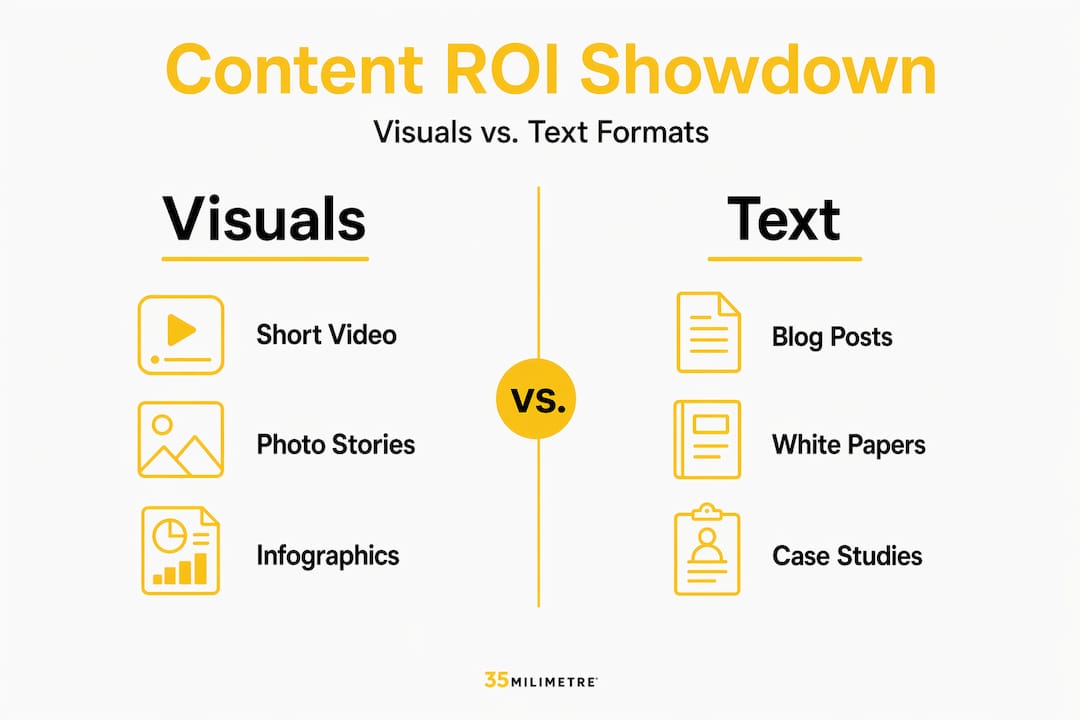
The practical gap between the top and bottom of that list is significant. Brands that rely primarily on text-based content and static posts are competing at a disadvantage, particularly in visually driven categories like auto and consumer tech.
Success in visual content is also measured differently than many brands expect. Raw reach matters less than how audiences actually engage with what you produce. Tracking video engagement metrics like play rate, watch time, and rewatch behavior tells a more honest story than impressions alone. This shift in measurement thinking is one of the most important adjustments you can make as a marketing professional investing in visual production.
There are also real business challenges worth naming. Producing high-quality visual content demands investment in time, talent, and tools. Budget holders sometimes resist because the connection between a beautifully retouched campaign image and revenue feels indirect. The solution is to build the business case before you build the content, and to connect every visual initiative to measurable outcomes from the start. Exploring visual content campaign strategies with a clear ROI framework makes that connection much easier to defend internally. You can also draw on established visual strategy tips that have been tested across sectors.
How visual storytelling drives audience action
After understanding which visual content delivers ROI, the next question is: what makes it so effective in driving action?
The mechanism behind visual content’s performance is rooted in how the brain actually processes information. Visual storytelling shapes attention and encodes memory in ways that text alone cannot replicate. When a viewer watches a product video that shows a car’s interior at dusk with the right color grading and ambient sound, they are not just receiving information. They are having a micro-experience that attaches emotion to the brand. That emotional attachment accelerates decision-making.
“Visuals don’t just decorate a message. They are the message. For high-consideration categories, the quality and coherence of your visual narrative determines whether a prospect moves forward or steps back.”
For automotive and technology brands specifically, automotive visual content plays a defining role in how consumers evaluate products before they ever visit a showroom or store. Buyers arrive at the point of sale already shaped by what they have seen. If your visual content has built confidence and familiarity, the in-person experience simply confirms a decision that was already forming. That is an enormous strategic advantage.
Here is a practical approach to building a visual journey that moves users through your funnel:
- Awareness stage: Use short-form video and eye-catching photography to interrupt the scroll and establish emotional tone. Prioritize distinctiveness over completeness at this stage.
- Consideration stage: Deploy longer videos, 360-degree product views, CGI detail shots, and comparison content. This is where precision and quality in retouching and compositing really pay off.
- Decision stage: Focus on social proof visuals, lifestyle imagery, and conversion-oriented creative with clear calls to action. Trust is built and confirmed here.
- Retention and advocacy: Post-purchase visual content that reinforces the brand story, including unboxing content, feature highlights, and owner community imagery, keeps customers engaged and drives word-of-mouth.
Pro Tip: Map each visual asset you create to a specific stage in this journey. If you cannot answer “which stage does this serve?”, the asset probably lacks strategic focus and may underperform regardless of its production quality.
The engagement strategies with visuals that work best are those built around your audience’s actual decision process, not just your brand’s communication calendar. And if you are building or refreshing a brand identity, the principles behind visual identity for auto brands apply broadly to technology categories as well.

Nuances and risks: Avoiding the visual content pitfalls
While visual content has undeniable power, maximizing ROI requires sidestepping several real-world risks.
The single most overlooked problem in visual content investment is not quality. It is distribution. Teams spend enormous resources producing stunning video and photography, then publish it once across their owned channels and move on. According to Wistia’s research, engagement dropped across video content by roughly 7% overall and 10% for short-form specifically, with the primary cause being underinvestment in promotion relative to production. That is a systemic issue, not a content quality problem.
The data reinforces a hard truth: only 28% of marketers report spending more time promoting content than creating it. That ratio is nearly inverted from what performance data suggests it should be.
| Risk factor | Common symptom | Recommended fix |
|---|---|---|
| Underpromotion | Low views despite strong creative | Increase paid amplification budget |
| Content fatigue | Declining play rates over time | Rotate formats and refresh creative cycles |
| Missing audience fit | Low engagement despite high reach | Sharpen platform-specific targeting |
| Vanity metrics focus | High impressions, low conversions | Shift to engagement and conversion KPIs |
| Lack of consistency | Fragmented brand perception | Build a documented visual identity system |
Content fatigue is a related problem. When short-form video floods every platform at once, audiences develop reflexive scroll behavior. Producing more content in response to declining engagement often accelerates the problem rather than solving it. The answer is better content paired with smarter distribution, not simply more output.
Key metrics worth monitoring include play rate (what percentage of people who see the video actually start watching), watch-through rate (how much of the video they complete), click-through rate on CTAs embedded in visual content, and return visitor behavior linked to specific visual campaigns. These measures are far more meaningful than raw reach or impression counts when evaluating video engagement trends.
Pro Tip: Build a simple promotion checklist that runs parallel to your content production workflow. For every major visual asset, plan the paid, organic, and partnership distribution before the shoot or render is even complete. The distribution strategy should be designed at the same time as the visual itself.
You can also boost engagement with visuals by repurposing a single hero asset into multiple format variants, stretching your production investment across more placements without duplicating the creative workload.
Making the most of your investment: Practical frameworks
To overcome these risks, here is how to use proven frameworks for smart, sustainable visual content investment.
The foundation of any high-performing visual content system is repeatability. One great campaign photograph or video is valuable, but a repeatable process that consistently produces great work is a competitive asset. Marketing experimentation research supports a three-part framework: establish a consistent brand visual language, tailor formats to each platform’s native behavior, and run structured experiments to find what genuinely moves engagement rather than guessing.
Here is how that plays out in practice:
- Establish the brand visual language first. This means defining color palettes, lighting styles, compositing standards, and image treatment guidelines that apply across all formats and channels. Without this, your visual content may be high quality individually but fail to build cumulative brand recognition.
- Tailor formats to platform behavior. A hero video for your brand website is not the same asset as a six-second pre-roll ad or an Instagram Reel. Each platform rewards different pacing, aspect ratios, and storytelling approaches. Treating them as interchangeable is one of the most common and costly mistakes in visual content planning.
- Run structured visual experiments. Test thumbnail styles, opening frames, color grading treatments, or CTA placement in a controlled way. Document what you learn. Over time, these small experiments compound into a significant strategic advantage.
Additional principles that support a sustainable visual content system include brand consistency across every customer touchpoint, conversion focus embedded into the creative brief rather than added as an afterthought, and a regular review cadence that evaluates performance data against creative decisions.
Building efficient visual workflows is especially important for teams working with external production partners or managing high campaign volumes. Structure reduces cost and accelerates quality. Staying current with visual content trends in 2026 also ensures your frameworks evolve alongside audience expectations and platform algorithms.
A smarter take: What most brands overlook in visual content ROI
Stepping back, the real story of visual content ROI is not about choosing the right format. It is about building a feedback loop that connects production decisions to audience behavior data and then doing something with that information.
Most brands we observe over-index on volume. They treat content production as a pipeline to fill rather than a strategic lever to pull. The brands that consistently outperform their categories are the ones that treat every visual asset as both a branding investment and a funnel asset simultaneously. A product render that appears in a paid social ad should be doing at least three jobs: establishing brand quality, communicating a specific product benefit, and nudging a specific audience segment toward the next step in their journey.
That kind of intentionality is genuinely rare. It requires alignment between creative teams, media buyers, and brand strategists that many organizations have not built. But the ROI gap between brands that have that alignment and those that do not is measurable and growing.
The uncomfortable truth is that most underperforming visual content is not bad creative. It is unfocused creative deployed without a measurement plan. Beautiful imagery without a strategy attached to it is decoration, not investment. The goal is to make each visual count, which means connecting every production decision to a strategic outcome before the work begins.
For technology and automotive brands, this is especially achievable because the category is inherently visual. The product itself is the story. A well-executed CGI render of a new processor architecture or a color-graded hero shot of a vehicle in motion already contains the narrative. The discipline is in aligning that narrative to where your audience actually is in their decision process. Exploring the strategic role of visuals is the right starting point for teams that want to close this gap.
How to elevate your visual content investment
The insights in this guide point toward one consistent conclusion: the brands that win on visual content do so because they pair strong creative with strategic intent, rigorous measurement, and a production process built for consistency and scale.

At 35milimetre, we work with technology and automotive brands at exactly this intersection. Our team brings over two decades of experience in retouching, compositing, CGI, and color grading to campaigns that need to do more than look good. They need to perform. Whether you are building a launch campaign, refreshing your product photography library, or experimenting with AI-enhanced imagery, our post-production services are designed to elevate your visual content from functional to genuinely standout. Reach out to discuss what your next campaign needs and how we can help deliver it.
Frequently asked questions
Why is video preferred over static images for engagement?
Video drives higher engagement and recall because it combines motion, sound, and narrative in a format audiences actively choose to watch. Short-form video leads all content formats in reported ROI, according to HubSpot’s marketing industry survey.
How should brands measure visual content success?
Brands should prioritize engagement and play-rate metrics over reach or impression counts. Video measurement trends show that watch-through rate and click-through behavior are far more predictive of real business impact than views alone.
What’s a common mistake when investing in visual content?
The most frequent error is spending the majority of resources on production while underinvesting in distribution and promotion. Engagement drops significantly when strong content is published without a structured amplification plan.
Why is visual storytelling especially important for automotive brands?
Car buyers form their impressions through visual-first discovery long before they visit a dealership. Automotive visual benchmarks show that the quality and consistency of a brand’s visual content directly shapes consumer trust and consideration at every stage of the journey.
