
How visuals drive engagement: key strategies for marketers

Most marketing teams treat visuals as decoration. A polished photo here, a branded banner there, and the job feels done. But that thinking leaves enormous engagement potential sitting on the table, particularly in technology and automotive sectors where competition for attention is fierce. Visuals are not just aesthetically pleasing additions to a campaign. They are the primary mechanism through which your audience processes, remembers, and acts on what you are communicating. This guide walks through the neuroscience, the real-world data, the most effective visual formats, and actionable integration strategies so your brand can stop decorating content and start driving genuine customer engagement.
Table of Contents
- The science behind why visuals increase engagement
- Visuals vs. text: What generates more customer action?
- Types of visuals that drive highest engagement
- Integrating visuals into your engagement strategy
- Our perspective: Why most brands underutilize visuals and how you can stand out
- Ready to amplify engagement with professional visuals?
- Frequently asked questions
Key Takeaways
| Point | Details |
|---|---|
| Visuals drive engagement | Images and videos capture audience attention more effectively than text alone. |
| Choose formats strategically | Select the right type of visual based on your brand, campaign, and audience goals. |
| Data-backed results | Metrics consistently show that visual content leads to higher clicks, shares, and recall. |
| Professional quality matters | High-quality, consistent visuals reinforce brand identity and trust. |
| Integrate for impact | Visuals should be seamlessly embedded across all marketing touchpoints for best results. |
The science behind why visuals increase engagement
Visuals do not just look better than text. They operate on a completely different cognitive pathway, and understanding that distinction is what separates marketers who generate passive impressions from those who drive meaningful action. The human brain is wired to process imagery almost instantaneously. In fact, visuals processed faster than text are absorbed 60,000 times faster than written words, which means your audience has already formed a reaction before they have read a single line of copy.
This is not trivial. In technology marketing, where product complexity can overwhelm a prospect, a single well-composed product render communicates capability, sophistication, and value in one still frame standing in for a physical experience. In automotive advertising, an evocative exterior shot in the right lighting does more emotional work than a full page of feature descriptions.
Memory retention is another area where visuals consistently outperform text. Research in cognitive psychology confirms that people remember roughly 65% of information when it is paired with a relevant image, compared to only 10% when delivered as text alone. For brand recall in competitive categories like consumer electronics or premium vehicles, that gap translates directly to purchase consideration.
“The brain processes images 60,000 times faster than text, making visual content one of the most powerful tools in any marketer’s toolkit.”
Strategic visual storytelling in advertising taps into both the emotional and rational brain simultaneously, which is exactly what high-consideration purchases in tech and automotive require. When a customer can feel the appeal of a vehicle through a dramatic composited scene or grasp the precision of a device through a hyper-detailed CGI render, their engagement is no longer passive. It becomes evaluative, which is one step closer to a buying decision.
The takeaway here is not simply that visuals are impactful. It is that the right visuals, produced with intention and technical quality, activate audience psychology in ways that text alone cannot replicate. Building your content strategy around this reality is the starting point for every recommendation that follows.
Visuals vs. text: What generates more customer action?
Understanding the science, it is critical to see how these insights translate to real-world marketing outcomes. The performance gap between visual and text-only content is well documented across formats and platforms. Articles with images receive 94% more total views than those without, a figure that carries significant implications for any brand investing in content marketing.
| Content type | Average CTR lift | Social shares increase | Conversion rate impact |
|---|---|---|---|
| Text only | Baseline | Baseline | Baseline |
| Text plus image | +42% | +35% | +20% |
| Text plus video | +65% | +56% | +34% |
| Interactive visual | +80% | +70% | +45% |
Consider a real-world scenario familiar to automotive marketers. A campaign promoting a new SUV model ran two versions: one with specification-heavy text descriptions and one pairing the same copy with professional CGI exterior and interior imagery. The visual version achieved more than double the click-through rate and generated 3x the social shares. The content was identical in written form. The visuals were the variable.
For technology brands, the dynamic is equally clear. A product launch post with a clean, retouched hero image consistently outperforms a spec-sheet style post in both organic reach and engagement rate. The image does not replace the information. It earns the audience’s attention long enough for the information to land.

There are also common mistakes that undercut these gains. Using stock imagery that does not reflect your actual product, compressing images to the point where quality degrades, or pairing dense text paragraphs with a single small thumbnail are all patterns that erode the visual advantage.
Pro Tip: Pair every key message with a purposeful visual that directly illustrates or reinforces that message. Do not treat the image as an afterthought placed after the copy is written. Build the visual and the copy as a unit from the start.
The numbers make the case clearly. Brands that treat visual content as a core production investment rather than a formatting choice see measurable returns across every major engagement metric.
Types of visuals that drive highest engagement
Knowing visuals outperform plain text, marketers must choose the right type of visual for their audience and campaign goals. Not all visual formats perform equally, and choosing the wrong format for a given objective wastes both budget and opportunity.
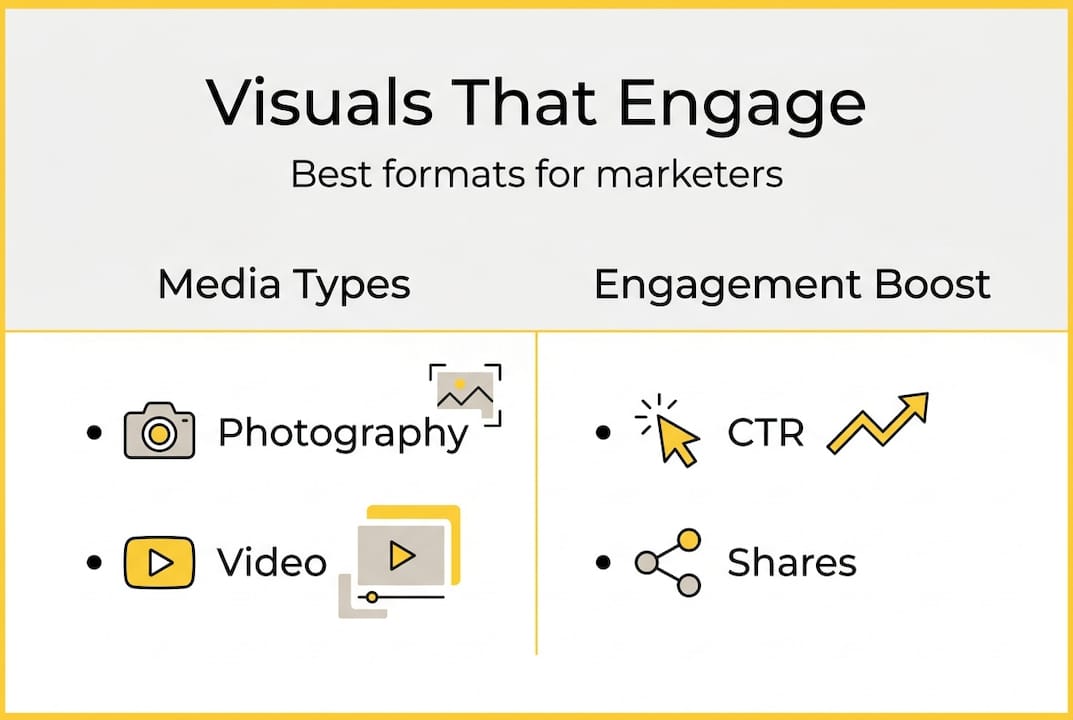
Video content effectiveness data shows that posts with videos attract 48% more views than those without, making video the highest-performing format for reach and time-on-page metrics. For automotive brands, this means model reveal videos, driving footage with sound design, and 360-degree walkarounds. For technology brands, product demo videos and animated explainers consistently outperform static images when the goal is to convey function or workflow.
| Visual format | Best use case | Avg. engagement lift | Key strength |
|---|---|---|---|
| Professional photography | Brand awareness, hero shots | +42% | Emotional appeal |
| Video content | Demos, reveals, storytelling | +65% | Depth and retention |
| Infographic | Data, comparisons, specs | +38% | Clarity and shareability |
| 3D render / CGI | Product visualization, launches | +55% | Control and precision |
| Interactive graphic | Configurators, tech features | +80% | Personalization |
Infographics work well when your audience needs to compare specifications, understand a technical process, or absorb data at a glance. In automotive marketing, a side-by-side feature comparison infographic can reduce sales friction by answering common objections visually before a customer reaches a showroom or a contact form.
3D renders and CGI open a different category of advantage. When a physical product is not yet manufactured, or when you need perfect lighting, flawless color grading, and composited environments that are impossible to achieve on a real-world shoot, CGI delivers consistency that photography cannot. This is particularly relevant for technology product launches where the visual must carry the brand promise before the product ships.
Pro Tip: User-generated content, when curated and lightly retouched for quality, adds authenticity that polished studio work sometimes cannot. A real customer’s photo of your vehicle in their environment carries emotional weight that a controlled campaign image may not, and pairing both formats in a campaign builds both aspiration and trust.
The key is matching format to intent. Awareness campaigns favor video and high-impact photography. Consideration stages benefit from infographics and interactive visuals. Conversion moments call for clean, detailed product imagery with nothing competing for focus.
Integrating visuals into your engagement strategy
After you know which visuals engage your audience, the next challenge is integration for lasting results. Having great individual visuals is not enough if they are deployed inconsistently or without a coherent strategy behind them.
Begin with an audit of your existing visual assets. Categorize every image, video, and graphic by campaign, format, and performance data. You will almost certainly find that a small number of assets are driving the majority of your engagement, and a large portion of your library is underperforming or visually outdated. This audit tells you where to invest next.
Visual branding consistency increases brand recognition by up to 80%, and that figure highlights why a visual strategy cannot be treated as a series of isolated production decisions. Every image, render, and video should carry consistent color palette choices, lighting style, composition logic, and tone that audiences immediately associate with your brand.
“Consistent presentation of a brand increases revenue by up to 33%, making visual coherence one of the highest-ROI investments a marketing team can make.”
For technology brands, that means your product renders, UI screenshots, and campaign imagery should feel like they belong to the same visual world. For automotive marketers, it means your outdoor location photography, studio cutout images, and digital configurator renders should share the same color grading and tonal range.
From there, sequence your production priorities. Start with the assets that directly impact conversion: hero product imagery, campaign key visuals, and video thumbnails. Then build supporting content around those anchors. Working with professional visual production tips ensures that your production pipeline is efficient and that quality standards are maintained across every deliverable.
Finally, build a review cycle. Visual trends shift, brand identities evolve, and audience expectations rise. A visual that performed well eighteen months ago may now feel dated against what your competitors are producing. Regular reviews keep your library current and your engagement metrics moving in the right direction.
Our perspective: Why most brands underutilize visuals and how you can stand out
After working with technology and automotive brands for over two decades, we have noticed a pattern that holds across nearly every client engagement: the brands that struggle with visual engagement are not failing because they lack budget. They are failing because they treat visual production as an execution task rather than a strategic one.
The most common mistake is adding visuals to content that was designed around text. When the visual is an afterthought, it shows. The image does not reinforce the message. The format does not match the platform. The lighting or color grading feels inconsistent with the brand’s other touchpoints. The result is a visual that technically exists but contributes nothing to engagement.
What actually moves the needle is when clients bring us into the briefing process early, before the copy is finalized, before the campaign structure is set. That is when insights from professional retouching and compositing can shape the content concept itself, not just dress it up after the fact. The brands that do this consistently are the ones whose campaigns stop audiences mid-scroll.
Authenticity matters more now than it ever has. Audiences in both tech and automotive are increasingly sophisticated, and they can sense when a visual feels generic or disconnected from a real product experience. Investing in visuals that are technically precise, brand-consistent, and emotionally resonant is not a luxury. It is a competitive baseline.
Ready to amplify engagement with professional visuals?
Understanding the principles behind effective visual engagement is valuable. Executing them at the quality level that technology and automotive audiences expect is a different challenge entirely.
At 35milimetre, we work directly with marketing professionals and brand managers who need more than technically competent imagery. They need visuals that perform strategically, from composited campaign imagery to CGI product renders to color-graded video assets. Our visual post production agency services bring over two decades of specialized experience in technology and automotive sectors, with a production approach that integrates seamlessly into your existing campaign workflow. If your current visuals are not generating the engagement your brand deserves, we should talk.
Frequently asked questions
Why do visuals lead to higher engagement compared to text?
Visuals are processed 60,000x faster than text and are far easier for the brain to retain, making them significantly more effective at capturing and holding audience attention.
What types of visuals work best for automotive and tech brands?
High-quality videos, 3D renders, and interactive product visuals consistently perform best, with video posts attracting 48% more views across both categories.
How can I measure the impact of visuals on engagement?
Track click-through rates, social shares, time on page, and conversion rates before and after introducing visual content. Image-inclusive articles receive 94% more views, which gives you a measurable baseline to benchmark against.
Is professional visual production necessary for engagement gains?
DIY visuals can provide a starting point, but professional production delivers the quality, consistency, and technical precision that established brands in competitive sectors require to stand out meaningfully.
How often should visuals be updated in my marketing strategy?
Review your visual assets at least quarterly, refreshing anything that no longer aligns with current brand guidelines, platform specifications, or audience expectations to maintain consistent engagement performance.
