
Why ad agencies rely on post-production for powerful campaigns

Most marketing executives think of post-production as the final polish pass, the stage where someone tweaks the brightness and calls it done. That assumption costs campaigns more than it saves. Post-production is actually the creative engine that transforms raw footage and assets into work that moves audiences, builds brand equity, and drives measurable results. This article covers what post-production truly involves, why agencies gain a strategic edge by prioritizing it, how the workflow actually runs, and what the rise of AI means for how you manage it going forward.
Table of Contents
Key Takeaways
| Point | Details |
|---|---|
| Amplifies storytelling | Post-production shapes raw footage into emotionally resonant campaigns that connect with audiences. |
| Saves time and cost | Agencies leverage post-production partners for efficient, scalable, and cost-effective execution. |
| Continuous innovation | Balancing new tools like AI with creative oversight is vital to maintain campaign quality and authenticity. |
| Avoids creative pitfalls | Over-complicating processes can harm creativity; simple, trusted workflows deliver better results. |
How post-production elevates ad campaigns
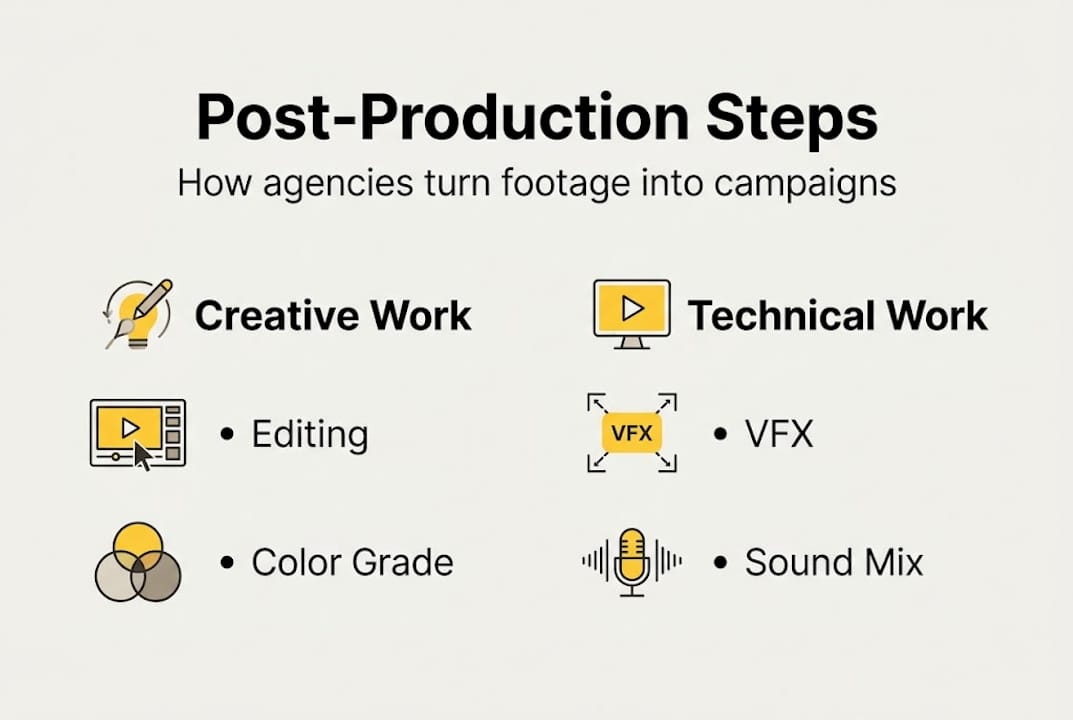
Post-production is the phase where raw creative material becomes a finished, audience-ready campaign asset. It covers a wide range of disciplines working in concert: editing shapes the narrative arc, color correction and color grading establish mood and brand consistency, visual effects (VFX) add elements that were never captured on set, motion graphics communicate information with clarity and style, and sound design ties the emotional experience together. Each of these functions is a craft in its own right, and the quality of each directly affects how your audience feels about the brand.
For ad agencies, this phase is where storytelling either lands or falls flat. A beautifully shot product film can feel cold and forgettable without the right grade. A lifestyle campaign can lose its emotional thread if the edit does not pace the viewer’s attention correctly. Professional visual post production is not a support function; it is a creative discipline that shapes how viewers interpret and remember a brand.
The core capabilities post-production brings to an agency’s work include:
-
Editing and narrative structure: Sequencing footage to guide viewer emotion and attention
-
Color grading: Establishing a visual language that aligns with brand identity
-
VFX and compositing: Creating environments, product interactions, or effects impossible to shoot practically
-
Motion graphics and typography: Communicating key messages with visual clarity
-
Sound design and audio mixing: Reinforcing mood and brand voice at every frame
Ad agencies use post-production to transform raw footage into polished, visually compelling campaigns that enhance storytelling and audience engagement.
When these capabilities are applied with intention, the result is not just a cleaner video. It is a campaign that earns attention in a crowded feed, communicates brand values without a single word of copy, and gives your client something they are genuinely proud to put their name on.
Key benefits for agencies: Speed, scale, and better results
The strategic case for investing in post-production goes well beyond aesthetics. Agencies that treat post as a serious discipline, whether in-house or through a trusted external partner, consistently deliver faster, at higher quality, and with fewer costly revisions. Those that treat it as an afterthought tend to discover the problem only after a client has already seen the rough cut.

Post-production provides specialized expertise, time efficiency, cost savings, and scalability for agencies without large in-house teams. Here is how that plays out in practice:
| Factor | In-house team | Outsourced partner |
|---|---|---|
| Upfront cost | High (salaries, software, hardware) | Project-based or retainer |
| Speed to delivery | Slower ramp-up, faster iteration over time | Fast mobilization, specialized workflows |
| Flexibility | Fixed capacity | Scales with campaign volume |
| Specialist access | Limited to hired roles | Access to VFX, 3D, CGI on demand |
| Creative range | Consistent but narrow | Broader capability per project |
For most mid-size agencies managing multiple campaigns simultaneously, outsourcing post-production to a specialized studio offers a clear advantage. You get access to artists who work at a high level every day, not generalists splitting time across departments.
Beyond the numbers, there is a creative benefit that often goes unspoken. When your account and strategy teams are not managing render queues or chasing file formats, they focus on what they do best: building client relationships and developing stronger briefs.
Common pitfalls when post-production is neglected include rushed color work that creates brand inconsistency across deliverables, mismatched audio that undermines emotional impact, and VFX that look unfinished because they were scoped too late in the process.
Pro Tip: If your agency runs fewer than four major video campaigns per year, outsourcing post-production is almost always more cost-effective than maintaining a full in-house team. Use retouching services for agencies to fill capability gaps without the overhead.
Process breakdown: From raw footage to final cut
Understanding the post-production process helps agency leaders set realistic timelines, write better briefs, and manage client expectations with confidence. The workflow is sequential, and each phase depends on the one before it being done correctly.
-
Offline editing: The editor assembles a rough cut from all available footage, establishing the story structure and pacing. This is where the narrative backbone is built.
-
Client review and creative approvals: The agency and client review the rough cut together. Changes at this stage are far less expensive than changes made after color and VFX work has begun.
-
Color correction: Technical color issues are resolved, ensuring consistency across all shots regardless of lighting conditions during the shoot.
-
Color grading: The colorist applies a creative look that supports the campaign’s emotional tone and aligns with brand guidelines.
-
VFX and compositing: Visual effects, product CGI, and composite elements are integrated into the edit.
-
Motion graphics: Titles, lower thirds, end cards, and any animated brand elements are added.
-
Sound design and audio mix: Music, sound effects, and voiceover are balanced and finalized.
-
Quality control and delivery: The final master is reviewed against technical specs for each platform, then exported in the required formats.
Creative approvals at the edit stage are the single most important checkpoint in the entire post-production process. Decisions made late cost time and budget that cannot be recovered.
Post-production includes editing, color correction, VFX, motion graphics, sound design, and each of these phases requires a clear handoff between the agency and the vendor. The agencies that run the smoothest post processes are the ones that treat their post-production partners as collaborators from the brief stage, not contractors who receive a hard drive on day thirty.
Rushing any phase, particularly color or VFX, introduces errors that compound downstream. A grade applied before the edit is locked, for example, means that grade work is often discarded entirely when the cut changes.
Modern challenges: Finding the right balance in a fast-changing landscape
Post-production strategy is under real pressure right now, and not just from client budget constraints. The tools are changing faster than most agency workflows can absorb, and the debate about what good production actually requires has become genuinely contentious.
Traditional agency production processes are increasingly criticized as slow, bloated, and expensive, with calls for curation over bureaucracy and taste over excessive craft layers. That critique has merit. Triple-bid processes, multi-round approval chains, and over-engineered production schedules often add cost without adding creative value.
| Dimension | Traditional workflow | Modern workflow |
|---|---|---|
| Speed | Weeks per deliverable | Days with streamlined tools |
| Cost | High fixed overhead | Flexible, project-scaled |
| Creative control | Agency-driven, committee-reviewed | Collaborative, vendor-empowered |
| AI integration | Minimal | Growing, hybrid approach |
AI is now a real factor in post-production, and it is worth being direct about what it does and does not do well. AI tools accelerate tasks like rotoscoping, background removal, noise reduction, and even preliminary color matching. They reduce the time artists spend on repetitive technical work, which is genuinely valuable.
However, AI accelerates post but human oversight ensures authenticity and taste. Over-reliance risks generic output that lacks emotional truth. That is not a warning to avoid AI. It is a reminder that AI is a production tool, not a creative director.
To maintain quality while adopting new tools, agencies should:
-
Assign a senior creative to review all AI-assisted outputs before client delivery
-
Use AI for technical acceleration, not creative decision-making
-
Maintain clear brand guidelines that AI tools are calibrated against
-
Treat AI outputs as drafts, not finals
Pro Tip: The agencies seeing the best results with AI in post are using it to give their artists more time for judgment calls, not to replace those calls. Review agency production best practices to understand how to integrate new tools without sacrificing the creative quality your clients expect.
A fresh perspective: Less process, more impact
After more than two decades working with agencies across technology and automotive campaigns, we have seen a consistent pattern: the projects that produce the strongest creative work are rarely the ones with the most elaborate production processes. They are the ones where the agency trusted the vendor early, communicated clearly, and resisted the urge to manage every micro-decision by committee.
The triple-bid model and multi-layer approval structures were designed for a different era of production, one where mistakes were expensive and irreversible. Today, with iterative digital workflows, the cost of trying something and adjusting it is far lower than the cost of debating it endlessly before anyone touches a frame.
What we advocate for, based on real post-production experience, is a simpler model: a strong brief, a trusted partner, fast feedback loops, and the creative confidence to make decisions. Emotional connection in advertising rarely comes from perfect craft. It comes from clarity of intent and the courage to commit to a point of view. Less process, more impact.
Unlock better campaign outcomes with expert post-production
The insights in this article point to one practical conclusion: post-production is not a line item to minimize. It is a strategic investment that determines whether a campaign resonates or just runs.

At 35milimetre, we work directly with ad agencies to deliver visual post production services that range from compositing and color grading to CGI and AI-enhanced imagery. Our team brings over twenty years of hands-on experience to every project, with the flexibility to scale for campaigns of any size. If you are looking for a post-production partner who treats your creative brief as seriously as you do, we would be glad to talk through what that looks like for your next campaign.
Frequently asked questions
What are the main steps of post-production in advertising?
Post-production steps include editing, color correction, visual effects, motion graphics, and sound design, applied in sequence to transform raw footage into a finished campaign asset.
Why do agencies outsource post-production instead of keeping it in-house?
Outsourcing gives agencies access to specialized talent and scalability without the fixed overhead of a full in-house team, which is especially valuable when managing multiple campaigns at once.
How does AI impact post-production for ad agencies?
AI speeds up technical tasks like rotoscoping and noise reduction, but human oversight remains essential to preserve the creative judgment and emotional authenticity that make campaigns effective.
What risks do agencies face if they skip or rush post-production?
Rushing post-production leads to brand inconsistency, weak emotional impact, and deliverables that fail to engage audiences the way a properly finished campaign would.
