
How 3D Artists Elevate Advertising: Visual Impact & Innovation
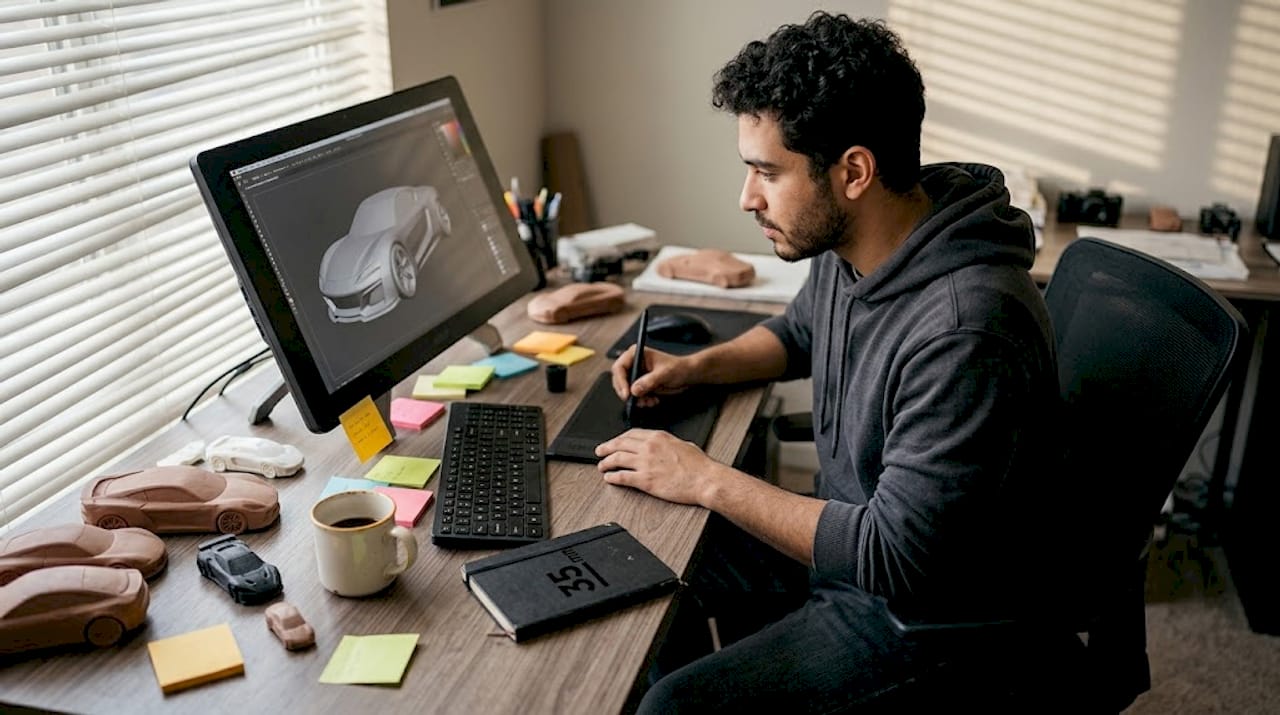
Most iconic car and tech ads you see today were never filmed on a physical set. The gleaming vehicle rotating in perfect light, the smartphone dissolving into its components, the immersive virtual showroom — these are the work of 3D artists whose contribution is rarely credited but almost always essential. Yet most marketing teams still treat 3D as a finishing step rather than a strategic creative force. That’s a missed opportunity. This article breaks down exactly what 3D artists do, how their work compares to traditional production, and how you can integrate them earlier and smarter into your ad campaigns.
Table of Contents
- What 3D artists actually do in advertising
- 3D artistry versus traditional production methods
- Integrating 3D artists into your ad campaign workflow
- Emerging trends for 3D artistry in advertising
- A fresh perspective: The hidden creative edge of 3D artists in advertising
- Next steps: Unlock world-class 3D for your ads
- Frequently asked questions
Key Takeaways
| Point | Details |
|---|---|
| Essential campaign roles | 3D artists handle everything from digital modeling to rendering and play a vital part in modern ad production. |
| Superior to traditional methods | 3D artistry delivers flexible, cost-effective, and visually stunning outcomes that often surpass conventional production. |
| Strategic campaign integration | Early involvement of 3D artists improves results by enabling collaboration and agility across the campaign lifecycle. |
| Enabling AR/VR innovation | 3D artists unlock advanced, immersive experiences crucial for tech and automotive advertising. |
| Creative advantage | The real value of 3D artists lies in their ability to spark innovation and rapid iteration for unique ad campaigns. |
What 3D artists actually do in advertising
The title “3D artist” covers a surprisingly wide range of skills, and understanding that range is the first step toward using these professionals effectively. At the core, their work spans modeling, texturing, lighting, rendering, and pipeline integration, each of which is a discipline in its own right.
Modeling is the process of building digital objects from scratch, whether that’s a car chassis, a smartphone, a retail environment, or a human character. Texturing adds surface detail, making a metal panel look brushed or a plastic casing look matte. Lighting is where mood and realism converge, shaping how a product feels as much as how it looks. Rendering is the final computation that produces the finished image or animation. And pipeline integration means the 3D artist works within your production schedule, handing off assets to compositors, motion designers, and editors without breaking the workflow.
According to a detailed 3D Artist Job Description, key responsibilities include modeling, texturing, lighting, rendering, optimization for AR/VR and web, and working within production pipelines to meet deadlines. That last point matters more than most clients realize. A 3D artist who can’t integrate smoothly into a fast-moving campaign timeline creates bottlenecks, no matter how talented they are technically.
The types of assets 3D artists produce for advertising are broad. In the automotive sector, they build photorealistic vehicle models that can be placed in any environment, lit any way, and revised without a reshoot. In tech advertising, they create exploded product views, animated UI overlays, and futuristic environments that would be physically impossible to capture on camera. For both sectors, they also build virtual showrooms and experiential environments that serve AR and VR campaigns.
| Asset type | Common use case | Sector |
|---|---|---|
| Vehicle model | Launch campaign, configurator | Automotive |
| Product render | Hero shot, e-commerce | Technology |
| Virtual environment | AR/VR experience, showroom | Both |
| Character/avatar | Brand mascot, interactive ad | Both |
| UI/UX animation | App demo, product explainer | Technology |
Consider a real-world example: a global automaker launching a new EV model. Instead of shipping physical cars to multiple locations for regional shoots, the production team builds one photorealistic 3D model and places it in dozens of environments, from city streets to mountain roads, all without leaving the studio. The savings in logistics alone are significant, but the creative control gained is even more valuable.
Pro Tip: Bring your 3D artist into the concept phase, not just the execution phase. Early involvement means they can flag technical constraints before they become expensive problems and suggest visual ideas that only work in the 3D space. Pair them with your creative director early, and you’ll see the ideas get sharper.
For a broader view of how visual post production roles support campaign production, it helps to see 3D artistry as one layer within a larger visual system, not a standalone service.
3D artistry versus traditional production methods
Now that you know what 3D artists can do, it’s essential to see how their craft stacks up against more traditional ad production. The comparison isn’t about which method is better in absolute terms. It’s about knowing when each approach serves your campaign goals.
Live-action production offers authenticity and emotional warmth that resonates with audiences. But it comes with hard constraints: physical locations, weather, talent availability, and the cost of reshoots when a brief changes after the camera rolls. 2D illustration and motion graphics are faster and more affordable but lack the depth and photorealism that premium tech and auto brands require.
3D production sits in a different category entirely. Once a model or environment is built, it can be relit, repositioned, recolored, and repurposed without additional cost. A single vehicle model can generate hundreds of distinct campaign assets. That flexibility is not just a production convenience — it’s a strategic asset.
“The ability to optimize assets for AR/VR and web-based delivery means 3D artists can support a campaign across every channel simultaneously, from a 30-second broadcast spot to an interactive mobile experience.”
Here’s how the three approaches compare across the dimensions that matter most to marketing executives:
| Factor | Live-action | 2D/motion graphics | 3D production |
|---|---|---|---|
| Upfront cost | High | Low to medium | Medium to high |
| Revision flexibility | Low | Medium | Very high |
| Photorealism | High | Low | Very high |
| AR/VR compatibility | Limited | Limited | Native |
| Speed of iteration | Slow | Medium | Fast |
| Asset reusability | Low | Medium | Very high |
For automotive and technology brands, the AR/VR compatibility row is increasingly decisive. Optimization for AR/VR and web allows 3D artists to deliver assets for a range of digital experiences, meaning a single production run can feed a broadcast ad, a social campaign, a dealer configurator, and an AR showroom app. No live-action shoot can do that.
There are also scenarios where 3D is the only practical option. Advertising a product that doesn’t physically exist yet, showing internal components that can’t be filmed, or creating a visual environment that would cost millions to build on set — these are all cases where 3D isn’t just preferable, it’s the only viable path.
Integrating 3D artists into your ad campaign workflow
Understanding the unique strengths of 3D over traditional methods, let’s look at how to incorporate these artists into your ad campaigns in a way that actually works. The biggest mistake agencies and brands make is treating 3D as a service you order at the end of a project, like color grading or final audio mix. That approach limits what 3D can contribute.
The most effective workflow involves 3D artists from the earliest creative conversations. Here’s a practical sequence that works well for tech and auto campaigns:
- Concept alignment. Share mood boards, reference imagery, and campaign objectives before any production begins. Let the 3D artist respond with what’s technically feasible and what visual opportunities exist that you may not have considered.
- Asset scoping. Define exactly which assets need to be built, in what formats, and for which channels. A car model built for a broadcast ad may need different polygon counts and file formats than the same model used in a web AR experience.
- Feedback loops. Establish clear review milestones: a gray model review, a textured review, a lit preview, and a final render approval. Each stage should have a defined decision-maker and a fixed turnaround time.
- Delivery and handoff. Agree upfront on file formats, naming conventions, and version control. A 3D artist who works within production pipelines and meets deadlines is a production asset, not just a creative one.
Pro Tip: Define your deliverables in writing before production begins. Vague briefs produce vague results. Specify resolution, file format, number of render variations, and revision rounds. This protects both sides and keeps the project moving.
Rigid workflows that treat 3D artists as order-takers rather than collaborators consistently underperform. The studios and agencies that get the best results are those that build cross-discipline teams where the 3D artist sits alongside the art director, not downstream from them. Whether you’re working with an in-house team or a specialist production pipeline partner, that structural decision shapes everything.
Common pitfalls to avoid include late-stage brief changes without timeline adjustments, unclear asset ownership across teams, and failing to account for render time in the production schedule. Rendering complex scenes can take hours or days depending on complexity, and that time needs to be built into the calendar, not squeezed out of it.
Emerging trends for 3D artistry in advertising
As you sharpen your approach to integrating 3D, it’s critical to anticipate where the field is heading. The trends shaping 3D artistry in advertising right now are not incremental. They represent a fundamental shift in how brands communicate with audiences.
The growth of AR and VR in automotive and technology advertising is the most significant shift. Virtual dealerships allow customers to configure and experience a vehicle in their own driveway before it exists in physical inventory. Tech brands are using immersive product launches where audiences interact with a device in 3D space before it ships. These experiences require assets optimized for AR/VR and web-based delivery, which is a core 3D artist competency.
Real-time rendering is another major development. Traditionally, photorealistic 3D images required long render times. Real-time engines like Unreal Engine now allow near-instant visual feedback and dynamic scene changes, enabling campaigns to adapt visuals on the fly based on audience data, location, or time of day.
| Trend | Impact on advertising | Relevant sector |
|---|---|---|
| AR/VR experiences | Immersive product interaction | Automotive, technology |
| Real-time rendering | Dynamic, personalized visuals | Both |
| AI-assisted 3D | Faster asset creation | Both |
| Localized 3D assets | Region-specific campaign variants | Both |
| Virtual influencers | Always-on brand characters | Technology |
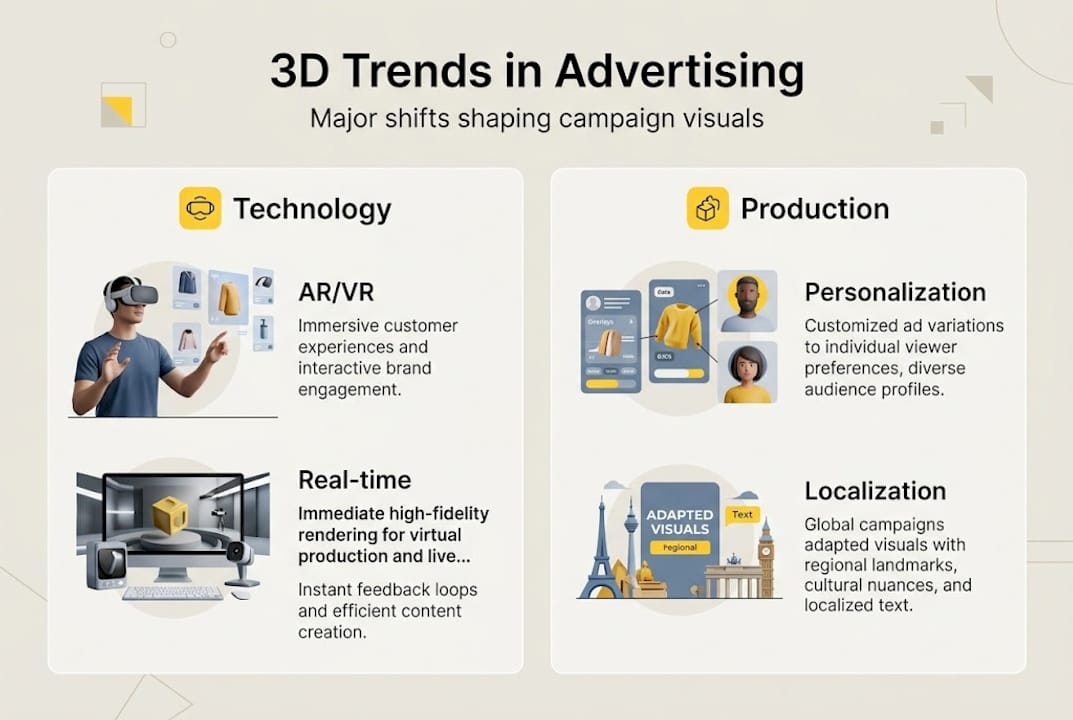
Personalization is also driving demand for localized 3D assets. A global tech brand can now produce one master 3D scene and then generate hundreds of regional variants, swapping backgrounds, text, and color schemes without rebuilding the core asset. This kind of scalable visual production was impractical five years ago.
The studios and agencies that are investing in these capabilities now are building a competitive advantage that will be very difficult to close later. The brands that treat 3D as a cost center rather than a growth tool will find themselves producing static imagery while their competitors are running fully interactive, personalized visual campaigns.
A fresh perspective: The hidden creative edge of 3D artists in advertising
The technical case for 3D artistry is clear. But there’s a more important conversation that rarely happens in agency briefing rooms. Most teams think of 3D artists as technical executors, people who build what the creative director imagines. That framing is limiting, and frankly, it wastes talent.
In our experience working on high-end campaigns for technology and automotive brands, the most surprising creative breakthroughs have come when 3D artists were part of the ideation process, not just the production process. They see visual possibilities that don’t exist in the physical world, and they know exactly how to make them feel real. That’s a rare combination.
The agencies that consistently produce industry-leading campaigns bring 3D in at the idea stage. Not to validate whether something is buildable, but to ask what’s possible. The answer is almost always more interesting than what the brief originally described. Explore 3D rendering insights and you’ll see how that creative partnership plays out in practice. Rethinking the 3D artist’s role from service vendor to core creative is one of the highest-leverage decisions a marketing executive can make.
Next steps: Unlock world-class 3D for your ads
If the ideas in this article have you rethinking how your team approaches visual production, the next step is straightforward. At 35milimetre, we’ve spent over two decades building high-end visuals for technology and automotive brands, and we know what it takes to translate a creative brief into imagery that genuinely stops people mid-scroll.
Our team works as a true creative partner, not just a production vendor. Whether you need photorealistic product renders, immersive 3D environments, or assets optimized for AR campaigns, we bring the same level of craft and strategic thinking to every project. If you’re ready to see what’s possible, we’d welcome the chance to walk you through our work. Connect with our visual post production agency team and let’s start with your next campaign.
Frequently asked questions
What specific tasks do 3D artists handle in advertising campaigns?
3D artists model, texture, light, and render digital assets for ads, and they optimize those assets for AR/VR and web delivery to ensure both visual impact and technical performance across every channel.
How do 3D artists improve ad campaign effectiveness?
They enable dynamic visuals, faster iteration, and immersive experiences like AR/VR, and assets optimized for digital delivery often reduce costs significantly compared to repeated live-action shoots.
At what stage should 3D artists be involved in the ad creation process?
For best results, involve 3D artists during concept development, not just execution, so their technical knowledge and creative input shape the campaign from the start.
What industries benefit most from 3D artistry in advertising?
Technology and automotive sectors use 3D art most heavily, leveraging it for photorealistic product visualization, virtual environments, interactive configurators, and immersive AR/VR ad experiences.
What makes 3D artistry critical for AR/VR advertisements?
3D artists optimize assets for AR/VR and web-based delivery, ensuring visuals are both realistic and technically efficient enough to run seamlessly across interactive platforms and devices.
