
Visual content trends for campaign success in 2026

Visual content now carries more weight than ever in determining whether a campaign breaks through or disappears into the feed. 94% more views go to visual content compared to text-based posts, and roughly 90% of all information the brain processes is visual. Yet the biggest shift in 2026 is not about producing more visuals. It is about producing the right kind. The assumption that flawless, AI-generated imagery automatically wins audience trust is being overturned by data, and the brands adapting fastest are the ones reshaping their creative strategies around authenticity, sensory engagement, and smart use of technology. This guide maps the key trends and gives you a practical framework to apply them.
Table of Contents
- The authenticity revolution: Imperfection as a trust signal
- Earthy tech and aesthetic shifts in technology and automotive
- Multi-sensory engagement: Beyond static images to dynamic video and interactive content
- AI, modularity, and the risks of sameness: Scaling creativity in 2026
- From trends to campaigns: Practical frameworks for 2026 success
- Our perspective: Break the sameness barrier with authentic emotion
- Unlock your next-level campaigns with our visual experts
- Frequently asked questions
Key Takeaways
| Point | Details |
|---|---|
| Embrace authenticity | Real, unposed visuals and imperfection increase trust and effectiveness in campaigns. |
| Adopt earthy aesthetics | Muted, organic color palettes are critical for engaging tech and automotive audiences in 2026. |
| Prioritize dynamic media | Video and interactive formats greatly outperform static images for audience engagement. |
| Use AI with purpose | Let AI accelerate creativity but avoid generic sameness by infusing unique perspectives. |
| Apply trend frameworks | Translate emerging trends into actionable steps for campaign planning and measurable results. |
The authenticity revolution: Imperfection as a trust signal
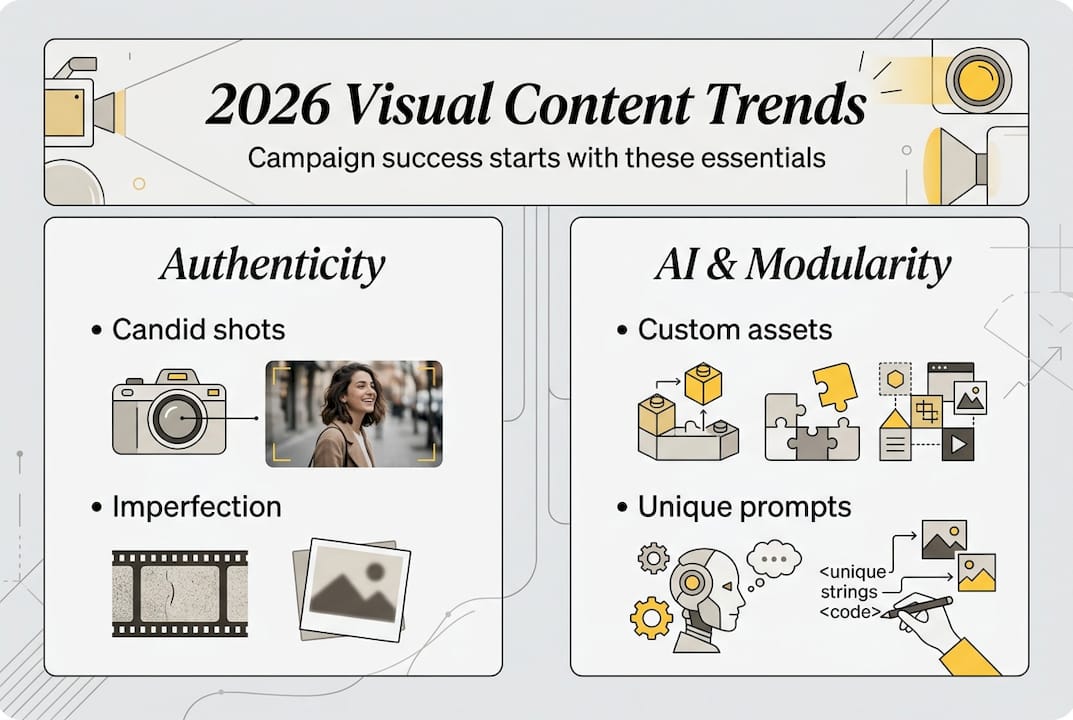
For years, the creative brief for most technology and automotive campaigns pointed in one direction: polished, precise, and pixel-perfect. The logic made sense. Premium brands needed premium visuals. But something has shifted at the audience level. Consumers have grown so accustomed to flawlessly retouched imagery and AI-generated composites that the very perfection of an image now triggers skepticism rather than admiration.
The Visual Trends 2026 Search Data Report confirms this directly, noting a clear shift from AI-perfect “optimal” visuals to human-centric “authentic” aesthetics, where imperfection functions as a trust signal. This is not a fringe preference. It reflects a broader cultural recalibration around what feels real versus what feels manufactured.
“Audiences are not looking for the most technically impressive image. They are looking for the one that feels honest.”
What does this mean practically? It means consumer trust studies now show measurable lifts in brand affinity when campaigns include unposed, situational imagery, such as a technician actually using a device, or a driver caught mid-expression on a test track, rather than a staged hero shot. The image does not need to be imperfect for its own sake. It needs to feel like it was captured rather than constructed.
The most effective authentic visuals we are seeing right now include candid behind-the-scenes moments from production or R&D environments, real customer interactions with products in natural settings, and photography that embraces natural lighting variations and environmental context. Common pitfalls include forcing “authentic” aesthetics onto obviously staged scenarios, using stock imagery that mimics candidness without genuine context, and over-filtering images that were originally raw and compelling.
For visual post production trends, this shift means the retouching brief itself is changing. The goal is no longer to remove every imperfection but to preserve the ones that communicate humanity.
Pro Tip: Always disclose AI involvement in your visual content when applicable. Transparency is not a weakness. It is a credibility signal, and audiences increasingly reward brands that are upfront about their creative process.
Earthy tech and aesthetic shifts in technology and automotive
Authenticity is not just about subject matter. It is evolving how entire industries present themselves visually, right down to the color palettes they choose.
The rise of “Earthy Tech” describes a move toward muted, organic color palettes for technology visuals, specifically designed to humanize digital interfaces and reduce what researchers are calling digital anxiety. Think warm terracottas alongside matte aluminum, or moss greens paired with soft white product surfaces. These are not accidental aesthetic choices. They are strategic responses to audiences who feel overwhelmed by the cold, saturated blues and high-contrast gradients that defined the previous decade of tech branding.

For automotive campaigns, the design language is evolving in parallel. 2026 automobile design trends point to aerodynamic slippery exteriors, skateboard EV architecture, pillar-to-pillar digital dashboards, sustainable interior materials, and illuminated grilles as the defining visual signatures of the moment. Campaigns that ignore these design realities and rely on older visual templates risk looking out of step with the very vehicles they are promoting.
| Visual element | Traditional digital approach | Earthy tech approach |
|---|---|---|
| Color palette | Saturated blues, high contrast | Muted terracottas, warm neutrals |
| Surface texture | Glossy, reflective finishes | Matte, tactile, organic materials |
| Lighting style | Studio-perfect, artificial | Diffused, natural, ambient |
| Human presence | Minimal or absent | Central, candid, relatable |
| Background | Abstract, digital environments | Real-world, contextual settings |
For technology brands, the earthy tech palette increases campaign dwell time because it reduces visual fatigue. Audiences linger longer on imagery that does not demand intense visual processing. For automotive brands, integrating human-centric imagery trends means placing real people inside these beautifully designed vehicles in environments that feel lived-in rather than rendered. The car becomes part of a life, not an object on a pedestal.
A quick checklist for automotive campaign teams: confirm that your hero shots reflect current exterior design language, include at least one people-centered scene per campaign set, and audit your color grading pipeline to ensure it supports warm, organic tones rather than defaulting to cool, high-contrast presets.
Multi-sensory engagement: Beyond static images to dynamic video and interactive content
Visual tone and palette set the mood, but the mechanics of engagement are rapidly changing too.
Short-form vertical video now dominates with over $111 billion in annual ad spend, and motion-first, multi-sensory branding has shifted from a nice-to-have to a campaign essential. Video already accounts for 82% of internet traffic, and brands that lead with visual content generate three times more leads than those relying on text-heavy formats.
| Format | Engagement lift vs. static image | Best platform fit |
|---|---|---|
| Short-form vertical video | Up to 60% higher | Instagram Reels, TikTok, YouTube Shorts |
| Carousel posts | 2.5x higher on LinkedIn | LinkedIn, Instagram |
| Interactive AR content | Significant session time increase | Snapchat, Meta, brand apps |
| Long-form video | Strong for consideration stage | YouTube, brand websites |
The implication for technology and automotive campaigns is significant. A single static render of a new device or vehicle, however beautifully composited, is no longer doing the full job. Audiences expect to see the product in motion, ideally in a context that activates more than one sense. Sound design layered over a product reveal, haptic-responsive mobile ads, and 360-degree interactive walkthroughs are all part of the multi-sensory toolkit that high-performing campaigns are now deploying.
Here is a practical sequence for integrating multi-sensory elements into your next campaign. First, map the emotional journey you want the audience to experience, not just the product features you want to showcase. Second, identify which sensory layers (motion, sound, interactivity) are available within your platform mix. Third, produce a motion-first hero asset and adapt it into static derivatives, not the other way around. Fourth, test carousel formats for storytelling sequences where a single image cannot carry the full narrative. Fifth, measure dwell time and completion rates alongside click-through to get a complete picture of sensory engagement.
AI, modularity, and the risks of sameness: Scaling creativity in 2026
With high engagement expected across platforms, brands need sustainable strategies for creative production at scale. AI is now central to that conversation, but not in the way many assumed it would be.
58% of creatives report that AI speeds up their work, and the role of AI has evolved from a simple assistant to a genuine creative collaborator, enabling personalization at a scale that was previously impossible. A campaign that once required 40 individual asset variations can now be templated and adapted dynamically. That is a real operational advantage.
But the risk is equally real. When every brand in a category uses the same generative AI tools with similar prompts and similar training data, the output starts to converge. Campaigns begin to look like each other. The Adobe 2026 Creative Trends research points to this homogenization as one of the defining creative challenges of the moment. The brands that will stand out are the ones that use AI to amplify a distinctive creative voice rather than to generate one from scratch.
Key strategies for keeping content unique within AI-assisted production include anchoring every campaign in a human creative brief that reflects genuine brand personality before AI tools enter the workflow. You should also use AI for adaptation and variation rather than origination, building modular creative systems where core visual elements remain brand-specific while formats flex across platforms.
Pro Tip: A modular creative system means designing your campaign around a core set of brand-specific visual assets, such as a signature color grade, a recurring compositional approach, or a distinctive lighting style, and then using AI to scale those assets across formats and platforms. The brand identity stays intact. The production efficiency increases.
From trends to campaigns: Practical frameworks for 2026 success
To bring these concepts together, let us construct a practical road map for success.
The Adobe 2026 Creative Trends Report identifies four key themes shaping creative direction: All the Feels (emotional resonance), Connectioneering (community and co-creation), Surreal Silliness (unexpected humor and absurdism), and Local Flavor (cultural specificity). Each of these maps directly onto the authenticity and sensory engagement trends we have covered.
Here is a numbered framework for applying these insights in your campaign planning. First, audit your current visual library against the 2026 trends. Identify which assets feel dated, over-polished, or tonally misaligned. Second, define your brand’s authentic visual signature, the specific combination of palette, texture, lighting, and human presence that is distinctly yours. Third, build a motion-first production pipeline, even if your primary deliverables are static. The discipline of thinking in motion improves static work. Fourth, integrate AI tools at the adaptation stage, not the ideation stage, to preserve creative originality. Fifth, measure emotional engagement metrics alongside conversion data to understand whether your visuals are building the brand equity that sustains long-term campaign performance.
| Trend | Campaign action | Key metric |
|---|---|---|
| Authenticity and imperfection | Include candid, unposed imagery | Brand trust surveys, sentiment analysis |
| Earthy tech palettes | Update color grading presets | Dwell time, recall scores |
| Multi-sensory video | Lead with short-form vertical video | Completion rate, engagement rate |
| AI and modularity | Build modular asset systems | Production efficiency, variation coverage |
For creative campaign execution, the most important shift is treating visual content as a strategic system rather than a series of individual deliverables.
Our perspective: Break the sameness barrier with authentic emotion
After more than two decades of working on visual campaigns for technology and automotive brands, we have noticed a consistent pattern. The campaigns that generate lasting impact are almost never the ones with the highest production budgets or the most technically impressive compositing. They are the ones where the creative team made a deliberate choice to communicate something true.
The current AI moment is genuinely exciting. The tools available now would have seemed implausible even five years ago. But we see a real risk in the industry’s rush toward generative efficiency. When the brief becomes “produce more, faster,” the creative instinct to ask “what does this audience actually feel?” gets squeezed out. Brand identity does not erode overnight. It erodes one AI-generated asset at a time.
Our advice, grounded in real campaign experience: use technology to amplify your human creative vision, not to substitute for it. The media innovation insights that matter most in 2026 are not about which tools you use. They are about whether your audience recognizes something genuine in what you show them. That recognition is what builds brands.
Unlock your next-level campaigns with our visual experts
Ready to put visual content trends into practice? Here is how expert support can transform your next campaign.
At 35milimetre, we work directly with creative directors and marketing teams at technology and automotive brands to translate trend intelligence into production-ready visuals. Whether you need compositing, color grading, CGI, or AI-enhanced imagery built around an authentic creative brief, our post production agency services are structured to deliver at the level your campaigns demand. We also offer AI-powered visual solutions that keep your brand identity at the center of every output. Let us help you build visuals that do not just follow trends but define them.
Frequently asked questions
Why are authentic, unpolished visuals more effective in 2026 campaigns?
Audiences have developed a strong sensitivity to over-produced imagery, and brands that show authentic human aesthetics build measurably more trust than those relying on AI-perfect visuals. Realism, even with its imperfections, signals honesty in a way that flawless composites no longer can.
How is AI changing visual content creation for tech and automotive brands?
AI now functions as a creative collaborator rather than just a production tool, and 58% of creatives confirm it accelerates their workflow significantly. The key is using AI to scale a distinctive brand voice rather than letting it generate one from scratch.
What visual formats are currently driving the highest engagement rates?
Short-form vertical video commands the largest share of ad spend and delivers up to 60% higher engagement than static formats, while carousel posts generate 2.5 times more engagement on LinkedIn. Both formats reward brands that lead with motion and storytelling.
What’s the role of color palettes like ‘earthy tech’ in 2026 brand campaigns?
Muted, organic palettes reduce digital fatigue and make technology and automotive visuals feel more approachable, which is exactly why the earthy tech trend is gaining traction across both sectors. Warmer, textured color systems increase dwell time by lowering the visual processing load on audiences.
How can brands guard against visual content ‘sameness’ with AI?
The most effective defense is building a modular creative system anchored in brand-specific visual signatures before AI tools enter the workflow, since 44% of brands using generative AI risk producing indistinguishable content. Disclosing AI use also protects trust, as undisclosed AI can trigger a 15 to 20% drop in audience confidence.
