
Visual content creation guide: boost engagement and brand impact

Marketing teams that rely on text-heavy campaigns are quietly losing ground to competitors who let visuals do the heavy lifting. Visual content drives dramatically higher engagement and ROI than text-based content alone, and the gap is only widening. Whether you are running paid social for a tech brand, building a startup’s identity from scratch, or managing creative output for a busy ad agency, the quality and strategy behind your visual content will define your results. This guide walks you through the business case, the content types, the creation workflow, and the measurement frameworks that separate forgettable campaigns from ones that actually move the needle.
Table of Contents
- Why visual content dominates modern marketing
- Essential types of visual content and when to use them
- Step-by-step workflow for effective visual content creation
- Troubleshooting common challenges and maximizing impact
- Measuring success: KPIs, trends, and continuous improvement
- Our perspective: Blending AI and authenticity for visual content that works
- Get expert help for next-level visual content
- Frequently asked questions
Key Takeaways
| Point | Details |
|---|---|
| Visuals drive ROI | Image, video, and interactive content consistently outperform text in marketing engagement and revenue. |
| Mix formats strategically | Use a blend of images, infographics, and short-form video to reach your audience at every stage of their journey. |
| Optimize and measure | Tailor visual assets for each channel, run regular tests, and track real KPIs for continuous campaign improvement. |
| Balance AI with authenticity | AI tools can scale your content, but always include human creativity to build trust and emotional impact. |
Why visual content dominates modern marketing
The numbers behind visual content are not subtle. Visual content gets 94% more views than text-only content, posts with images produce 650% higher engagement on Facebook, video marketers achieve 66% more qualified leads, and brands with strong visual strategies grow revenue 2.9x faster than those without. These are not marginal gains. They represent a fundamental shift in how audiences process and respond to information online.
The shift toward visual-first marketing happened for a reason rooted in human psychology. People process images roughly 60,000 times faster than text, which means your audience forms an impression of your brand before they read a single word. In a feed environment where attention is measured in fractions of a second, that processing speed is everything. A well-composed image or a three-second video clip can communicate brand values, product quality, and emotional tone instantly, while a paragraph of copy cannot.
“Brands that invest in consistent, high-quality visual content do not just get more clicks. They build the kind of trust that converts browsers into buyers and buyers into advocates.” This is the core business case for professional visual content production.
The HubSpot marketing data reinforces this consistently: visual content outperforms text across virtually every digital channel, from organic social to paid display to email. The implication for marketing professionals is clear. Visual content is no longer a nice-to-have layer on top of your strategy. It is the strategy.
| Content type | Engagement lift vs. text | Lead generation impact |
|---|---|---|
| Static images | Up to 650% higher | Moderate |
| Short-form video | Up to 1200% more shares | High (66% more leads) |
| Infographics | 3x more social shares | Moderate to high |
| Interactive visuals | 2x longer page dwell time | High |
The table above illustrates why mixing formats is not optional for serious marketers. Each format serves a different function in the attention economy, and the brands winning right now are the ones treating visual content as a core production discipline rather than an afterthought.
Essential types of visual content and when to use them
Not all visual content is created equal, and choosing the wrong format for the wrong moment in the buyer journey is one of the most common and costly mistakes marketing teams make. Understanding the strategic role of each format is what separates a scattered content calendar from a focused, funnel-aware visual strategy.
Static images and graphics are the workhorses of visual marketing. They are fast to produce, easy to optimize for any platform, and highly effective at the awareness and consideration stages. A well-retouched product image or a bold branded graphic can stop a scroll just as effectively as video, especially on platforms like Instagram and Pinterest where image quality is a direct signal of brand credibility. For retouching for visual content that meets platform standards, the investment pays off in both engagement and brand perception.
Infographics excel at turning complex data or multi-step processes into something a viewer can absorb in under thirty seconds. They are particularly effective for B2B content, where your audience wants substance but does not have time to read a white paper. Short-form video, which now dominates TikTok, Instagram Reels, and YouTube Shorts, is the highest-engagement format at the awareness stage and increasingly effective for direct conversion when paired with strong creative.
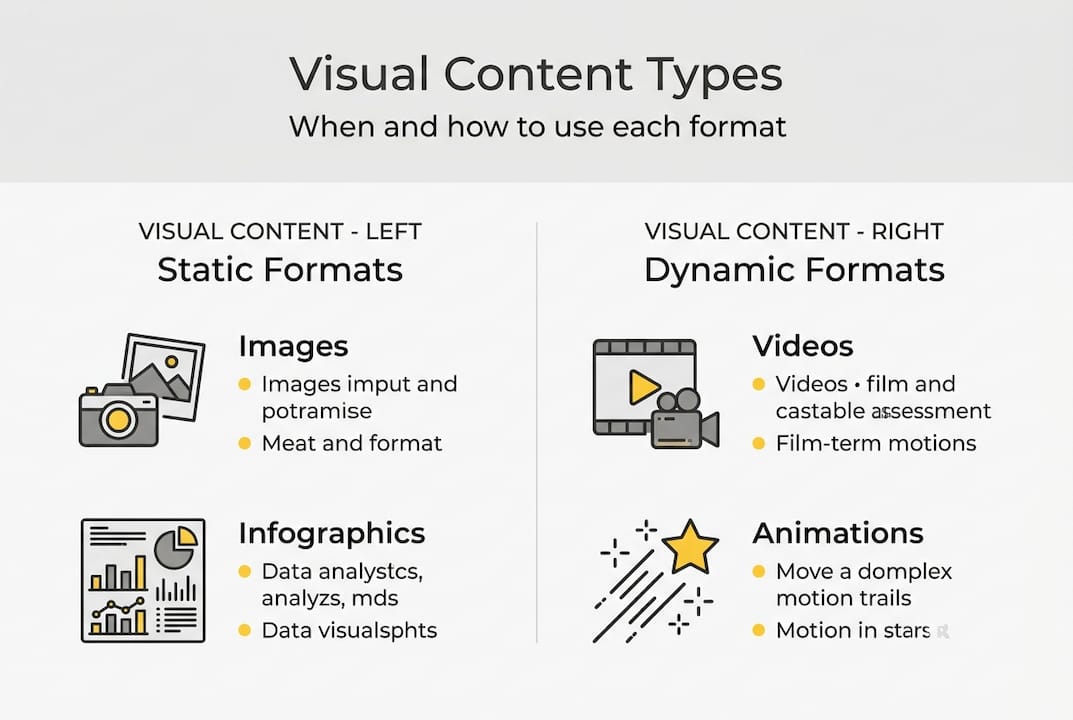
Animations and motion graphics bridge the gap between static and video, offering movement and visual interest without the production overhead of live-action shoots. Interactive visuals, including AR try-ons, 360-degree product views, and interactive infographics, sit at the bottom of the funnel where conversion intent is highest. Mixing formats strategically across buyer journey stages compounds the effect of each individual piece.
Pro Tip: Layer your formats across campaign touchpoints rather than relying on a single type. Use a bold static image for initial awareness, a short-form video for engagement, and an interactive or detailed product visual for the conversion moment. Each format reinforces the last, and the cumulative effect on brand recall is significantly stronger than any single format used alone.
Mobile-first thinking is non-negotiable here. Over 60% of social media consumption happens on mobile devices, which means vertical formats, legible typography at small sizes, and fast-loading files are not technical details. They are creative requirements.
Step-by-step workflow for effective visual content creation
Having the right formats in mind is only useful if you have a reliable process for executing them at quality and at scale. The following workflow is built around what actually works for marketing teams producing visual content under real-world time and budget constraints.
Step 1: Define your strategy before you open any design tool. Clarify your campaign goals, your target audience’s specific pain points, your core message, and the KPIs you will use to judge success. Skipping this step is the single most common reason visual content underperforms. Without a clear brief, even beautiful creative can miss the mark entirely.
Step 2: Ideate and storyboard with your audience in mind. Brainstorm concepts that are relevant to your audience’s world, not just your brand’s preferences. A storyboard does not need to be elaborate. Even a rough sketch of the visual hierarchy and key message for each asset keeps production aligned with strategy.
Step 3: Design with brand consistency and simplicity as your guardrails. Limit your color palette to your brand colors, use no more than two typefaces, and keep the focal point of each visual clear and uncluttered. Brand consistency in design is directly correlated with audience recognition and trust over time.
Step 4: Leverage AI tools for speed, but apply human judgment for quality. AI can accelerate asset generation, resizing, and variation testing. The best visual content tools in 2026 combine AI automation with human creative oversight, which is the combination that produces both efficiency and authenticity.
Step 5: Optimize for each platform before publishing. This means correct aspect ratios, compressed file sizes for fast loading, descriptive alt text for accessibility, and keyword-rich file names for SEO. Platform-specific optimization is where a lot of otherwise strong creative loses its impact.
Step 6: Test, publish, measure, and iterate. Run A/B tests on key variables like headline placement, color, and format. Use the three-second audit: if your visual does not communicate its core message within three seconds of viewing, revise it. Measure engagement and ROI after every campaign and use the data to sharpen the next one.
Pro Tip: Build a simple creative brief template that every visual project runs through before production begins. It takes five minutes to complete and saves hours of revision cycles by ensuring everyone on the team is aligned on goals, audience, and message from the start.
Troubleshooting common challenges and maximizing impact
Even well-planned visual content campaigns run into obstacles. Knowing where the common failure points are, and how to address them, is what separates teams that improve over time from those that repeat the same mistakes.
AI-generated imagery is one of the most discussed topics in visual marketing right now, and for good reason. AI delivers 12% higher CTR on Meta placements and significant cost savings at scale, but it consistently underperforms in high-value conversion contexts, showing an 8% drop in conversions for high-average-order-value products. The reason is authenticity. AI-generated visuals can look technically perfect while feeling emotionally hollow, and audiences sense that disconnect even if they cannot articulate it.
User-generated content is one of the most underused tools in the marketing professional’s arsenal. UGC outperforms stock photography for trust and conversion, and it costs a fraction of a custom shoot. Building UGC into your content strategy, through customer photo programs, social tagging campaigns, or creator partnerships, is one of the highest-ROI moves available to most brands.
“The brands that win on visual content in 2026 are not the ones with the biggest production budgets. They are the ones who understand which moments call for polished production and which call for raw, human authenticity.”
Platform optimization is another area where most teams leave performance on the table. Mobile accessibility, including sufficient color contrast, readable font sizes, and captions on video, is both a legal consideration and a performance one. Captioned videos consistently outperform uncaptioned ones because a significant portion of mobile video is watched without sound.
Perhaps the most striking gap in the industry is this: only 3.6% of marketers are actively optimizing their creative on an ongoing basis. That means that simply committing to a regular testing and iteration cadence puts you ahead of the vast majority of your competitors.
Measuring success: KPIs, trends, and continuous improvement
Creating strong visual content is only half the equation. Knowing whether it is working, and why, is what allows you to build on success rather than guess at it. Yet only 36% of organizations accurately measure the ROI of their visual content efforts. That is a significant blind spot with real business consequences.
The KPIs worth tracking depend on your campaign goals, but the most actionable ones for visual content include engagement rate, click-through rate, video completion rate, lead quality (not just volume), and revenue attribution by content type. Vanity metrics like impressions and follower counts tell you reach, not impact. Focus on the numbers that connect directly to business outcomes.
For 2026, the trends shaping visual content performance are clear. Authentic content and UGC are outperforming polished, produced imagery in trust and conversion metrics. AR and interactive visuals are gaining traction at the bottom of the funnel, particularly in e-commerce and tech. Short-form video continues to dominate awareness and engagement across every major platform.
Iterative improvement is the practice that compounds all of these gains over time. After each campaign, document what worked, what did not, and what you will test next. Build a simple performance log that tracks creative variables alongside KPIs. Over two or three campaign cycles, patterns emerge that allow you to make smarter creative decisions faster, reducing wasted spend and increasing the consistency of strong results.
Our perspective: Blending AI and authenticity for visual content that works
We have spent over two decades producing visual content for major brands, and the conversation around AI in 2026 is one we find genuinely interesting, not because AI is a threat, but because it forces a sharper question: what does human creativity actually add?
AI reduces production costs by 47% and accelerates output significantly. We use it ourselves. But we have also seen firsthand what happens when AI-generated imagery is deployed without human editorial judgment. The results are technically clean and emotionally flat. They look like everything else in the feed. And in a world where UGC is four times more effective for building trust than polished brand content, that flatness is a real liability.
Our view is that the best visual content in 2026 is not purely AI-generated or purely hand-crafted. It is the product of a workflow where AI handles the repetitive and the scalable, and human creativity handles the emotional and the strategic. The brands that figure out that balance will stand out. The ones that automate everything will blend in.
Get expert help for next-level visual content
If your team is ready to move beyond templates and stock imagery, we are here to help you build visual content that genuinely represents your brand.
At 35milimetre, we work directly with ad agencies, tech companies, and startups to deliver high-end post-production, compositing, retouching, and CGI that meets the demands of modern marketing campaigns. Whether you need a single hero image or a full campaign’s worth of assets, our visual content agency team brings two decades of hands-on experience to every project. Reach out to discuss your next campaign and see what purpose-built visual content can do for your brand.
Frequently asked questions
What is the most effective type of visual content in 2026?
Short-form video and UGC consistently lead on engagement, trust, and conversion metrics in 2026, outperforming both polished AI-generated content and traditional stock photography.
How can AI help with visual content creation?
AI accelerates production timelines and enables scale, delivering up to 47% cost reduction, but it works best when a human creative team reviews and refines outputs to maintain emotional authenticity.
How do I measure visual content ROI?
Focus on engagement rate, click-through rate, lead quality, and revenue attribution by content type. Only 36% of organizations measure this accurately, so even a basic tracking system gives you a meaningful competitive edge.
What are key mistakes to avoid in visual content marketing?
Overrelying on AI without human review, ignoring mobile optimization, and failing to test creative variations are the most damaging errors. Only 3.6% of marketers actively optimize creative, which means consistent testing alone puts you ahead of most competitors.
How often should I refresh my visual content?
Refresh visual assets at the start of each new campaign and conduct a full creative audit at least quarterly to keep messaging current and engagement rates healthy.
