
3D-Referenced AI Video: What It Actually Solves (and What It Doesn't)
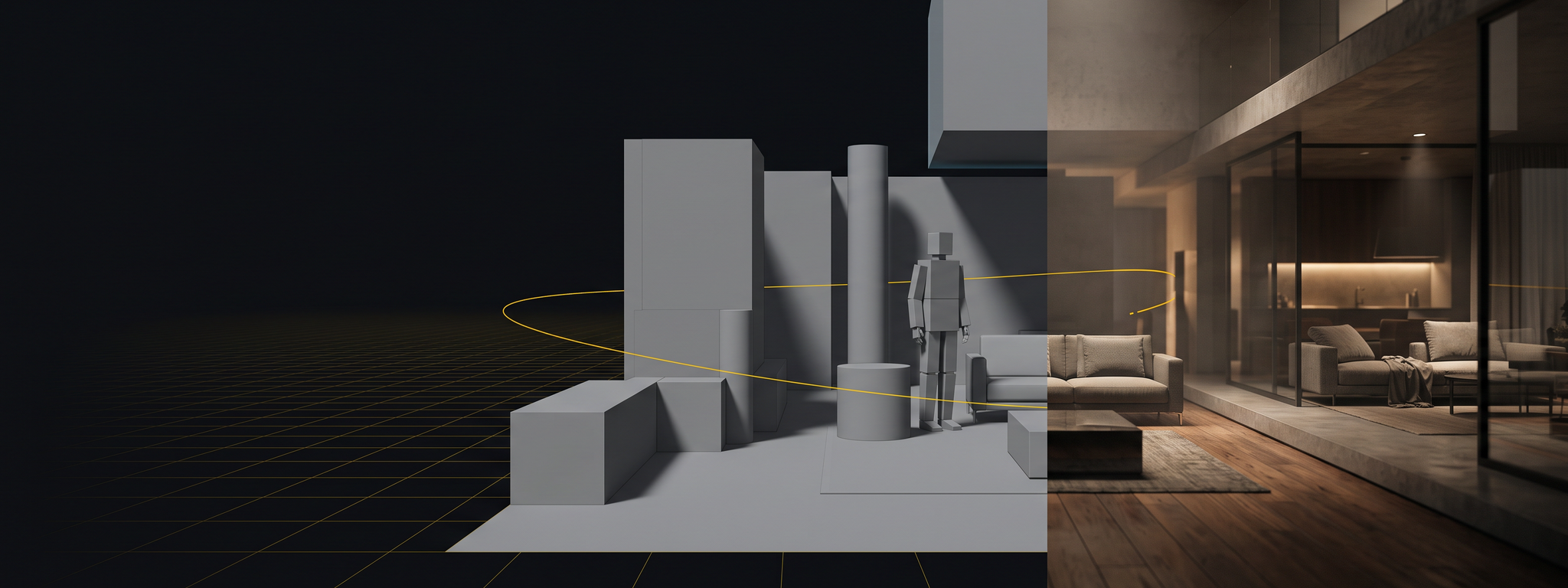
One filmmaker documenting the shift describes spending close to 5,000 credits on a single dialogue scene and getting nothing she could cut. The shots looked fine in isolation. The problem was that the two characters would not stay in the same room from one cut to the next; who sat where, who looked at whom, which way the camera moved. None of it held.
That is not a quality problem. It is an addressing problem, and it is the one thing 3D-referenced AI video is built to fix. It is also why most AI video work has stayed in the mood-film and social-teaser bracket rather than moving into paid campaigns. Meanwhile, the volume keeps climbing: the IAB's 2026 Digital Video Ad Spend and Strategy Report, published in July, found that one-third of ad assets will use generative AI this year, up from one-quarter in 2025, with the share projected to hit 43% by 2027. Nearly two-thirds of video buyers now use it somewhere in their creative.
3D-referenced AI video is the change that makes that volume usable. It does not make the models better. It makes them directable.
What the 3D layer actually fixes
The method is simple enough to describe in a sentence: you build a rough grey-box version of the shot in 3D, no textures and no detail, place the characters and props where they belong, set the camera path and the timing, then export that as a reference for the generative model. The text prompt stops carrying the layout. It only has to carry the look.
This is no longer a carried sound. ByteDance's Seedance 2.5 accepts clay renders as a native reference input, alongside up to 30 images, 10 video clips and 10 audio clips per pass, generating up to 30 seconds at a time with extensions that hold character and environment. Higgsfield's Blender plugin puts generation inside the viewport and exposes an MCP bridge, so an assistant can build and adjust the blockout in the open scene. The precedent goes back further: NVIDIA shipped its AI Blueprint for 3D-Guided Generative AI in April 2025, using a depth map straight out of Blender to steer FLUX.1-dev through ComfyUI, on the reasoning that composition, camera angle and object placement are very hard to specify in words alone.

What that buys you, concretely:
A camera move that behaves like a real lens on a real path, because it was one.
Screen direction and eyelines that survive a cut, because the geometry says where everyone is standing.
Object scale that stays consistent; the classic failure where a bottle grows half a size between shots disappears when the bottle is a mesh.
Timing you can set against a beat rather than describe and hope for.
None of this is glamorous. It is blocking, which is the oldest part of directing, arriving in a pipeline that had been trying to do without it.
The economics change before the look does
The more interesting shift is where the iteration happens.
In a prompt-first workflow, every attempt at a different camera angle costs money and returns a full generation you then have to judge. In a 3D-referenced workflow, the camera, the blocking, and the timing are all settled in the part of the pipeline that costs nothing. A playblast takes seconds and no credits. You can move the camera forty times before you spend anything.
That reorders the whole job. Credits get spent on execution rather than discovery, and the number of blind generations per finished shot drops sharply. The same filmmaker who burned 5,000 credits on an unblocked scene reports usable results within the first few iterations once the blocking existed.
There is a second, quieter benefit that anyone who has run client revisions will recognise: the grey-box scene is a reviewable artifact. A client can recognize camera movement and a layout before a frame of expensive output exists. Traditional production solved this with previs decades ago. AI video skipped the step and has been paying since.
What does it do to the craft?
Writing prompts, as a standalone discipline, deflates. It was always a proxy skill; a way of negotiating with a system you could not address directly. Once you can address it directly, the value moves back to the things that were valuable before: layout, lens choice, staging, continuity, knowing why a 35mm at waist height reads differently from a 50mm at eye level. Whoever can build the grey-box scene owns the shot.
That is good news for 3D generalists and for post artists, who already think in cameras, passes and scene graphs. It is harder news for anyone whose entire position was fluency with a text box. Based on what we have seen across the last year of production, the teams getting consistent results are the ones with a 3D person in the room, not the ones with the best prompt library.

Where does this fit in real production?
For anything brand-critical, the honest shape of this workflow is hybrid rather than end-to-end.
Product and packaging geometry cannot be hallucinated. Label typography, brand color, cap threading, the way a liquid sits in a specific bottle: the color pass/fail, and a generative model has no reason to get them exactly right. So the hero asset stays hard-modelled or shot, the AI generates environment, light interactionhard-modeledround it, and the finish happens in compositing, where you can hold the product to spec and let the rest breathe. That is the structure we use when a project needs both photorealistic accuracy of the product and an environment at a scale nobody is going to build.
The 3D reference layer makes that hybrid far easier to hold together, because the same scene file that drives the AI pass also gives you your camera for the CGI pass. One camera, two renders, matching perspective. That alone removes a lot of the tracking and reprojection pain that made photo-plus-CGI composites expensive.
The risks worth naming
Control does not remove exposure. It changes which exposure matters.
Provenance and rights. Disney, Universal and Warner Bros. are in active litigation with Midjourney, and the discovery fight has now turned outward, with Midjourney seeking disclosure of the studios' own AI use. Whatever the outcome, the practical effect for commercial work is that clients will increasingly ask what a model was trained on. That is why rights-cleared models such as Moonvalley's Marey, trained on licensed data, exist as a procurement answer rather than a technical one. A 3D reference layer helps here in a small way: the more of the frame that originates in geometry you own, the less of it rests on a training set you cannot audit.
Regulation. The EU AI Act's Article 50 transparency obligations took effect on 2 August 2026. Providers of generative systems must embed machine-readable markings and offer a detection mechanism; deployers must disclose deepfakes and AI-generated content on matters of public interest unless a person takes editorial responsibility for it. Non-compliance runs to €15 million or 3% of worldwide annual turnover, whichever is higher. If you deliver into Europe, disclosure is now a line item, not a philosophy.
Likeness. Under the SAG-AFTRA Commercials Contract, digital replicas require clear and conspicuous written consent based on a reasonably specific description of the intended use, now handled through a standard Digital Replica Rider; state laws in California, Illinois and New York add their own informed-consent requirements. A 3D-blocked scene with a generated performer in it is still a performer.
Trust. Research from the Nuremberg Institute for Market Decisions, surveying 1,000 respondents each in the US, UK and Germany, found only 21% trust AI companies, and that identical ads labelled as AI-generated were rated less natural and less useful, with lower willingness to engage or buy. Transparency is required, and it carries a penalty; those two facts are both true, and brands need to plan for them rather than choose between them.
The technical ceiling. ByteDance says plainly that physical plausibility in complex motion and stability across multi-subject interaction still need work. A 3D reference constrains layout and camera; it does not constrain physics. Cloth, liquid, hair, and contact between bodies remain where these workflows break. Add platform dependency to the list: a pipeline built on one vendor's plugin, credits, and model version is a pipeline with someone else's roadmap in it.
The return of blocking
The useful way to read this shift is not that AI video got smarter. It is that the industry stopped trying to describe a shot and went back to building one.
That puts the leverage in a familiar place. Anyone who can stage a scene, choose a lens, and hold continuity across cuts now has a direct line into these tools; anyone who cannot is still rolling dice, just at higher resolution. The tools will keep changing every few months. Blocking will not.
If you are working out where this fits in a real campaign pipeline, particularly where a product has to stay exactly on spec, we are always happy to talk it through.
