
The Handmade Branding Trend Just Became a Real Brief, Not a Look
The last time I wrote about retouching vanishing slowly from my invoices while branding work had been taking over that area. That is now where that space is being directed: briefs which, in simple terms, request something to look "handmade."
It isn't 'warm' and not 'premium'; instead it is handmade, particularly and now with a complementary range featuring the phrase 'not AI-looking'. I have come across that expression so frequently that it is no longer just the subject of a trend article; it has become a standard specification.
What I would like to discuss in the following is the difference between carrying it out well and merely pretending to, since at the moment the majority of the stuff being shipped under that label is the latter and it wouldn't make it through a second season.
When "make it look handmade" became a line in the brief
Over the last year or so there has been a change. In the old days clients would give us reference images and let the atmosphere speak for itself; nowadays they explicitly mention the anxiety, because they don't want the work to appear to be generated.
The evidence supports the impression that I have myself observed on my own desk: a 2026 report on design trends states that among Gen Z people the feeling of fatigue towards excessively refined digital appearances exceeds 70%, and it shows that 60% of consumers say that it is the emotional or sensory aspects, not the refinement, which actually determine their preference for a brand. A recent change by Snapple to a highly serifed typeface taken from its own archives is an obvious example of a well-established brand acting on that instinct rather than ignoring it.
It's not only a problem with small artisan labels; it's also happening in reports submitted by larger clients who are embarrassed by their output appearing algorithmic and prefer to overemphasize texture and imperfection rather than run the risk of looking just like everyone else's AI-generated content.
Why that's not the same as a grain filter
The difference that is important and one that most of this trend is at present ignoring is that a handmade appearance and a genuinely handmade process are not the same.
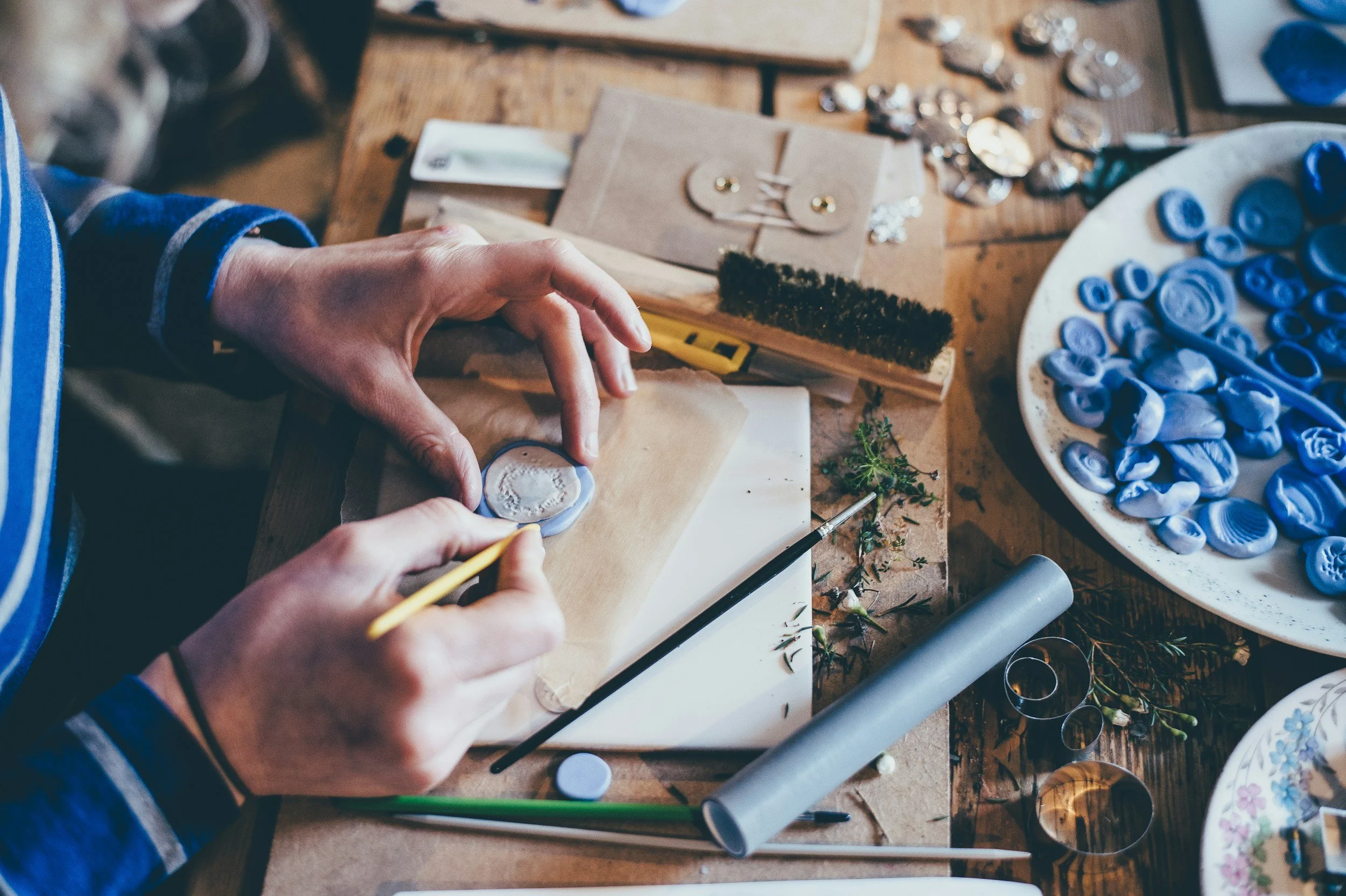
The actual method — the one that's been used by us in our work on beverage and FMCG labels this year — begins with a physical element. A person hand-paints or hand-letters the item, we then scan it at high resolution, and the retouching is carried out in a particular manner: we remove the dust and scanner artifacts that are undesirable, yet we leave the brush pressure, the pooling of the ink, and the slightly uneven baseline that we do want. After that, the image is combined with the actual shape of the label and checked to see how it will look when applied to the real material, since a texture which seems appealing on a screen can become muddy or flat as soon as it comes into contact with a bottle or a pouch.
The short-cut method omits all of that. It involves taking a standard photograph and adding a 'distressed' texture layer, or applying a grain overlay to an AI-generated illustration afterwards at 20% opacity, since that's currently what people consider to be the definition of handmade. It appears satisfactory when viewed at 100% zoom in a slide show, but breaks down as soon as it's printed, or the moment ten other products on the same shelf are found to have used the same texture pack.
The part of this that's genuinely new: certification
The way this cycle differs from previous nostalgia trends is that 'made by humans' has begun to appear as a real label, not just a certain style.
Merriam-Webster has chosen "slop" as its word of the year for 2025. In 2026, Spotify introduced "Verified by Spotify" badges. The Authors Guild now provides a "Human Authored" certification mark, and programmes and films, such as Pluribus, have begun to include "made by humans" in their credits. iHeartMedia has found that 90% of its listeners, including those who use AI tools, want the media they consume to be created by humans, and Deloitte's Connected Consumer Survey showed that about 70% of the people surveyed were concerned about AI-generated content being used to deceive.
In my view the trend nowadays towards handmade effects in branding is basically the same thing but without the need for a formal stamp. When a logo has clearly hand-written letters or a label features actual scanned texture, it is making the same kind of assertion as a "Verified Human" badge does directly. It is a trust signal that uses design rather than a certificate.
What this actually means for the work we take on
This brings us right back to my point made the last time: AI has not only reduced the amount of routine work in the areas of retouching and 3D but has also generated a particular new kind of demand that it is unable to meet on its own. That kind of demand is now appearing in the form of paid work.
The kinds of jobs that end up on our desk as a result of this trend are specific: they involve scanning physical materials, editing hand-lettering without removing the features that give it a hand-lettered appearance, combining craft textures into packaging and label systems, and then checking all of these against actual printed output. That is expertise in compositing and retouching being put to use on a new rather than a disappearing brief.
A noteworthy point deserves careful consideration: despite the fact that OpenAI, the company most linked with AI, promoted ChatGPT using a real 35mm film negative rather than anything produced by AI. The fact that the company best known for AI has opted to use physical film grain in order to give its own advertising a human touch shows just how far this instinct has developed and how little it has to do with the company's size or financial resources.
Where this actually lands
Trends such as this don't last long. Skeuomorphism was overused until Apple eventually gave up on it, and grunge typography burned out in the same way in the late 1990s. Handmade branding will probably follow a similar pattern: it will be overused within a couple of years and then get diluted when it appears on every shelf and every SaaS landing page.
The aspect which does not disappear as quickly is the underlying requirement to provide proof that a real person actually made the decisions. So long as this demand exists, there is genuine and well-paid work to be done by carrying out the task properly rather than merely faking it with a texture pack.
If you're weighing whether a handmade direction is the right call for your brand, or just a trend you'll be quietly walking back in two years, we're happy to talk it through.
