
What Is Motion Design? A Guide for Creatives
Motion design is one of the most misunderstood disciplines in the visual arts. Ask ten people what it means and you will get ten different answers, ranging from “animated logos” to “video editing.” The truth is more precise and more interesting. Motion design is a full discipline that sits at the intersection of graphic design, animation, and visual storytelling, requiring both creative vision and technical command. This article breaks down the motion design definition clearly, walks through how it works in practice, and shows why it matters for anyone serious about visual communication.
Table of Contents
- Key takeaways
- What is motion design, exactly?
- Principles and visual storytelling techniques
- The motion design workflow: from concept to output
- Applications: where motion design actually lives
- My honest take on motion design as a craft
- How 35milimetre approaches motion and visual production
- FAQ
Key takeaways
| Point | Details |
|---|---|
| Motion design vs. motion graphics | Motion design is the discipline; motion graphics are the specific animated assets it produces. |
| Design first, animation second | Strong typography, color, and composition are the foundation before any movement is added. |
| Workflow starts in pre-production | Storyboards that map timing and transitions are what separate professional work from amateur output. |
| Motion systems save time | Repeatable rules for easing and timing create brand consistency and accessibility compliance across projects. |
| Applications are everywhere | From broadcast packages to app onboarding, motion design shapes how audiences absorb information. |
What is motion design, exactly?
The confusion starts with terminology. Most people have heard of motion graphics, but the term motion design is often treated as interchangeable with it. They are related but not the same thing. Motion graphics are pieces of animation or digital footage that create the illusion of motion, frequently combined with audio for multimedia use. They are the output, the deliverable you hand over to a client or upload to a platform.
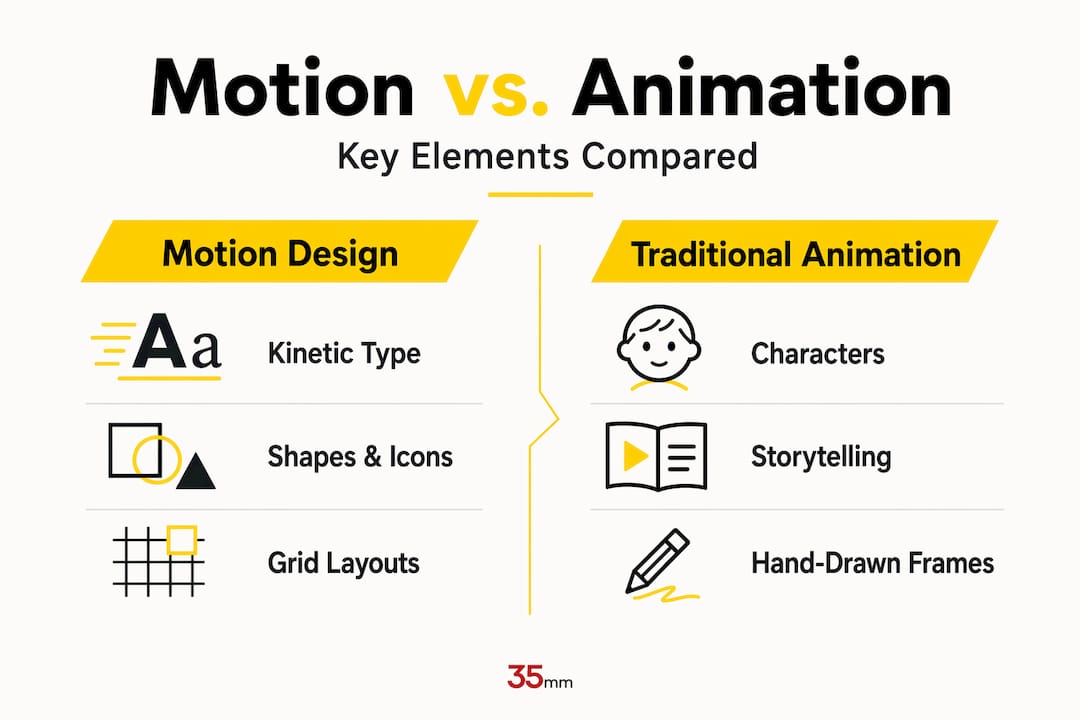
Motion design, by contrast, is the broader discipline. It is the practice of applying graphic design thinking to time-based media. Where a graphic designer arranges elements on a static canvas, a motion designer arranges those same elements across time. Typography moves. Shapes transition. Color shifts in response to a beat. Every decision about when, how fast, and in what direction something moves is a design decision, not just a technical one.
This distinction matters professionally. Motion design as a discipline encompasses motion graphics, but it also pulls from filmmaking, UX design, and sound design. It is worth understanding where it sits relative to traditional animation as well.
| Attribute | Motion design | Traditional animation |
|---|---|---|
| Primary focus | Graphic elements, typography, shapes | Characters, narrative scenes |
| Storytelling method | Information and emotion via visuals | Character-driven narrative |
| Typical use case | Branding, UI, explainers, broadcast | Film, TV series, short films |
| Core tools | After Effects, Cinema 4D, Blender | Toon Boom, hand-drawn, 3D rigs |
| Design foundation | Graphic design principles | Illustration and acting principles |
The key elements that go into motion design work include typography in motion (kinetic type), abstract graphic shapes and icons, composited visual effects, color grading, and audio synchronization. A finished motion design piece can be ten seconds of an animated logo reveal or a five-minute explainer video for a product launch. The discipline covers both.
Principles and visual storytelling techniques
What separates competent motion design from genuinely great work comes down to principles, not software skills. Effective motion design requires blending aesthetic design principles with precise timing and pacing to engage viewers both emotionally and intellectually. Knowing how to keyframe is easy. Knowing when to move something, and how slowly, is the real craft.
The core principles that every motion designer needs to internalize include the following:
- Timing and pacing. How long a motion lasts communicates weight and importance. A quick cut signals urgency; a slow fade suggests calm or reflection.
- Easing. Objects in the real world accelerate and decelerate. Ease-in and ease-out curves mimic this, making movement feel natural rather than mechanical.
- Motion paths. Whether an element travels in a straight line or an arc changes how it reads emotionally. Arcs feel organic; straight lines feel deliberate.
- Visual hierarchy in time. Just as layout guides the eye on a static page, motion guides attention sequentially. What enters first, what holds longest, and what exits last all shape meaning.
- Staging and composition. Every frame in a motion piece is also a graphic design decision. The rule of thirds, contrast, and negative space all apply.
One principle that is often overlooked is the importance of storyboarding before any software is opened. Storyboards in motion design differ from traditional film storyboards in that they focus sharply on timing, transitions, and movement details rather than character-driven scenes. A storyboard here is less about what happens and more about how it moves and when.
It is also worth noting that motion graphics do not need narrative characters to convey emotion or information. A carefully paced sequence of text and geometric shapes, scored to the right music, can communicate a brand’s entire ethos without a single face on screen. This is one of the things that makes motion design so versatile across commercial contexts.
Pro Tip: Build a small motion moodboard before you open After Effects. Collect three to five reference clips that capture the timing and feel you are after. Your first keyframe will be far more intentional when you know what you are aiming for.
The motion design workflow: from concept to output
Understanding how motion design projects actually get made demystifies the process for both designers and the clients who commission them. Motion design sits at the crossroads of graphic design, animation, and filmmaking, which means the workflow draws from all three disciplines.
A professional motion design project generally moves through these stages:
- Brief and concept development. The designer receives a creative brief, defines the message, tone, and intended audience, and begins sketching conceptual directions. This is where decisions about style, color palette, and typography are locked in before any movement begins.
- Storyboarding and animatic creation. Pre-production storyboards define timing, transitions, and the sequence of information. An animatic, a rough timed slideshow of storyboard frames, tests whether the pacing works before full production begins.
- Asset design. Static graphic elements, icons, backgrounds, typography treatments, and 3D models are designed in full before animation starts. Rushing this stage is the most common cause of weak motion design output.
- Animation and keyframing. Keyframing, behavior systems, and scripting are used to control how elements move. Simple transitions are handled with keyframes; complex or procedural motion uses expressions and scripting within the software.
- Post-production and audio sync. Visual effects, color grading, and compositing layers are added. Audio, whether music, sound effects, or voiceover, is synced carefully because sound dramatically amplifies the emotional impact of motion.
- Rendering and delivery. The final output is rendered to the correct format and resolution for its destination: broadcast, web, social media, or digital signage.
Popular tools for this workflow include Adobe After Effects for 2D compositing and motion graphics, Cinema 4D for 3D animation and rendering, and Blender as a free, production-capable alternative. Plugins like Lottie enable lightweight animation export for app and web interfaces, which has made motion design increasingly central to product design as well.
Pro Tip: Experienced teams build motion design systems with defined rules for timing, easing curves, and entrance animations. This creates visual consistency across a whole campaign and saves significant production time on subsequent deliverables.
Applications: where motion design actually lives
Motion design is now present in nearly every channel where brands and audiences interact. Understanding its range of applications helps clarify both its commercial value and its creative scope.
- Broadcast packages. Network television relies on motion design for title sequences, lower thirds, bumpers, and sports graphics. This is one of the most technically demanding areas of the field.
- Digital advertising. Animated banner ads, social media video ads, and pre-roll spots all use motion design to communicate brand identity within tight time and format constraints.
- App and UI animation. The transitions, loading states, and onboarding sequences in mobile apps are motion design decisions that directly affect user experience and retention.
- Explainer videos. Complex products or services, particularly in technology and financial sectors, use kinetic typography and animated diagrams to make abstract information concrete.
- Social media content. Short-form motion graphics on platforms like Instagram and TikTok are one of the highest-demand applications today, where thumb-stopping visual behavior is the entire goal.
Motion design drives impact in modern advertising campaigns specifically because it communicates faster than static imagery and more efficiently than a narrator reading copy. A well-designed six-second animated sequence can land a brand message that a full paragraph of text would struggle to deliver.
The benefits of motion design for brands extend beyond aesthetics. Animated content retains viewer attention longer, improves message recall, and performs better in paid media environments where cost per engagement is measured directly. For campaigns running across multiple platforms, a well-built motion system means assets can be resized, reformatted, and adapted without rebuilding from scratch each time.
My honest take on motion design as a craft
I have worked across post-production and visual design long enough to watch motion design go from a specialist niche to a mainstream commercial expectation. And in that time, the most consistent mistake I see is designers jumping into animation before they have solid design fundamentals. Motion design does not rescue weak graphic design. It amplifies it, both the strengths and the weaknesses.
What I have learned is that the best motion designers are, first, excellent graphic designers who happen to understand time. They think about a composition holding for two seconds and ask whether every element earns its place in that frame. That discipline is harder to teach than keyframing.
I have also seen the industry underestimate how much repeatable motion systems change the economics of creative work. When a studio builds a consistent set of easing curves, entrance behaviors, and transition rules for a client, every subsequent deliverable becomes faster to produce and more coherent as a whole. It shifts motion design from a craft exercise to a strategic asset. That shift is where the real professional value lies, and it is where experienced studios consistently outperform freelancers working without a system.
— 35mm
How 35milimetre approaches motion and visual production
If you are thinking about incorporating motion design into a brand campaign, a product launch, or a content series, the quality of your foundational visuals determines how far the work can go.
At 35milimetre, we bring over two decades of post-production and compositing experience to every project, whether that involves still imagery, brand video post-production, or full visual production pipelines for ad agencies and technology brands. Our work spans CGI, retouching, color grading, and 3D rendering, all the building blocks that feed into high-quality motion work. If your visuals need to move and impress, explore our post-production services to see how we can support your next campaign.
FAQ
What is the motion design definition?
Motion design is the discipline of applying graphic design principles to time-based media, creating animated visuals that convey information, emotion, or brand identity. It differs from traditional animation in that it focuses on graphic elements rather than character-driven narratives.
How does motion design differ from motion graphics?
Motion design is the broader discipline and practice, while motion graphics refers to the specific animated assets it produces. Think of motion design as the field and motion graphics as one of its primary deliverables.
What are common examples of motion design?
Examples include animated logo reveals, TV broadcast title sequences, app onboarding animations, kinetic typography ads, social media video content, and explainer videos for technology products.
What software do motion designers use?
The industry standard tools are Adobe After Effects for 2D compositing and animation, Cinema 4D for 3D motion work, and Blender as a capable open-source alternative. Plugins like Lottie are widely used for web and app animation export.
What does motion design mean for brand communication?
For brands, motion design translates complex messages into fast, visually compelling sequences that outperform static imagery in engagement and recall, making it one of the most efficient formats in modern digital marketing.
