
How post-production shapes your campaign's true impact

Great production value is essential, but it rarely tells the whole story. Most marketing directors invest heavily in shoots, talent, and creative direction, then treat post-production as a finishing step rather than a strategic force. That thinking costs campaigns dearly. The visual work that happens after the camera stops rolling is where brand perception is actually forged, where consistency is built, and where imagery is transformed from raw material into something that genuinely persuades. This article breaks down why post-production deserves a larger seat at the strategic table, how the process actually works, and what you can do right now to make it work harder for your campaigns.
Table of Contents
- Why post-production is the backbone of effective campaigns
- The anatomy of post-production: From automation to human craftsmanship
- How post-production drives campaign performance (and its true limits)
- Best practices and pitfalls: Achieving premium results every time
- Why high-end post-production is your campaign’s unsung differentiator
- Drive your next campaign’s performance with expert post-production
- Frequently asked questions
Key Takeaways
| Point | Details |
|---|---|
| Hybrid workflows win | Combine automation for efficiency and manual review for detail to avoid critical campaign flaws. |
| Beyond vanity metrics | Great visuals should drive not just clicks but genuine conversions and brand value. |
| Manual cleanup matters | Human oversight catches subtle errors that automation misses and protects brand credibility. |
| Strategy guides success | Align post-production work directly with campaign goals for maximum impact. |
Why post-production is the backbone of effective campaigns
Most campaigns begin with a clear creative vision. The shot list is planned, the models are briefed, the lighting is calibrated. But when the raw files land in the editing suite, a second and equally important creative process begins. Post-production is not a cleanup operation. It is where visuals take their final strategic shape, calibrated to match the brand’s tone, the platform’s demands, and the audience’s expectations.
Consider storytelling in marketing. Every compelling campaign communicates a narrative, and post-production is the layer that makes that narrative land visually. Color grading sets the emotional temperature of an image. Compositing places a product in a context that would be impossible or prohibitively expensive to recreate on set. Retouching removes distractions that pull the eye away from the brand’s message. These are not cosmetic fixes. They are deliberate decisions with measurable impact on how your audience receives the campaign.
It is also worth acknowledging that post-production’s influence on campaign outcomes extends well beyond aesthetics. Post-production ensures visual consistency across every deliverable: social assets, display banners, broadcast spots, OOH placements, and e-commerce imagery. When those assets feel unified, the brand feels authoritative. When they do not, even the most expensive shoot looks fragmented.
As pixel-level edge adjustment research makes clear, post-production integrates visual elements and maintains brand quality control where automation falls short. Automation accelerates the process, but it cannot make judgment calls about whether a sky replacement serves the brand or undermines it, whether a product reflection feels natural or distracting, or whether a skin tone has shifted slightly in a way that would read as off to an attentive consumer.
“The campaign you planned is only as strong as the execution that reaches the audience. Post-production is the final filter between creative intent and commercial reality.”
Key areas where post-production protects and elevates brand value include:
- Brand consistency: Color grading and compositing ensure every asset reads as part of a cohesive family, regardless of where it appears.
- Platform optimization: Assets are resized, reformatted, and adjusted for each channel without losing visual quality or brand integrity.
- Error elimination: Visual flaws, whether a stray object on set, an unflattering shadow, or a distracting background element, are removed before they reach consumers.
- Credibility protection: A single noticeable flaw in a hero image can undermine the perceived quality of the product it represents, making post-production a form of brand insurance.
The anatomy of post-production: From automation to human craftsmanship
Understanding how post-production actually works helps you make smarter decisions about where to invest attention and budget. The process typically moves through distinct stages, each serving a specific function.
- Ingest and organization: Raw files from the shoot are cataloged, sorted, and reviewed for technical quality. This stage identifies immediately unusable shots and flags candidates for retouching.
- Basic corrections: Exposure, white balance, and noise reduction are applied, often through automated batch processing. This is where automation earns its keep, handling large volumes quickly and consistently.
- Retouching: Individual images receive detailed attention. Blemishes, distractions, and set imperfections are removed. For automotive campaigns, this might mean correcting reflections on a car’s body panel. For tech products, it means ensuring every bezel, port, and surface reads perfectly.
- Compositing: Elements from multiple sources are combined into a single, seamless image. Backgrounds are replaced, environments are built, and products are placed into contexts that reinforce the campaign’s narrative.
- Quality control: Every asset is reviewed against brand guidelines, platform specs, and the original creative brief before delivery.
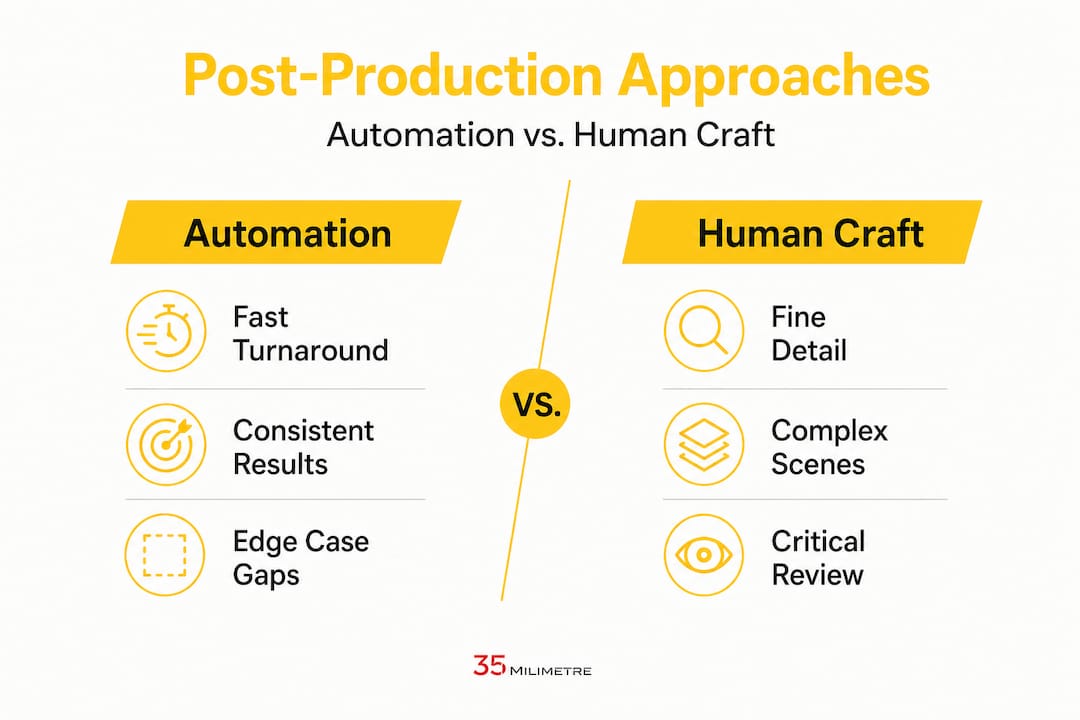
The question of where automation ends and human expertise must begin is critical. Hybrid approaches are essential: automated steps handle scale, while manual expertise manages nuanced cases like hair, glass, and smoke. These categories present genuine technical challenges that no automated tool currently solves reliably.
Hair, for example, involves thousands of semi-transparent strands that interact with light and background color in complex ways. A mask generated by an AI tool will often produce a halo effect, a telltale ring of the original background color clinging to the edge of the subject. Glass presents a similar problem because its transparency means it carries color information from both sides of the frame simultaneously. Smoke, steam, and fine fabric textures present yet another category of challenges that require a skilled retoucher to address at the pixel level.

| Workflow type | Speed | Consistency | Handles edge cases | Recommended for |
|---|---|---|---|---|
| Full automation | Very high | High (for simple assets) | Poor | High-volume, low-complexity assets |
| Hybrid | High | Very high | Good | Most professional campaigns |
| Human-led | Moderate | Excellent | Excellent | Hero images, flagship campaigns |
The table above illustrates why most professional campaigns use a hybrid model. Building efficient workflows in post-production means knowing which assets can move through automated pipelines without review and which ones require skilled hands.
Pro Tip: Identify your campaign’s five to ten hero assets before post-production begins, and route them immediately to human review. These images carry the most brand weight and deserve the most attention, regardless of overall asset volume.
How post-production drives campaign performance (and its true limits)
Strong post-production work does measurably improve campaign performance. Cleaner, more cohesive visuals improve initial engagement. Consumers spend more time looking at imagery that feels polished and intentional. Brand recall improves when visual identity is consistent. Trust increases when product imagery reflects what the customer actually receives.
That said, it is important to be clear-eyed about the limits. High CTR from visually impressive creative does not always translate to better funnel performance. Alignment with conversion intent is critical. A beautifully retouched campaign image that attracts clicks from the wrong audience segment will not improve your revenue numbers, even if your engagement metrics look exceptional.
This distinction matters especially in technology and automotive marketing, where the purchase journey is long and the consideration phase is nuanced. A campaign that prioritizes visual spectacle over relevance might drive impressive initial numbers, and then disappoint when those numbers do not carry through to configured quotes, test drive bookings, or purchase completions.
The table below maps common post-production issues to their downstream campaign risks:
| Visual flaw | Likely campaign risk |
|---|---|
| Edge halos on product shots | Perceived low quality, brand credibility drops |
| Inconsistent color grading across assets | Fragmented brand perception across channels |
| Overretouched product surfaces | Consumer distrust when physical product differs |
| Poor compositing on background replacement | Reduced believability, weakened storytelling |
| Incomplete masking on transparent elements | Amateur appearance that undermines premium positioning |
The visual strategy for campaign success always connects execution quality to business goals rather than creative goals alone. Similarly, staying current with campaign visual trends in 2026 helps ensure that post-production choices align with what audiences currently respond to, rather than what worked in previous years.
Key performance connections worth tracking:
- Dwell time: Polished imagery increases the time a viewer spends engaging with an asset, which correlates with higher brand recall.
- Perceived product quality: Consumers routinely judge product quality based on the quality of its imagery. In automotive and tech contexts, this judgment happens within seconds.
- Return rate: Overpromising through excessive retouching increases return rates when the physical product does not match the campaign visual.
- Conversion alignment: Post-production choices, particularly context and environment in compositing, should reflect the buyer’s mindset at the specific funnel stage being targeted.
Best practices and pitfalls: Achieving premium results every time
Knowing what can go wrong is half the battle. The other half is building the processes that prevent those failures from reaching your audience. Here is how experienced marketing directors approach that challenge.
The foundation is a hybrid workflow that treats automation as a tool rather than a solution. Batch automation handles routine corrections at scale and keeps timelines manageable. But scheduling manual inspection for every key asset is not optional. As research confirms, manual oversight in post-production prevents subtle, brand-damaging errors that automation misses, ensuring campaign creative meets strategic standards.
A practical pre-sign-off checklist for your team to apply to every hero asset should include:
- Edge quality: Check for halos, fringing, or artifacts along the edges of any subject that has been masked or composited.
- Reflection accuracy: On product shots, particularly automotive, verify that reflections are consistent with the scene’s light sources and environment.
- Color consistency: Compare the hero asset side by side with at least two other campaign assets to confirm tonal and color alignment.
- Glass and transparent element integrity: Any glass surfaces, whether a car windshield, a smartphone screen, or a bottle, should be reviewed individually for masking accuracy.
- Background integration: Composite elements should cast appropriate shadows and show appropriate interaction with environmental light.
- Platform specs: Verify that the final asset meets the technical requirements of every placement it will appear in, including resolution, color profile, and file format.
Pro Tip: Build a brief visual QC (quality control) document specific to each campaign that lists the brand’s current color palette references, approved background environments, and any known retouching sensitivities for that product line. Share it with your post-production team before work begins, not after the first round of revisions.
Partnering with video post-production specialists who understand brand strategy alongside technical craft is the single highest-leverage decision you can make. A team that knows only software will produce technically correct images. A team that also understands brand positioning and consumer psychology will produce images that do real commercial work.
Finally, build feedback loops between creative, production, and brand strategy teams from the beginning of the project. Post-production teams who receive clear strategic context during briefing produce significantly better results than those who work from a vague request to “make it look great.” Creative storytelling techniques rely on that shared understanding of what the campaign is trying to accomplish emotionally and commercially.
Why high-end post-production is your campaign’s unsung differentiator
Here is a perspective we have developed through over two decades of working on campaigns for major technology and automotive brands: the difference between a campaign that performs well and one that becomes a reference point in the industry almost always comes down to decisions made during post-production, not during the shoot.
The shoot sets the ceiling. Post-production decides how close you get to it.
We have seen campaigns built on average photography become genuinely impressive through expert compositing, color grading, and retouching. We have also seen extraordinary photography underdelivered by rushed post-production that introduced subtle errors, inconsistent color, and rough masking. Consumers do not consciously identify these flaws, but they feel them. Trust erodes in ways that are difficult to diagnose because they rarely show up in post-campaign analytics.
This is why we treat creative production company decisions as strategic rather than operational. Choosing the right post-production partner is as important as choosing the right director for a brand film. The skills are different, but the stakes are identical.
The deeper point is about risk management. As automated pipelines can fail in complex visual scenarios, requiring manual oversight to prevent brand damage, the question is not whether you can afford expert post-production. It is whether you can afford to launch a campaign without it. For brands competing at the premium end of the technology or automotive market, a single hero image that reads as low-quality is not a small problem. It is a direct contradiction of everything your brand is trying to communicate.
Leaders in this space treat post-production as a strategic pillar. They budget for it properly, brief it thoroughly, and review it with the same rigor they apply to the creative concept itself.
Drive your next campaign’s performance with expert post-production
If the principles in this article resonate, the next step is straightforward: work with a team that brings both technical precision and strategic understanding to every asset they touch.

At 35milimetre, we have spent over two decades helping technology and automotive brands close the gap between creative ambition and campaign reality. From compositing and retouching to CGI and AI-enhanced imagery, our team works as an extension of your creative process, not a downstream vendor. If your next campaign demands visuals that hold up under scrutiny and deliver against your conversion goals, we would welcome the conversation. Explore our professional post-production services and see what thoughtful post-production looks like when it is done at the level your brand deserves.
Frequently asked questions
What key issues can automation miss in post-production?
Automation often struggles with edge cases involving hair, glass, smoke, or semi-transparent elements, all of which require skilled manual cleanup to resolve without visible artifacts.
Does better-looking creative guarantee higher campaign performance?
Not automatically. High CTR can mask poor conversion when visuals attract interest from audiences who are not aligned with the campaign’s conversion goal, making strategic alignment as important as visual quality.
How can I ensure post-production meets my brand’s quality standards?
A hybrid approach combining automation with manual review delivers the strongest results, using automated tools for speed on routine assets and human expertise for hero images and complex visual elements.
What’s the main risk of neglecting post-production details?
Brand damage from subtle failures missed by automated workflows can quietly erode consumer trust and reduce the return on your entire campaign investment, often without showing up clearly in standard analytics.
