
Boost engagement: the strategic role of visuals in marketing

Nearly half of marketing visuals fail to generate meaningful impact, not because of poor production quality, but because they lack storytelling. For marketing professionals and brand managers in technology and automotive sectors, this is a striking and often uncomfortable reality. You can commission technically flawless imagery, invest in high-end compositing and color grading, and still watch campaigns underperform. The difference between visuals that move audiences and those that simply look good comes down to narrative coherence, cultural fit, and strategic intent. This guide breaks down exactly how to close that gap and turn your visual assets into genuine engagement drivers.
Table of Contents
- Why visuals matter in modern marketing
- Visuals beyond aesthetics: Crafting narrative-driven experiences
- Tailoring visuals for target audiences and markets
- From strategy to execution: Building repeatable visual frameworks
- Visual strategies for the automotive and technology sectors
- The uncomfortable truth: Many visuals still miss the mark
- Bring your visual strategy to life
- Frequently asked questions
Key Takeaways
| Point | Details |
|---|---|
| Narrative is essential | Visuals drive results when embedded in coherent stories, not standalone. |
| Adapt to local markets | Tailoring visuals to cultural preferences dramatically boosts effectiveness. |
| Strategic consistency wins | Long-term visual frameworks—like EPIC—outperform one-off creative bursts. |
| Sector-specific strategies matter | Automotive and tech brands need visuals that match research and decision behaviors. |
Why visuals matter in modern marketing
Setting the stage for why visuals work, let’s explore their essential role in driving engagement.
The human brain processes visual information roughly 60,000 times faster than text. That single fact reshapes how you should think about every image, video, and render your team produces. Visuals are not supplementary to your marketing message. They are often the first and sometimes the only impression a potential buyer receives. In tech and automotive marketing, where purchase decisions are complex and emotionally weighted, that first impression carries enormous strategic importance.
Visuals create emotional resonance in a way that body copy rarely can. A well-executed automotive lifestyle shot does not just show a car. It places the viewer inside an aspirational moment. A product render for a new consumer tech device, when lit and composed with intention, signals innovation before a single specification is read. This is the core promise of visual storytelling in marketing: imagery that communicates brand values and emotional truths in a single frame.
The psychological effects of strong visual marketing work across several dimensions. Attention is captured faster and held longer when visuals contain narrative elements rather than isolated product features. Memory encoding improves significantly when emotion is embedded in an image, making brand recall stronger during the consideration phase. Emotional impact drives the kind of connection that separates brands people like from brands people trust.
- Attention: Narrative visuals outperform feature-only shots in initial engagement
- Memory enhancement: Emotionally embedded images strengthen long-term brand recall
- Emotional impact: Story-driven imagery builds trust at the consideration stage
“Story-embedded visuals outperform product-feature-focused campaigns,” according to an IPSOS effectiveness study, flagging a measurable gap between visually rich creative and strategically coherent storytelling.
The implication is clear: half of ads are leaving engagement on the table simply by prioritizing aesthetics over narrative.
Pro Tip: When briefing your creative team or agency, ask not just “does this look good?” but “what story does this tell, and does that story match where our audience is in their journey?”
Visuals beyond aesthetics: Crafting narrative-driven experiences
After understanding why visuals matter, it’s critical to see how their impact deepens when integrated into stories.
There is a meaningful difference between a visual that is polished and one that communicates. Both can be expensive to produce. Only one reliably moves the needle. The most common trap we see brands fall into is what we call the “pretty but empty” problem: imagery that has strong technical execution but no clear narrative purpose. The viewer admires the craft and moves on, with no emotional imprint and no brand connection formed.

The research is direct on this point. The lift in campaign impact happens when visuals are embedded in coherent narrative experiences, not when they simply showcase product attributes. This distinction shapes every creative decision, from the choice of setting and talent to the color palette and post-production treatment.
Here is how feature-only visuals compare against narrative-driven ones across key marketing metrics:
| Metric | Feature-only visuals | Narrative-driven visuals |
|---|---|---|
| Engagement rate | Below benchmark | Above benchmark |
| Brand recall | Low retention | High retention |
| Conversion lift | Marginal | Significant |
| Emotional connection | Transactional | Relational |
Building a visual narrative is a structured process, not a creative accident. Consider working through these four stages for any major campaign:
- Define the message: What single idea should the audience carry away from this visual?
- Choose a relatable setting: Ground the story in an environment your audience recognizes and aspires to inhabit.
- Show transformation: The most powerful visuals capture a before-and-after state, even subtly. A driver’s expression, a workspace transformed by a new device.
- Reinforce with emotion: Color grading, composition, and lighting should all serve the emotional tone, not just the technical brief.
Pro Tip: Anchor your visual campaigns to consistent brand archetypes, whether that is the innovator, the adventurer, or the trusted expert. Audiences subconsciously recognize and respond to these narrative patterns across touchpoints.
Tailoring visuals for target audiences and markets
While narrative focus is essential, tailoring visuals by market ensures stories genuinely connect.
A visually compelling campaign can fail completely when it lands in the wrong cultural context. This is particularly relevant for global technology and automotive brands, where campaigns are often produced centrally and then distributed across vastly different markets. What reads as aspirational in one region may feel tone-deaf or even offensive in another. The stakes are high, and the production investment makes the misstep even more costly.
Research confirms that cultural incongruence can reduce visual effectiveness even when production quality is high. Symbols, settings, people, and color associations carry meaning that differs sharply across regions. A visual featuring wide-open landscapes may communicate freedom in one market and feel irrelevant in an urban-dominant market where buyers have entirely different reference points.
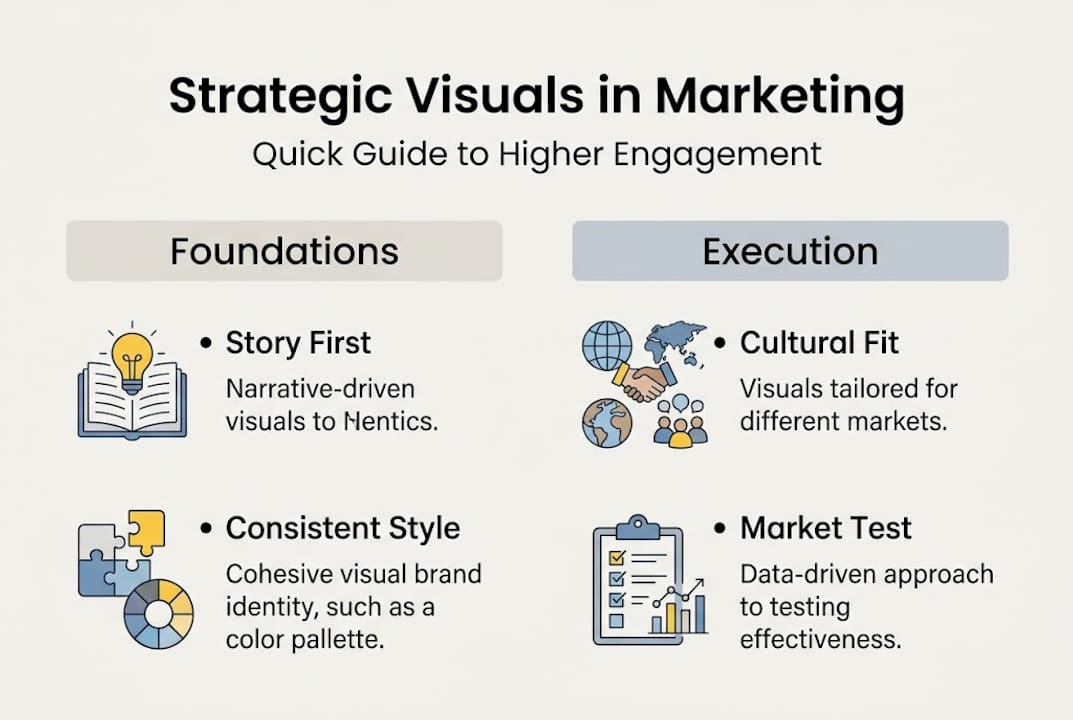
Here is how cultural fit affects visual performance across regions:
| Region | Common visual approach | Cultural fit outcome |
|---|---|---|
| Western Europe | Minimalist, individual-focused | Strong resonance with tech buyers |
| Southeast Asia | Community and family settings | High trust signals in automotive |
| Middle East | Luxury cues, aspirational settings | Effective for premium segments |
| Latin America | Vibrant color, emotional warmth | Drives emotional connection |
Avoiding cultural missteps requires deliberate process, not just sensitivity. Practical methods for building cultural resonance into your visual workflow include:
- Market-specific testing: Run visual concepts through focus groups or panel testing in each target region before production scales.
- Feedback loops: Build regional feedback mechanisms into campaign review cycles, not just at the brief stage but at the creative review stage.
- Local creative input: Involve photographers, art directors, or consultants who are native to the target market, even if the core team is centralized.
- Symbol and setting audits: Before final sign-off, review every visual element for unintended cultural signals.
For automotive campaigns especially, where aspirational identity is central to the purchase decision, getting local narrative right is not optional. It is a core driver of whether the campaign builds or erodes brand trust.
From strategy to execution: Building repeatable visual frameworks
Knowing how to tailor and narrate visuals, the next step is reliable execution across time.
One of the most common weaknesses in visual marketing programs is the reliance on one-off creative bursts. A campaign launches beautifully, the team celebrates the work, and then the next project starts from scratch. There is no carried visual logic, no accumulated brand equity from consistent motifs, and no recognition built over time. This is a structural problem, and it requires a structural solution.
The EPIC visual framework is one of the more rigorous approaches to bridging strategy and visual execution. It moves teams from isolated campaigns toward a system of repeatable, recognizable visual language. The four stages work as follows:
- Envision: Define what the brand should look, feel, and communicate visually across all touchpoints.
- Plan: Map specific visual elements, settings, color systems, and narrative themes to campaign types and audience segments.
- Implement: Execute with discipline, ensuring that every asset, regardless of format or channel, adheres to the planned visual system.
- Consistency check: After each campaign cycle, audit all produced assets against the original vision. Identify drift and correct it before it compounds.
Repeatable visual motifs work because audiences build pattern recognition over time. Think of the warm, kinetic lifestyle aesthetic that has defined a leading sports apparel brand for decades, or the clean, high-contrast renders that signal premium quality across a global consumer tech company’s product line. These are not accidents. They are strategic systems.
Research on visual brand frameworks confirms that repeatable visual cues foster long-term trust and recognition by reducing cognitive load for the audience, making brand recall faster and more reliable.
Pro Tip: Audit your last 12 months of visual assets as a team. Look for patterns you built intentionally and gaps where brand coherence slipped. That audit is the first step toward a genuinely systematic visual program.
Visual strategies for the automotive and technology sectors
To bring strategy to life, consider sector-specific visual tactics for deeper market impact.
Automotive and technology brands share a common challenge: consumers make complex, high-consideration decisions that benefit enormously from immersive visual support. For automotive, 360-degree views and videos act as digital showroom substitutes, aligning precisely with how modern shoppers research and compare vehicles before ever visiting a dealership. For technology brands, interactive demos and real-environment product placements answer the question buyers are silently asking: “How will this fit into my life?”
Top-performing visual formats across both sectors include:
- 360-degree product tours and configurators for automotive consideration stages
- Contextual product demos showing devices in recognizable user environments
- Side-by-side comparison visuals for specification-heavy decision points
- Short-form lifestyle videos that anchor product features to emotional outcomes
“Automotive visual content benchmarks consistently show that immersive formats drive higher engagement and longer session times than static imagery,” reinforcing the case for investing in automotive digital showrooms over single-angle product shots.
Test multiple visual types across funnel stages. Top-funnel content benefits from emotionally rich storytelling, while bottom-funnel assets should prioritize clarity, specificity, and direct comparison.
The uncomfortable truth: Many visuals still miss the mark
Reflecting on these frameworks, here is a perspective on what most advice still misses.
After working across technology and automotive campaigns for over two decades, we have seen a consistent pattern: brands invest heavily in production quality while systematically underinvesting in the harder work of narrative coherence, cultural adaptation, and visual system building. The result is a portfolio of visually impressive assets that do not accumulate brand equity over time.
The uncomfortable truth is that chasing design trends and new formats often serves the team’s internal creative hunger more than the audience’s actual needs. We have reviewed campaigns where the visual direction shifted every six months to follow platform trends, leaving consumers with no recognizable brand identity to hold onto. That is not innovation. That is disruption of your own brand story.
The highest-ROI visual investments we have seen consistently come from three places: sustained visual consistency over time, story logic that respects the audience’s intelligence, and localized creative research that actually involves people from the target market. None of these are glamorous. All of them work.
The brands that win visually are not the ones with the biggest production budgets. They are the ones with the clearest visual strategy and the discipline to execute it repeatedly.
If your visual output looks different every quarter, that is the first problem to solve before worrying about format selection or trend participation.
Bring your visual strategy to life
If you are ready to move from theory to action, professional help can accelerate your success.
At 35milimetre, we have spent over two decades helping technology and automotive brands translate strategic intent into visuals that actually perform. From visual post production services including compositing, retouching, and CGI, to building scalable visual systems that maintain narrative coherence across campaigns, we work as a direct extension of your marketing team.
Whether you need a single high-impact campaign asset or a repeatable visual framework that carries your brand identity consistently across markets, our team is equipped to deliver. We combine technical precision with genuine story instinct, which is the combination that actually drives engagement. Reach out to us to explore how we can support your next visual marketing initiative.
Frequently asked questions
What makes a visual truly effective in marketing?
A truly effective marketing visual tells a story aligned with brand values and resonates with the target audience’s experiences. Visuals embedded in stories consistently outperform isolated product shots across engagement and recall metrics.
How do I adapt visuals for different regions or cultures?
Test for local symbols, avoid cultural mismatches, and involve market-based creative teams to tailor visuals authentically. Cultural incongruence can reduce effectiveness even when production quality is high.
Why do automotive brands rely heavily on visual content?
Automotive brands use rich visual formats like 360-degree tours and configurators as digital showroom tools that match how buyers research and compare vehicles. 360 views and videos serve as direct substitutes for in-person showroom experiences.
What is the EPIC framework in visual marketing?
EPIC is a strategy-to-execution visual framework covering four stages: Envision, Plan, Implement, and Consistency check. Frameworks like EPIC bridge strategy to visual execution, ensuring brand meaning is expressed through repeatable, cohesive visual elements rather than one-off creative efforts.
