
How a creative production company elevates brand storytelling
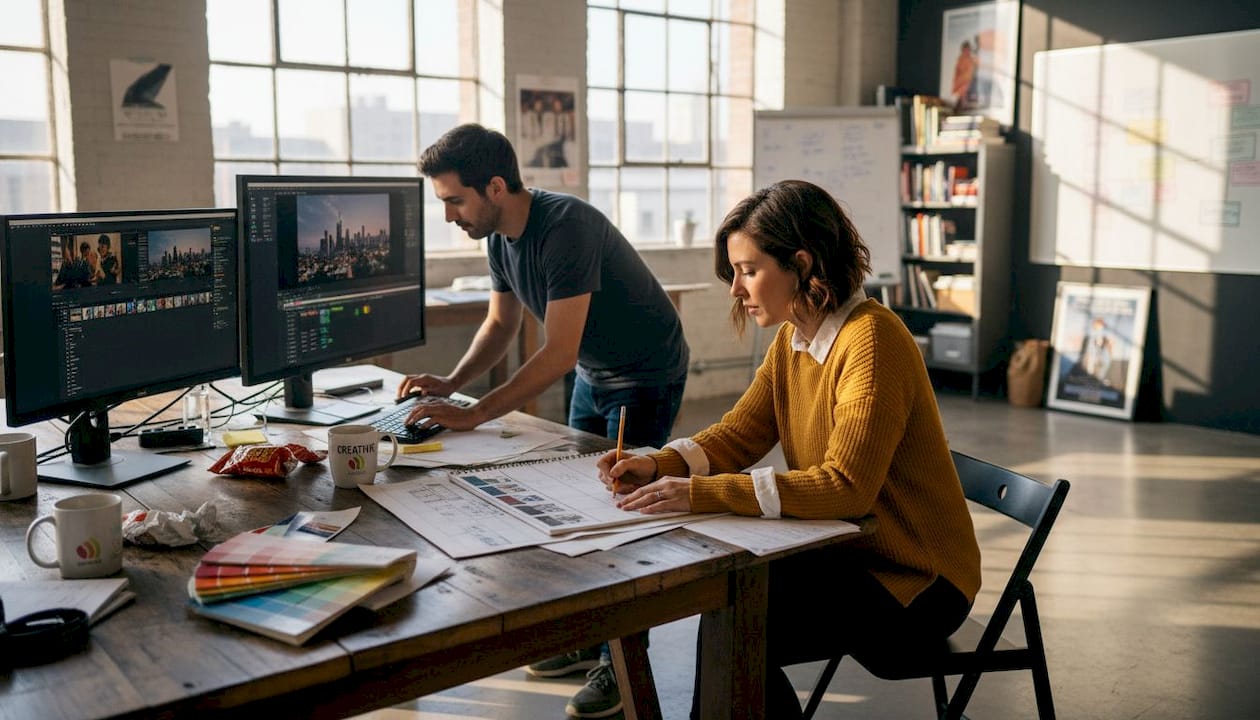
Powerful software and a growing library of AI tools have made it easier than ever to generate visuals at scale. Yet the brands that consistently command attention — the ones whose campaigns feel considered, credible, and memorable — are not simply the ones with the best technology stack. They are the ones that pair technology with strategic artistry and disciplined creative judgment. A creative production company sits at that intersection, translating a brand’s vision into imagery that does real work in the market. This guide breaks down what these studios actually do, how hybrid workflows operate, and what separates a partner worth trusting from one that just delivers files.
Table of Contents
- What does a creative production company do?
- Hybrid workflows: Merging human expertise and AI innovation
- How creative production enhances brand storytelling
- Choosing the right creative production partner
- Why ‘AI alone’ will never replace expert-driven brand visuals
- Partner with experts for world-class creative production
- Frequently asked questions
Key Takeaways
| Point | Details |
|---|---|
| Human-AI collaboration | The best creative production companies merge advanced AI with human strategy and judgment for brand credibility. |
| Workflow expertise matters | Expert-designed workflows enable brands to avoid creative shortcuts that could harm their image. |
| Brand storytelling impact | High-quality visual storytelling drives brand recognition and campaign effectiveness. |
| Choose partners wisely | Evaluating for strategic and cultural fit ensures your creative partner strengthens your brand. |
What does a creative production company do?
A creative production company is responsible for the end-to-end development of visual brand assets. That scope is broader than most marketing directors initially expect. It is not simply a retouching vendor or a CGI house. It is a strategic production partner that moves a project from the first creative brief all the way through to final delivery, managing every decision that shapes how a brand looks and feels.
The services inside that scope typically include project ideation and concept development, live action direction, CGI and 3D rendering, image retouching and compositing, post-production finishing, and content localization for different markets and formats. For technology and automotive brands, this often means producing hero imagery for product launches, campaign visuals for digital and print, and asset libraries that need to work across dozens of placements simultaneously.
What separates a strong creative production company from a freelance operator or a generalist agency is workflow design. The stages of a well-run production project look like this:
- Brief and discovery: Aligning on brand objectives, audience, and visual language before a single asset is created.
- Concept development: Translating the brief into a visual direction, including mood boards, reference imagery, and scene planning.
- Production: Capturing or generating raw assets, whether through live action shoots, CGI builds, or AI-assisted image generation.
- Post-production and retouching: Compositing, color grading, retouching, and finishing to bring assets to their final standard.
The integration of AI into this pipeline has changed the pace of production significantly, but it has not changed the need for human judgment at every stage. As one industry analysis puts it, being ‘AI-native’ requires redesigning workflows around human judgment, not simply adding tools on top of existing processes.
“AI-native is not just adopting tools but requires redesigning workflows and human judgment.” The studios that understand this distinction are the ones producing work that actually holds up.
At 35milimetre, our professional post production services are built around exactly this philosophy: technology serves the creative vision, never the other way around.
Hybrid workflows: Merging human expertise and AI innovation
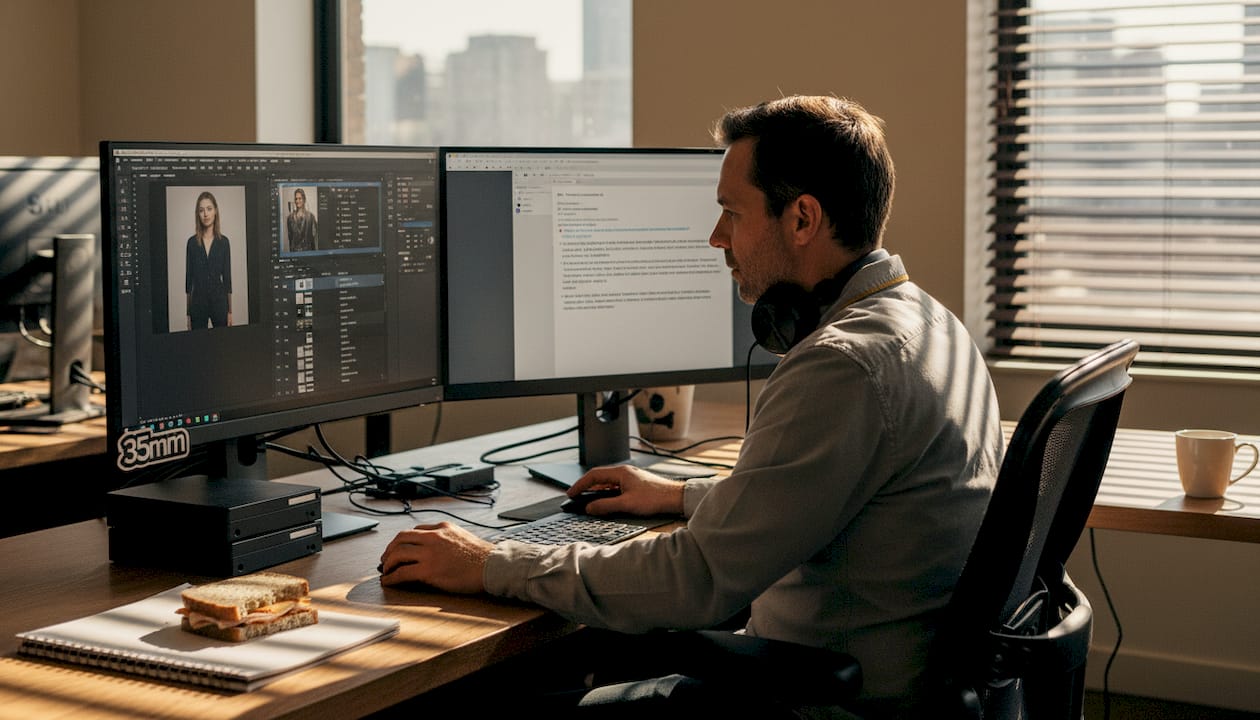
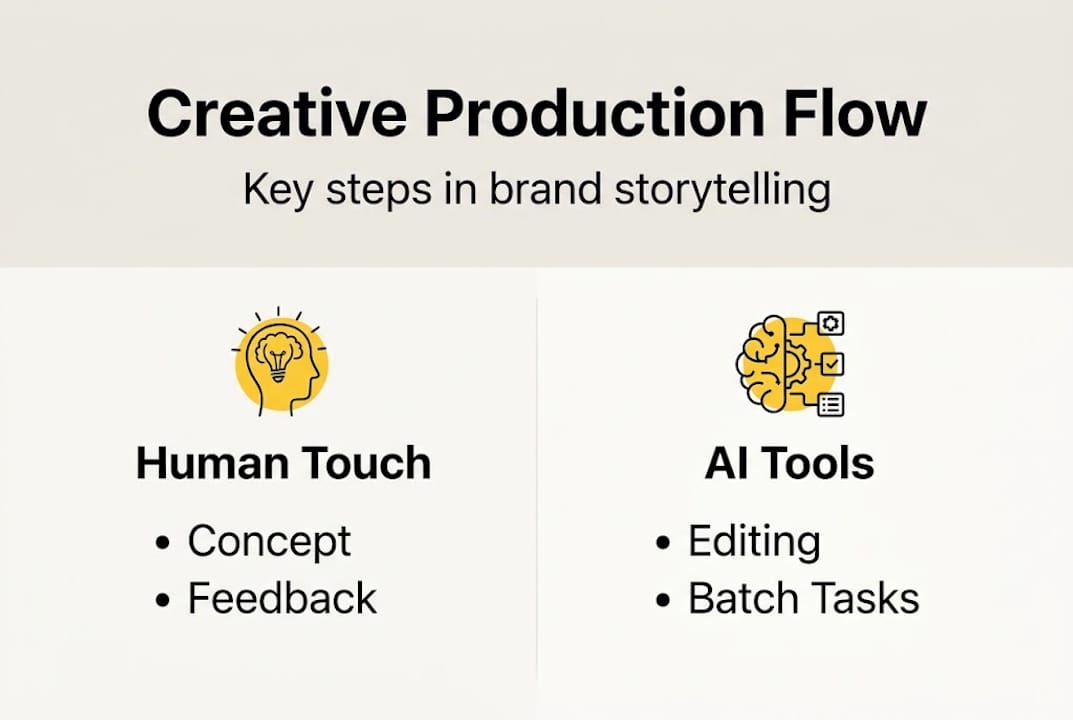
The phrase “hybrid workflow” gets used loosely, but in practice it means something specific: humans set the creative direction and make the final calls on brand quality, while AI handles the repetitive and time-intensive tasks that used to consume a disproportionate share of production hours.
Here is how that division of responsibility typically plays out across a production pipeline:
| Pipeline stage | Who leads | Role of AI |
|---|---|---|
| Ideation and concept | Human creative director | Reference generation, mood board exploration |
| Asset generation | Human artist with AI support | AI-assisted rendering, background generation |
| Quality control | Human post-production artist | Automated flagging of technical errors |
| Brand alignment review | Human creative director | None — judgment call only |
| Final finishing | Human retoucher | Color grading assist, batch processing |
AI genuinely excels at object removal, background replacement, batch color grading, and generating initial compositional options quickly. These are tasks where speed matters more than nuance, and automation delivers real efficiency gains. But the final edit on a hero campaign visual — the one that will represent a technology brand’s new product or an automotive marque’s launch — requires a trained eye and a clear understanding of what the brand stands for.
Expert nuance in hybrid workflows is precisely what determines whether a finished image feels like a considered creative decision or a competent technical output. Those are very different things, and audiences notice the difference even when they cannot articulate why.
Where automation helps most:
- Batch resizing and format adaptation for multi-platform campaigns
- Initial background generation and scene blocking
- Repetitive retouching tasks like skin smoothing or product surface cleanup
Where human intervention is non-negotiable:
- Final color decisions that reflect brand identity
- Compositional choices that carry emotional weight
- Any creative judgment that involves cultural sensitivity or brand positioning
Pro Tip: When evaluating an AI-assisted production workflow, always ask how the studio handles brand credibility review. Speed is a benefit; consistency and authenticity are requirements. Prioritize partners who treat those as separate checkpoints, not the same one.
Our approach to integrating AI and human retouching at 35milimetre reflects this balance: we use automation where it genuinely accelerates quality, and we apply human craft where it genuinely protects it.
How creative production enhances brand storytelling
Visual storytelling is not decoration. For technology and automotive brands especially, it is the primary way a product communicates its value before a customer reads a single word of copy. A well-produced image carries information about quality, positioning, and personality that no headline can replicate on its own.
The difference in approach between AI-only, hybrid, and traditional production methods is significant:
| Approach | Speed | Brand fit | Emotional resonance |
|---|---|---|---|
| AI-only | Very fast | Variable, often generic | Low without human direction |
| Hybrid (human + AI) | Fast | High when well-managed | High with expert oversight |
| Traditional production | Slower | High | High, especially for authenticity |
Aligning a brand’s visual vision with its creative execution requires a structured process. The steps that consistently produce the strongest results are:
- Define the visual language before production begins, including color palette, lighting style, and compositional rules.
- Brief the production team with specific reference imagery and clear articulation of what the brand should feel like, not just look like.
- Review concepts early and often, catching misalignments at the ideation stage rather than in post-production.
- Apply consistent finishing standards across every asset in a campaign, so the visual language holds across placements.
- Evaluate delivery against the original brief, not just against technical quality benchmarks.
Industry research consistently points to the limits of purely automated approaches. Live-action and traditional production remain essential for authenticity that AI cannot yet replicate, particularly in campaigns where real texture, genuine human presence, or physical credibility is part of the message.
Top technology and automotive brands invest in custom production for campaigns and launches because the stakes of a brand impression are too high to leave to generic outputs. One still frame standing in for a physical product experience needs to carry weight. That weight comes from deliberate creative decisions, not from rendering speed.
For brands that want post-production for brand impact, the investment in expert-led creative production pays back in audience trust and campaign longevity.
Choosing the right creative production partner
The criteria for selecting a creative production company go well beyond portfolio quality, though that is always the starting point. What you are really evaluating is whether this team can think like your brand and challenge your assumptions in productive ways.
The factors that matter most in practice:
- Portfolio fit: Does their existing work reflect the visual standard and genre your brand operates in? A studio with strong automotive retouching experience thinks differently than one that specializes in lifestyle photography.
- Industry knowledge: Do they understand the specific visual conventions and audience expectations of your sector?
- Workflow transparency: Can they walk you through their production process clearly, including where AI is used and where human oversight takes over?
- Technological adaptability: Are they keeping pace with new tools, and do they have a principled view on when to use them?
- Willingness to challenge the brief: The best partners push back on briefs that would produce mediocre work, not just execute instructions.
Cultural fit and strategic alignment matter as much as capability. A studio that produces technically excellent work but cannot communicate clearly or adapt to your brand’s evolving needs will create friction at every stage of a campaign.
Pro Tip: Ask any prospective production partner for a process walk-through using a real project from their portfolio. Ask specifically how they handled a creative challenge or a client revision. The answer tells you far more than a credentials deck.
The most important check before signing on with a production company is whether their workflows are designed for flexibility and credibility. As one analysis of modern production practice notes, workflow design should be a craft discipline, not a technology checkout. Studios that treat their process as a craft produce work that reflects it.
When evaluating production companies, look for teams that can demonstrate not just what they have made, but how they think.
Why ‘AI alone’ will never replace expert-driven brand visuals
Here is the part that most AI-optimistic production guides skip over: the problem with AI-generated brand content is not that it looks bad. The problem is that it often looks fine. Fine is the enemy of memorable. For technology and automotive brands competing in markets where every campaign is polished, fine is invisible.
The brands that consistently earn attention and trust are the ones where a human creative director has made deliberate, sometimes uncomfortable choices about what the image should prioritize. Those choices require taste, sector knowledge, and an understanding of what the brand has stood for over time.
AI tools, used without that oversight, default to what is statistically common in their training data. The result is imagery that feels vaguely familiar, competent, and forgettable. Human judgment prevents bad AI decisions driven by tool availability rather than creative or ethical fit. That is not a small distinction. It is the difference between a campaign that builds brand equity and one that simply fills a content calendar.
We have seen this pattern repeatedly in over two decades of post-production work. Shortcuts in creative production do not just produce weaker visuals. They produce off-brand visuals that quietly erode the credibility a brand has worked hard to build.
Partner with experts for world-class creative production
Understanding the role of creative judgment in production is one thing. Putting it into practice for a high-stakes campaign is another. The right production partner does not just execute your brief efficiently — they bring the expertise to make your brand’s visual story more compelling than you initially imagined.
At 35milimetre, we have spent over twenty years building visual post production solutions for technology and automotive brands that demand more than technically correct imagery. From compositing and retouching to CGI and AI-enhanced production, our team brings the kind of creative stewardship that turns a brief into a campaign worth remembering. If your brand’s visuals need to work harder, we would be glad to show you how.
Frequently asked questions
Why shouldn’t brands rely on AI alone for creative production?
AI tools lack the strategic judgment needed to protect brand credibility and can produce off-brand decisions without human guidance, defaulting to statistically common outputs rather than brand-specific ones.
How does a creative production company add value compared to in-house teams?
Creative production companies offer specialized expertise, scalable resources, and proven workflows that in-house teams rarely have the bandwidth to maintain. Being ‘AI-native’ means designing flexible workflows that go well beyond simply using advanced tools.
What should I look for when choosing a creative production partner?
Review their portfolio for sector relevance, ask for workflow transparency, and confirm how they integrate new technologies with expert oversight. Workflow design as a craft discipline is the clearest signal of a studio that takes quality seriously.
