
Examples of Automotive Visuals That Drive Real Results
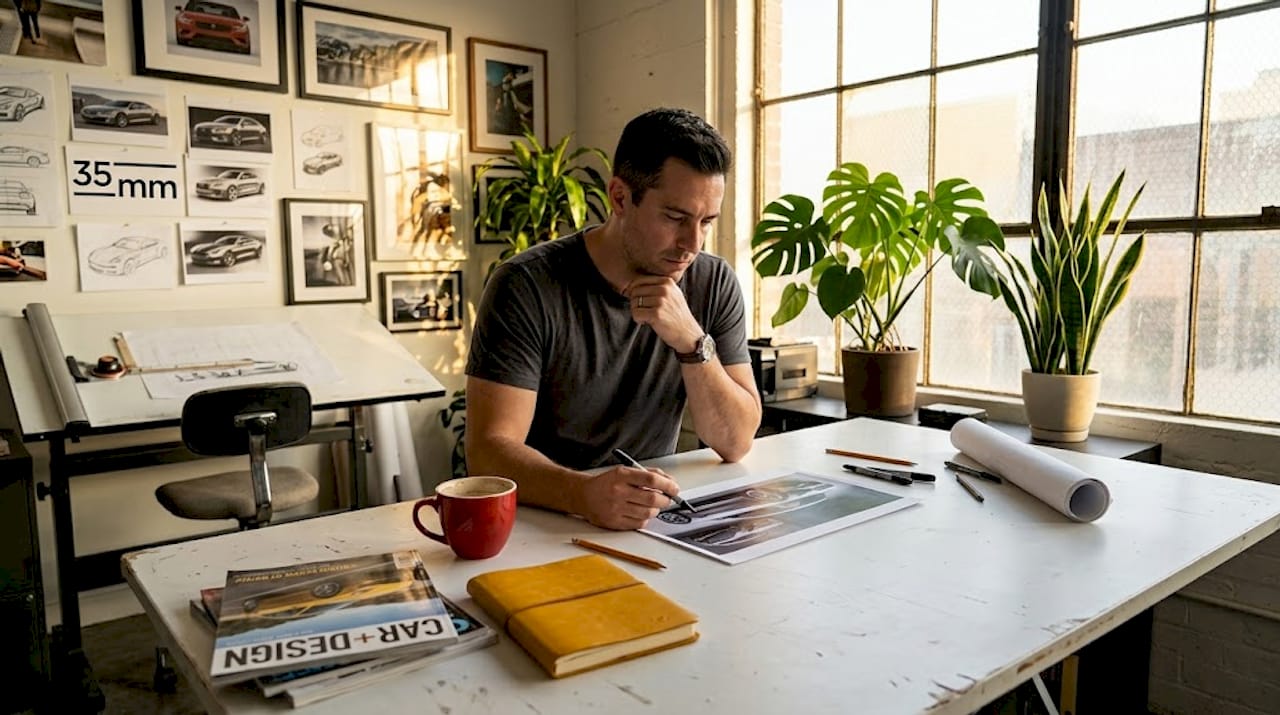
Choosing the right visual approach is one of the most consequential decisions a marketing team makes in automotive advertising. The best examples of automotive visuals do more than show a car. They make you feel the weight of the door, the quality of the leather, the pull of the road. Today’s creative teams work with an expanding toolkit: professional photography, CGI compositing, AI-generated environments, and real-time 3D. Knowing which approach fits which goal, and seeing real-world examples that prove it, is exactly what this guide delivers.
Table of Contents
- Key Takeaways
- 1. The criteria that make automotive visuals actually work
- 2. Photography-led and hybrid CGI automotive visual examples
- 3. Real-time interactive and 3D automotive visual experiences
- 4. Comparison of visual styles, technologies, and best-use scenarios
- 5. Pro tips and overlooked strategies for sharper automotive visuals
- My honest take on the future of automotive visuals
- How 35milimetre can build your automotive visuals
- FAQ
Key Takeaways
| Point | Details |
|---|---|
| Hybrid CGI and photography wins | Combining real photography with digital environments produces the most trusted and controlled automotive campaign imagery. |
| Interactivity lifts engagement | Real-time 3D configurators and spatial computing platforms let customers explore vehicles personally, improving conversion. |
| Consistency builds brand trust | Shooting with uniform lighting across 20+ angles per vehicle directly improves consumer confidence and lead conversion. |
| Emotion travels through light and motion | The strongest automotive ads skip dialogue and use restraint, shadow, and movement to create authentic engagement. |
| Technology requires aesthetic judgment | Advanced tools like Unreal Engine 5 and AI pipelines only deliver results when guided by experienced creative decision-making. |
1. The criteria that make automotive visuals actually work
Before studying examples, you need a framework for evaluating them. Without one, inspiration stays inspiration and never becomes a brief.
Product accuracy is non-negotiable. Every highlight on a C-pillar, every thread on a seat seam, every reflection in the paint needs to be true to the physical vehicle. CGI pipelines now enable precise lighting and shadow alignment that matches digital environments to real cars with 100% accuracy. That level of control protects the brand and prevents misrepresentation at scale.
Emotional storytelling is equally important, and more often neglected. A visual can be technically perfect and still feel cold. The best car design visuals use light direction, color temperature, and negative space to communicate desire without a single word. Authenticity comes from restraint, not spectacle.
Technical execution covers the unglamorous but critical layer: lighting, material rendering, and environment integration. Automotive rendering demands physical accuracy at the material level, from clear coat layers on paint to glass refraction and leather stitching depth. Skipping this depth produces visuals that look like catalog crops rather than aspirational imagery.
For digital and interactive media, functional clarity matters as much as aesthetics. Visuals in HMI and interactive contexts should guide user focus through deliberate layout and symbol use, not just decorative ambition. A configurator that looks beautiful but confuses the user has failed its job.
Finally, style consistency across a campaign is what separates professional visual content for automobiles from a patchwork of good-looking assets. Inconsistency signals a brand that is not paying attention.
Pro Tip: When reviewing automotive visual examples for campaign reference, score each one against these five criteria before discussing aesthetics. It stops subjective debates and turns feedback into a usable creative direction.
2. Photography-led and hybrid CGI automotive visual examples
The most instructive automotive visual examples are not born from a single discipline. They come from a marriage of camera and computer, where neither can do the job alone.
RECOM’s campaign work for Lexus is one of the clearest proof points available. The studio traveled to Los Angeles to photograph the vehicle in real environments, then built a high-end CGI pipeline around controlled AI to generate additional environments at the touch of a button. The result: digital backgrounds rendered with precise lighting and shadow that match the photographed car seamlessly, with full repeatability for different markets or seasonal updates. This is what hybrid automotive graphic design looks like at its ceiling.
The Kia EV4 and Renault Twingo campaigns offer different but equally instructive examples. Both leaned into full 8K AI-generated environments layered over photographic assets. The approach gave creative teams environmental flexibility that no single location shoot could offer, while preserving the physical authenticity of a real car on a real road.
“Despite advances in AI and CGI, traditional photography remains essential to preserve a natural, human-crafted aesthetic.” — GoSee
This insight deserves emphasis. Brands that have tried to eliminate the photography stage entirely report a consistent problem: the imagery reads as digital. Viewers cannot always articulate why, but they feel it. The subtle imperfections and micro-variations in photographed material carry emotional weight that pure CGI still struggles to replicate convincingly at scale.
For creative teams studying how to design automotive visuals with hybrid methods, the lesson is clear. Shoot the car. Build the world around it digitally. Use AI to scale, not to replace.
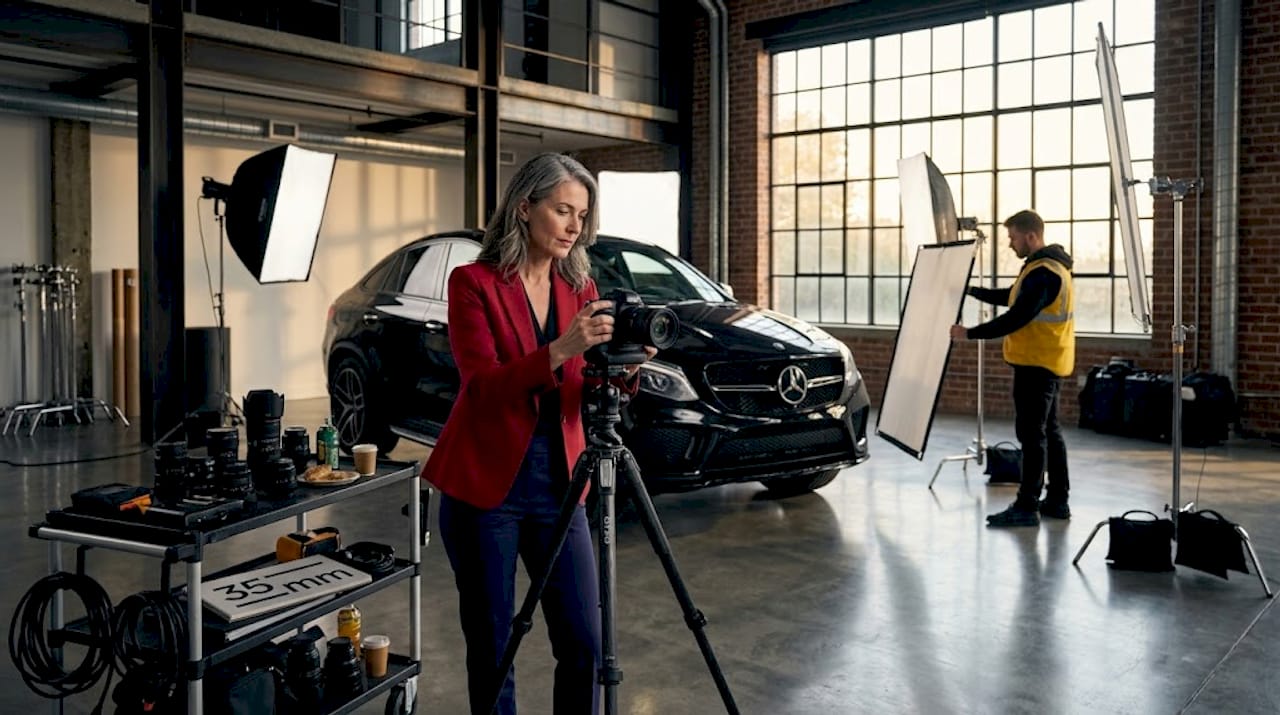
Pro Tip: When briefing a photographer for a hybrid automotive shoot, specify exact camera height, focal length, and lighting angle data that will be matched in post. This makes CGI integration significantly faster and more accurate downstream.
3. Real-time interactive and 3D automotive visual experiences
The shift toward interactive formats is not a trend. It is a structural change in how automotive brands communicate with buyers before they ever visit a dealership.
Unreal Engine 5’s Nanite and Lumen technologies have transformed what real-time automotive visualization can deliver. Nanite renders millions of polygons in real-time with no visible degradation, while Lumen handles dynamic global illumination and reflections that respond to environment changes instantly. The technical outcome is photorealistic vehicle rendering that moves, reacts, and adapts in real time, without pre-rendered outputs.
The Nissan and Demodern project for Apple Vision Pro is one of the strongest examples of spatial computing applied to automotive retail. Users explore a full-size Nissan in a fully rendered 3D environment, examining exterior panels, stepping virtually into the interior, and switching between custom driving modes. This is not a gimmick. Spatial computing removes the limitation of the screen and lets a car exist at actual scale in the customer’s environment.
Interactive configurators powered by Unreal Engine take this a step further by giving customers direct control. They can swap paint colors, adjust wheel designs, and select interior trims while viewing the result in real time on a photorealistic model. Blueprint visual scripting enables this without traditional coding, making the technology accessible to studios that are not full engineering teams.
For inspiring 3D design examples that have driven actual brand results, the common thread across these interactive automotive visual examples is that engagement time increases dramatically when customers feel ownership of the experience. Passive viewing converts at a lower rate than active exploration.
Pro Tip: When building a real-time configurator, prioritize the paint and exterior first. These are the highest-impact customization decisions buyers make and the ones that benefit most from photorealistic rendering fidelity.
4. Comparison of visual styles, technologies, and best-use scenarios
Not every campaign needs the most technically advanced approach. Understanding where each method excels is what separates efficient creative decisions from budget-burning overproduction.
| Visual style | Realism level | Engagement | Production cost | Best use case |
|---|---|---|---|---|
| Professional photography | Very high | Moderate | Medium | Hero imagery, editorial, press launches |
| Hybrid CGI and photography | Excellent | High | Medium-High | Campaign toolkits, seasonal variants |
| Full CGI rendering | High | Moderate | High | Pre-production, concepts, scalable assets |
| AI-generated environments | Variable | Moderate | Low-Medium | Background generation, rapid prototyping |
| Real-time 3D configurator | Very high | Very high | High upfront | Retail websites, spatial computing, showrooms |
| Spatial computing (Vision Pro) | Exceptional | Exceptional | Very high | Premium launches, experiential marketing |
The practical guidance here is about sequencing rather than choosing one method exclusively. A full campaign for a vehicle launch might begin with a hybrid CGI and photography shoot for hero assets, deploy real-time configurators on the product website, and use AI-generated background variants for regional adaptations. Each layer serves a different audience moment.
For visual content trends in 2026, the direction is clear: brands that blend approaches are outperforming brands that rely on a single visual style. The flexibility to produce regional backgrounds digitally while maintaining a photographed vehicle at the core gives global campaigns both authenticity and scalability.
5. Pro tips and overlooked strategies for sharper automotive visuals
The biggest gains in automotive visual quality often come not from upgrading technology but from addressing consistency gaps that creative teams overlook during production.
Automotive websites require 20 or more photos per vehicle across diverse angles, but the consistency of those images matters as much as the quantity. Mixing indoor studio shots with outdoor location photography, or daytime images with evening shots, immediately signals a lack of polish to buyers. Consistent lighting environments across every angle of a vehicle build confidence and increase lead conversion. This is one of the most underbudgeted decisions in automotive web production.
Load performance is the invisible conversion killer that most creative teams leave entirely to developers. Pages loading in under 3 seconds maximize conversions on automotive sites, and image formats like WebP and AVIF make that achievable even with high-resolution vehicle galleries. The best automotive visuals in the world are worthless if they load slowly on mobile.
Emotional storytelling through restraint is a principle the strongest campaigns treat as a technical discipline. Kia’s EV9 and Audi’s headlight campaigns demonstrate that silence, careful light placement, and controlled motion create more genuine engagement than any amount of voice-over or text overlay. Light is the most expressive tool in automotive advertising. Using it with intention is a skill, not an accident.
For teams building their own visual storytelling strategy, the principle worth internalizing is that technology amplifies aesthetic judgment. It does not replace it. A photorealistic render of a poorly lit scene is still a poorly lit scene.
Pro Tip: Export automotive web images in WebP or AVIF at 85% quality rather than full resolution JPEGs. This typically reduces file size by 40-60% with no visible quality loss, directly improving mobile load speed and search ranking.
My honest take on the future of automotive visuals
I have been working on automotive and technology visuals for over two decades, and one thing I have seen repeatedly is this: the teams that get the best results are not the ones with the biggest CGI budgets. They are the ones who understand when to use a camera and when to use a render, and who never confuse technical capability with creative judgment.
Pure CGI automotive work has a ceiling that most brands do not talk about openly. The images look correct. They pass every technical test. But they rarely move people. There is something in a photographed surface, a real reflection, a physical imperfection, that CGI still cannot fully manufacture at scale. Hybrid approaches persist not because the technology has not advanced enough. They persist because they produce better emotional results.
What I have found practically useful is treating the CGI pipeline as infrastructure for creative freedom, not as a replacement for physical production. When 35milimetre works on a vehicle campaign, the best outcomes always start with a real shoot that establishes the emotional register of the imagery. The digital layers that follow serve that register rather than define it.
The other thing worth saying is that workflow integration is where most creative teams lose time and quality. A render that does not match the camera data from the shoot creates weeks of correction work. Aligning those two pipelines from the brief stage is where the real efficiency gain lives, and it is the detail that separates studios with genuine automotive experience from generalist post-production teams.
The new tools, spatial computing, real-time rendering, controlled AI, are genuinely exciting. But they reward studios that already know how to see.
— 35mm
How 35milimetre can build your automotive visuals
If you are a marketing or creative team that needs automotive visuals at a professional level, the work involves more than access to the right tools. It requires a production workflow where photography, CGI, retouching, and AI integration speak the same creative language from day one.
35milimetre brings over two decades of hands-on experience in compositing, color grading, and high-end retouching to automotive and technology campaigns. The studio works with ad agencies, brand teams, and professional photographers to produce photorealistic visual production that holds up across every platform, from hero campaign pages to real-time configurators. Whether your next project requires full CGI environments, hybrid post-production, or AI-enhanced imagery at scale, 35milimetre delivers with the precision and craft that automotive branding demands.
FAQ
What are examples of automotive visuals used in brand campaigns?
Common examples include hybrid CGI and photography composites, real-time 3D configurators, spatial computing experiences, and AI-generated background environments layered over photographed vehicles. Campaigns from Lexus, Kia, Nissan, and Audi each demonstrate a different point on this spectrum.
How do you design automotive visuals with CGI and photography together?
Shoot the vehicle with documented camera settings and lighting data, then build matching digital environments in post using those exact parameters. CGI pipelines with controlled AI can generate repeatable environments that align precisely with the photographed asset.
What is the best technology for real-time automotive visualization?
Unreal Engine 5 is the current standard, with Nanite for polygon-dense geometry and Lumen for real-time global illumination. These tools enable real-time photorealistic rendering suitable for both interactive configurators and spatial computing platforms.
How many images does a strong automotive web gallery need?
Research shows that 20 or more photos per vehicle with consistent lighting across all angles builds consumer confidence and improves lead conversion. Fewer images or inconsistent lighting reduces trust, particularly on mobile.
Why do the best automotive ads avoid dialogue?
Automotive advertising research shows that emotional storytelling through light and motion produces more authentic viewer engagement than voice-over or dialogue. Silence and restraint, used deliberately, communicate premium quality more effectively than explanation.
