
Why the World Is Drinking Less, and Non-Alcoholic Beers and Spirits Are Filling the Gap
In 2017, a former hedge-fund analyst named Bill Schufeldt sat across a $200 tomahawk steak at a Manhattan dinner. He had stopped drinking a few months earlier, his ultramarathon times had dropped, and he felt sharper at work. The waiter had just put a Diet Coke next to him while everyone else opened a second bottle of red. A colleague leaned in, half joking: "What's the matter, you crash your car or something?"
That moment, almost cartoonish in hindsight, captures the in-between space the entire global drinks industry has been quietly trying to fill ever since. People who didn't want to drink alcohol that night, but didn't want to look like the awkward kid at the grown-ups' table either. Until very recently, no product served them properly. Today, that gap has become one of the fastest-moving categories in beverages, and it isn't slowing down.
This article looks at why the shift away from alcohol is happening, what's actually driving it, and why non-alcoholic beer and zero-proof spirits are no longer a niche aisle at the back of the store.
A generation drinking less, and not by accident
The headline numbers are striking. According to a 2025 Gallup reading, only 54% of Americans say they drink alcohol; the lowest figure on record and down from 62% in 2023. Gen Z drinks roughly 20% less per capita than millennials and boomers, according to recent reporting in Fortune, and 65% of Gen Z plan to drink less in 2025 according to Circana's sober-curious survey. Since 2021, an index tracking the world's top 50 alcohol companies has fallen by 46%, wiping out around $830 billion in market value.
These are not soft cultural signals. They are balance-sheet signals. Investors are repricing alcohol the way they once repriced cigarettes, and the same generation that grew up watching that happen to tobacco is the one driving it.
What makes this shift different from past "young people drink less" stories is that the curve isn't bouncing back. The under-35 cohort that started drinking less in their college years has stayed there into their late twenties and early thirties. That's not a phase. That's a habit.
The five forces behind the shift
If you ask ten consumers why they're cutting back, you'll get ten answers. But the data clusters into five forces that reinforce each other.
Mental health. In Circana's research, 58% of Gen Z said improving mental health was their main reason to drink less in 2025; a 45% jump from the year before. This generation has grown up in an open conversation about anxiety and depression, and alcohol's role in that conversation has shifted from social lubricant to known aggravator.
The data-driven body. Wearables changed the conversation. When your watch tells you exactly how badly two beers wrecked your sleep score, or your HRV, or your morning recovery, the cost of drinking moves from abstract to itemised. The audience that owns Whoop, Oura, Garmin and Apple Watch is the same audience reaching for alcohol-free options.
Cannabis legalisation. In North America especially, cannabis legalisation has created a competing relaxation product. Some former drinkers have moved sideways rather than disappeared, and the THC-infused beverage category, while still small, is part of the same broader rewiring.
Social media permanence. Gen Z is acutely aware that anything they do drunk can live online forever. Older generations didn't grow up with this. The behavioural caution this creates compounds the health argument and quietly reshapes party culture.
Post-pandemic wellness. COVID disrupted drinking in both directions. Some people drank more; many drank less, and the latter group built new routines around sleep, exercise, and mood. By the time bars reopened, those routines were sticky. IWSR data shows the no-alcohol category has posted +9% volume growth worldwide in 2024, and is forecast to grow 7% volume CAGR through 2028.
Spirits join the party
The beer story has had most of the coverage, but the more interesting recent move is in spirits. Zero-proof spirits posted a 108% jump in case volume and 86% in dollar sales in the 52 weeks ending December 2024, according to Shanken News Daily. The global non-alcoholic spirits market sat at around $356 million in 2025 and is projected to push past $760 million by 2034 (Fortune Business Insights).
What's powering it is hospitality. Mocktails are now $12 to $14 in most major cities, and bars and restaurants have wised up to the fact that a complex non-alcoholic drink, made with a botanical zero-proof spirit, expensive teas, and house tinctures, can carry margins comparable to a cocktail. Ten years ago, the alternative to a cocktail was a $3 iced tea. Now it's a built drink with the same craft attached. That's a meaningful unlock for venues that were watching young guests order water and leave early.
Diageo, Pernod Ricard and Bacardi have all entered the non-alcoholic spirits category alongside independents like Lyre's, Seedlip and Ritual. When the multinationals show up, the category is no longer a curiosity. It's a line item.
Chaser, pacer, replacer
One of the most useful insights to come out of the Athletic Brewing story is the language they developed for how their drinkers actually behave: chaser, pacer, replacer. Some people use a non-alcoholic beer as a chaser after stronger drinks. Some pace themselves by alternating beer and zero-proof through a night. Some replace alcohol entirely.
The category data backs this up emphatically. The vast majority of households buying non-alcoholic beer, wine and spirits also buy alcohol; sometimes on the same shopping trip. This is not a market of teetotalers. It's a market of moderators.
That distinction matters for any brand entering this space. The product isn't competing with alcohol. It's competing with the moments when you wouldn't normally drink at all: the lunch meeting, the post-workout cooldown, the Tuesday evening, the school-night dinner. Athletic Brewing's framing was bluntly correct: regular beer chases the one hour a day when people drink. Zero-proof beer is built for the other twenty-three.
What this looks like on the shelf
The implications cascade through the rest of the drinks economy. Around 200 major non-alcoholic beer brands now exist, where 15 years ago there were a handful: O'Doul's, Coors NA, St. Pauli Girl, and not much else. Heineken 0.0 has become the world's best-selling alcohol-free beer; Athletic Brewing has become the top non-alcoholic brand in the US and the 14th largest craft brewery in the country, which is an unprecedented thing for a brewery that makes no alcohol at all. Guinness Zero is winning critic taste tests against the original.
Even big alcohol brands have built entire NA wings. Anheuser-Busch InBev now claims that its combined non-alcoholic portfolio (Budweiser Zero, Stella Artois Zero, Beck's NA and others) makes it the world's largest maker of non-alcoholic beer. The category has moved from "should we have one?" to "how do we win it?".
Adjacent categories are crowding in too. Hop water (a craft seltzer with hops, no malt) sits next to NA beer on shelves and pretends to be its cousin. THC-infused drinks compete for the same wallet share in legal states. Functional sparkling drinks with adaptogens, nootropics or prebiotics are flanking the category from the wellness side. From a consumer's point of view, all of these now occupy the "I want a drink, but not that drink" slot.
Why this matters for brands and the visual side of the business
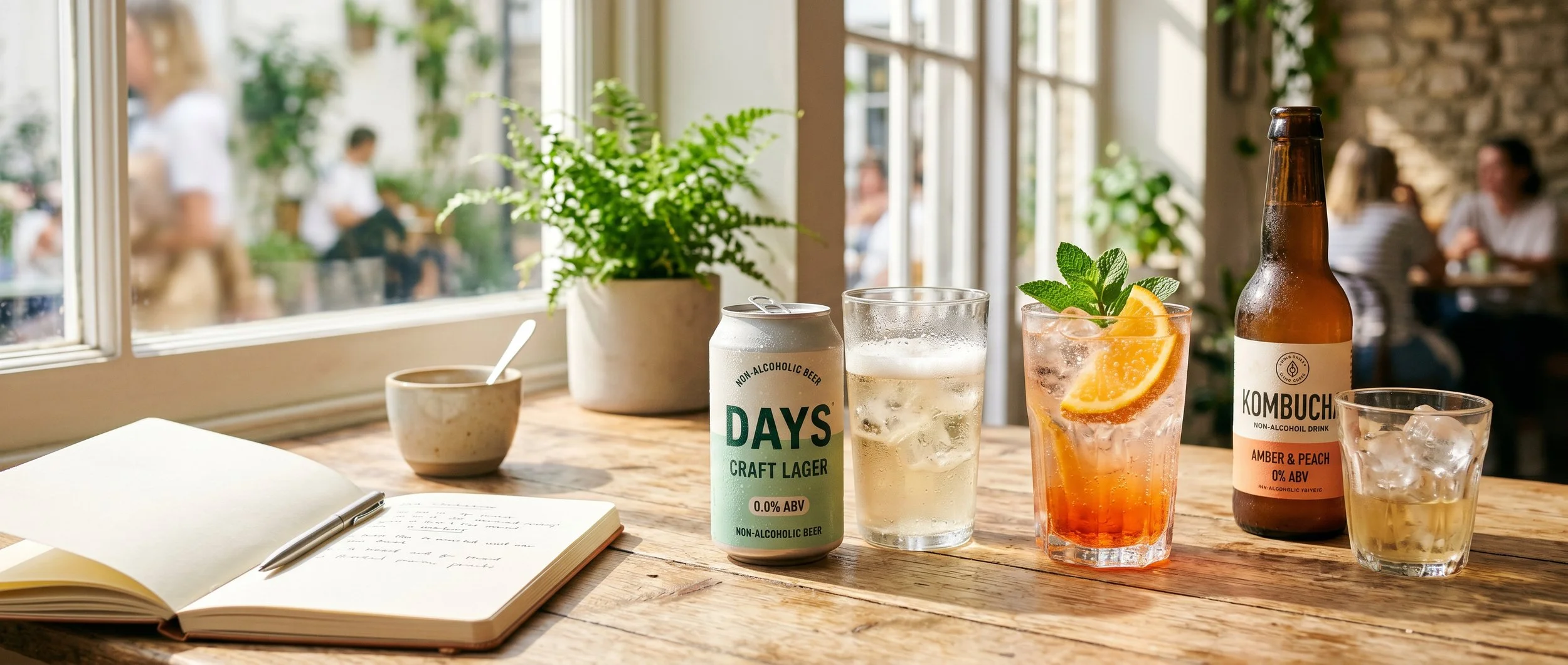
For brand teams, marketers and the studios that work with them, this shift quietly rewrites the brief. A non-alcoholic beer or spirit isn't sold the way a regular one is. The packaging doesn't lean on the bar; it lives next to a cold-pressed juice in a cafe fridge, on a desk during a workday, in a gym bag, at a wedding where half the guests are pregnant or training for something.
That changes everything about the visual system: the photography of the moment, the colour temperature, the typography, the can architecture, the place the brand sits when it's at home. We see this in the briefs that come across our desks at 35milimetre. Beverage clients increasingly want imagery and packaging that feels active, daytime, social, and clearly its own thing, not a dimmed-down version of an alcoholic ancestor. The CGI and packaging work for this category looks different because the moment is different.
The takeaway
The non-alcoholic shift is not a fad. It's a structural change driven by a generation that has more health data, more mental-health awareness, more options, and a more permanent record of its own behaviour than any before it. The drinks industry is responding because it has to, and the brands that win the next decade will be the ones that treat non-alcoholic as a parallel category with its own occasions, its own design language, and its own emotional logic, not a polite shrunken version of what they already make.
If you're working on packaging, visual identity or product imagery for a brand entering this space, we're always happy to talk; this is exactly the sort of work we like.
External Sources Cited
- Why Gen Z Is Drinking Less — TIME
- Gen Z drinking 20% less than Millennials — Fortune
- Sober Curious Nation — Circana
- Global low and no alcohol market data 2025 — Beverage Daily / IWSR
- Non-Alcohol Spirits Gaining Traction in the U.S. — Shanken News Daily
- Non-Alcoholic Spirits Market — Fortune Business Insights
- Growth of $4bn+ Expected from No-Alcohol Category — IWSR
