

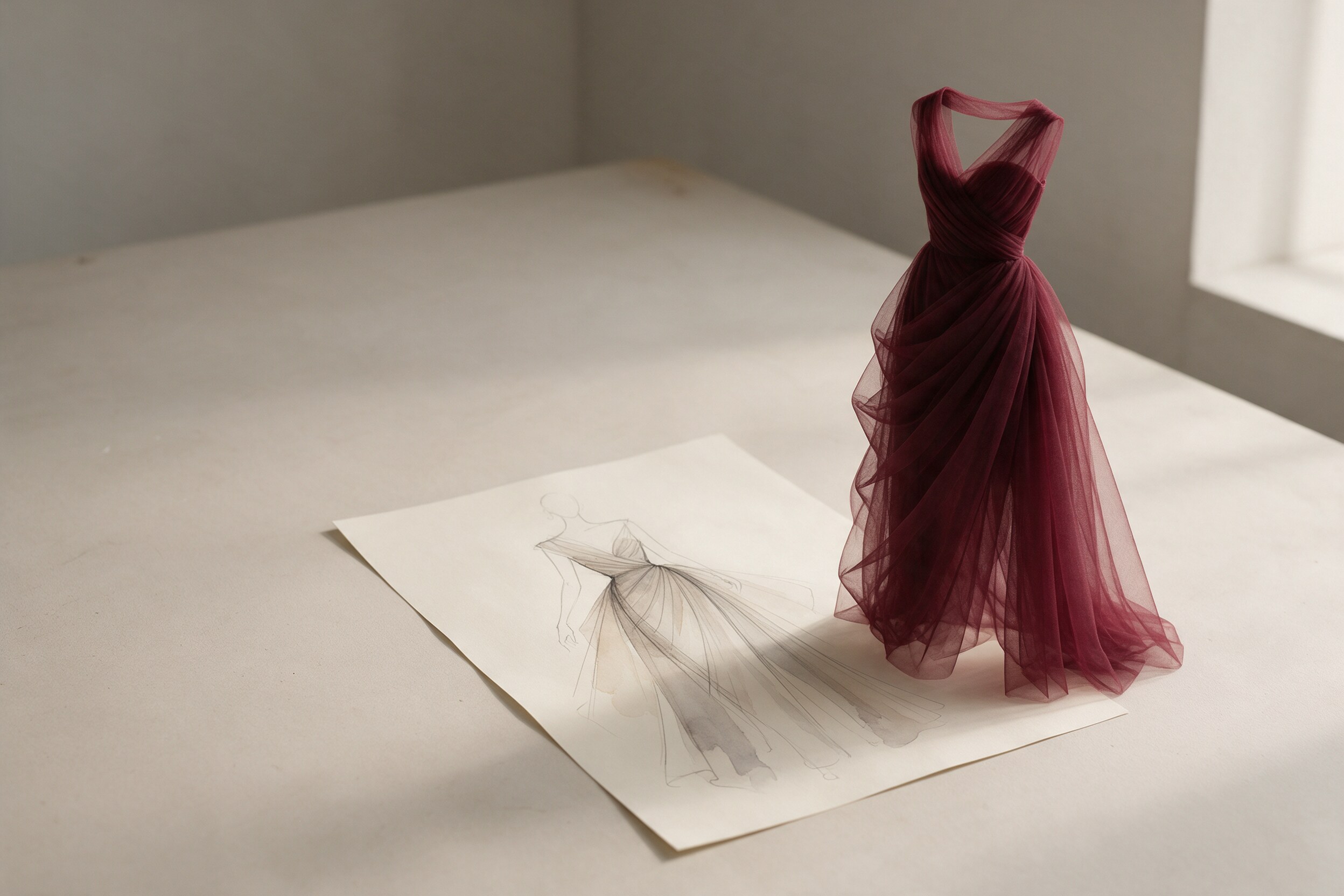
A collection is designed, the launch page is ready, and the first samples are still weeks away. That gap is where many apparel brands lose a selling window. AI ghost images and photorealistic on-model images made straight from the design file can close it: the garment can be shown, tested and pre-sold before a single sample is sewn.
Speed comes with trade-offs, though. In this article we compare three routes to promo-ready visuals of a new design: AI images made from the design, a classic sample plus photoshoot plus retouching, and a 3D build in CLO3D. We look at time first, then cost, then the places where AI still falls short, so you can choose per collection rather than by trend.
Three routes from design to promo image
Sample, photoshoot and retouching. A sample is sewn, then a photographer, a model or mannequin, a stylist and a studio are booked, and the frames are retouched. For ghost mannequin images, the garment is shot on a mannequin and the form is removed in post.
A CLO3D build. A 3D artist builds the garment from its patterns (or from a sketch, which takes longer), assigns fabric properties, simulates the drape on an avatar and renders it. The result is a digital twin of the garment.
AI from the design. We take the flats, sketch or artwork and generate photorealistic ghost or on-model images, then check and correct them by hand so the print, trims and proportions match the design.
Which route is fastest?
The photoshoot route is only as fast as the sample. Binary Cloth, a 3D apparel studio, puts a physical sample round at 30 to 35 days, against 24 to 48 hours for a digital sample. Add shoot scheduling, model booking and a retouching round, and the first images arrive weeks after the design is approved. If the sample needs a fix, the clock starts again.
CLO3D is much faster than physical sampling, and changes after the first build are cheap. CLO's own guidance says the marginal cost of an extra 3D iteration is effectively zero, and applying six colorways takes minutes. The slow part is that first build: it needs clean patterns, fabric data and a skilled artist, and a sketch-only project takes more development time.
AI from the design is the fastest of the three for a first look. There are no patterns to draft and no sample to wait for, so the first images come in days rather than weeks, and a new colorway or background is a re-run rather than a new booking. For a launch page, a pre-order campaign, an investor deck or a social test of which design to produce, that speed is the main reason to choose it.
What does each route cost?
Photoshoot. The line items add up. A 2026 guide from Imagine.art (an AI imaging platform) counts photographer day rates of $1,000 to $3,500, styling at $250 to $600 and model fees of $400 to $800 per model, which works out at roughly $50 to $250 per finished on-model image. Ghost mannequin images through a studio are often $20 to $60 per image, according to Claid, an AI product photo vendor. None of this includes the sample itself, shipping, or a reshoot when the sample changes. Many of these cost guides are published by AI companies, so read them as ballpark figures, not quotes.
CLO3D. Outsourced 3D garments can start low for simple styles; Binary Cloth advertises custom digital garments from $39, a vendor starting price, with jackets, structured pieces and multi-layer garments costing more. Rendering and post-production come on top. CLO3D pays back best when the brand also uses the file for fit sessions, sampling and production, because the cost is shared across several jobs.
AI from the design. Our published range for AI on-model images is $125 to $300 per image. Per frame, that can be more than a high-volume catalog shoot. But it replaces the sample, the studio day and the model booking for the first wave of images, and there is no reshoot fee when a colorway changes. The honest comparison is not per image; it is the total cost of a sellable set before a sample exists. For finished garments already on the rail, a well-run e-commerce shoot can still be the cheaper route.
Where AI ghost images fall short
AI images are a picture of the design, not proof of the garment. We would rather say that plainly than have a client find out after launch.
- Drape and fabric are guessed. The model does not know the real fabric weight, stretch or pattern. If the finished sample hangs differently, the image has promised something the product cannot deliver.
- No fit information. AI cannot show how a size M fits a real body. CLO3D can, because it simulates the real pattern on an avatar with real measurements.
- Detail drift. Small type, logos, stripe counts, print placement and seam lines tend to shift. They need a check against the artwork and often a manual fix in compositing.
- Consistency across views. Front, back and every colorway must match each other, not only the design.
- No production value. A CLO3D file can go on to fit sessions, pattern changes and the factory. An AI image ends at the image.
For products already on sale, we recommend replacing AI images on product pages with real photography or a CLO3D render once samples exist. We covered the wider picture in how AI is actually being used in product photography right now.
Two examples from our studio
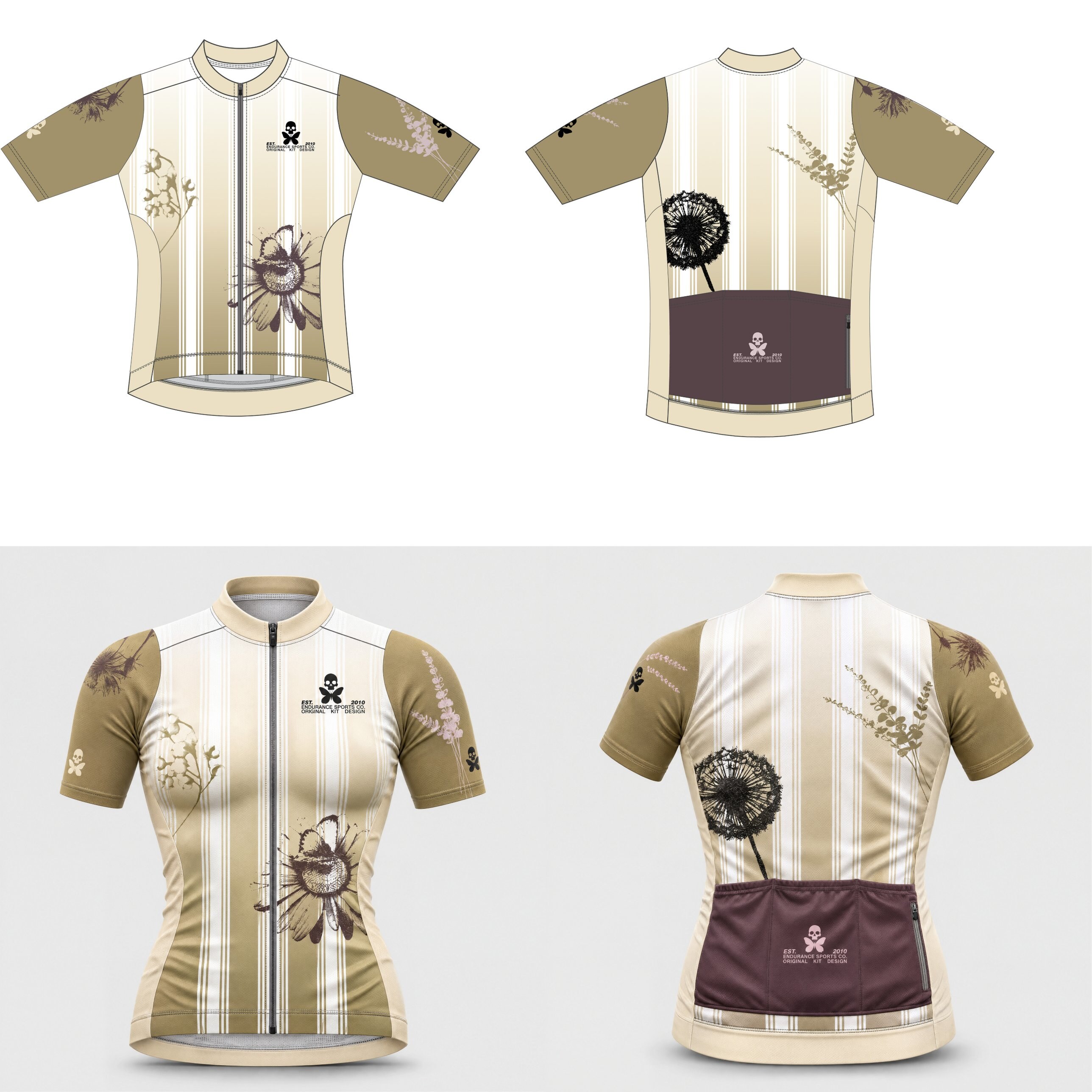
For a women's cycling jersey, we started from front and back flat drawings and produced photorealistic ghost-style front and back images on a fitted form. The vertical stripe pattern, the floral illustrations on the body and sleeves, the contrast rear pocket panel and the small chest and pocket type all had to sit in the same place as on the flats, on both views.
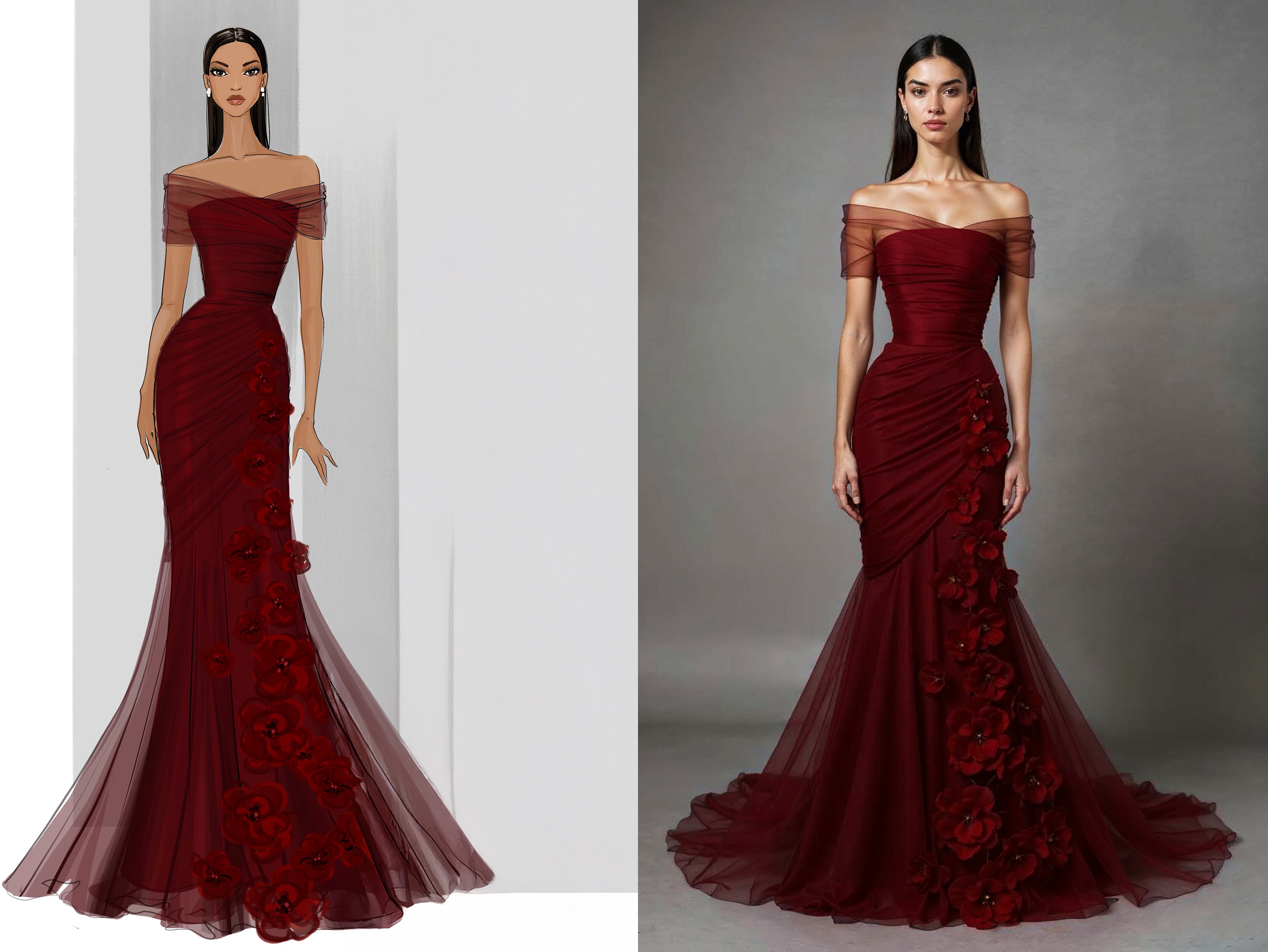
For an evening gown, the input was a fashion illustration. The output is an on-model studio image that keeps the off-shoulder sheer neckline, the draped bodice, the cascade of three-dimensional flowers down one side and the flared tulle skirt. Look closely and the photorealistic version gives the hem a wider sweep than the illustration. That is typical: AI fills gaps with its own idea, and someone who knows the design has to decide whether to keep it.
Neither job needed a sample, and both are the kind of image a brand can use to present, pre-sell or test a design. Neither replaces a photo of the finished garment once it exists.
The practical takeaway: which route to choose
Choose AI images from the design when:
- there is no sample yet and you need images in days;
- the images are for a launch page, pre-orders, crowdfunding, investors or a social test;
- you need many colorways or backgrounds quickly.
Choose CLO3D when:
- fit accuracy matters, or you need several angles and motion;
- patterns exist and the file will be reused for sampling and production.
Choose a photoshoot when:
- the product is ready and the images are for final product pages;
- fabric texture, sheen or transparency is a key selling point;
- the sales channel expects the image to show the exact physical product.
Many brands will use more than one: AI images for the first wave, then real photography or CLO3D once the garment exists. The same rule we wrote about in photography or 3D still applies: if the product is not ready, visualize it; if it is, shoot it.
If you have designs waiting for samples and want to see what they could look like now, you can see our work at 35milimetre.com.